The moment you realize you are in trouble is rarely dramatic. It is usually quiet. You check your bank balance. You do the math in your head—rent, utilities, that credit card payment due in three days. The numbers do not add up. Not by a little. By enough that you feel it in your stomach.
That feeling is not a character failure. It is a sign that you were never taught how money actually works. And if you have searched for help, you have likely found two very different kinds of personal finance books. One tells you to change how you think about money. The other tells you exactly what to do with it.
Both are useful. But they solve different problems at different stages.
The two books below represent these two approaches. One gives you a philosophical reset—a new way to see money itself. The other gives you a practical escape route—a step-by-step path out of the cycle. Which one you need depends on where you are right now.
From Debt to Wealth by Owen Pierce
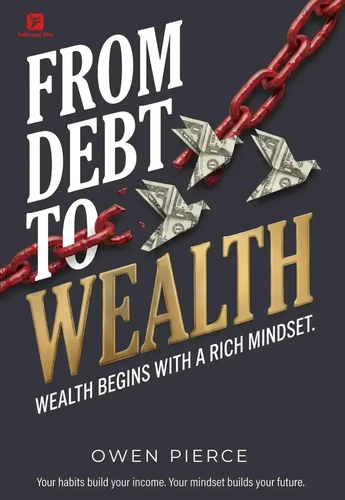
What this book does: It assumes you are stuck. Not because you are irresponsible, but because nobody ever showed you how money actually works.
Pierce starts with a question that most finance books avoid: why does your income never feel like enough? The answer is not about willpower. It is about habits you were never taught to break. You work harder, you earn a little more, but your expenses grow right along with it. You buy things to feel better and end up deeper in the hole.
The book walks you through the mechanics of escaping the cycle. How to build a buffer without feeling deprived. How to handle debt in a way that does not require superhuman discipline. How to create a system that works even when motivation runs out.
This book does not ask you to change your philosophy. It asks you to change your behavior, one step at a time.
Where it works best: You have debt. You live paycheck to paycheck. You need a practical plan, not a philosophical discussion.
The scenario: You have $47 until payday. You owe $3,200 on a credit card. Your instinct is to ignore it, spend the $47 on takeout, and deal with it later.
Pierce says: break it down. What is the minimum payment? What is the interest rate? Can you transfer the balance? What is your actual cash flow—not what you wish it was, but what it is? He gives you a system for answering these questions without shame.
The result is a spreadsheet, not a revelation. But that spreadsheet changes what you do next.
Your Money or Your Life by Vicki Robin
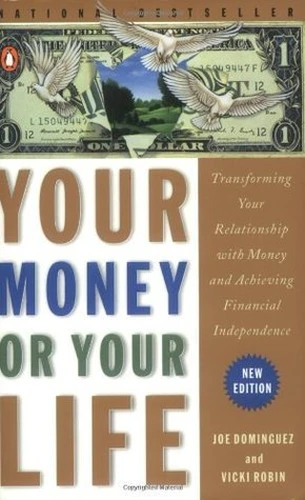
What this book does: It reframes everything. Robin asks a simple question with a powerful answer: what is money actually for?
She argues that money is life energy. Every dollar you spend is a piece of your time, your attention, your energy—time you will never get back. Once you see it that way, spending decisions become something else entirely. You stop asking “can I afford this?” and start asking “is this worth my time?”
The book walks you through a nine-step program that starts with tracking every penny and ends with rethinking your entire relationship with money. It is a slower, deeper approach than most personal finance books.
Where it works best: You have some stability. You are not in crisis. You want to understand why you spend the way you do and change it at the root.
The scenario: You have $47 until payday. You owe $3,200 on a credit card. Your instinct is to ignore it.
Robin says: stop. What did you trade for that $47? If you make $25 an hour, that $47 is nearly two hours of your life. Now look at the credit card debt. How many hours did you trade for those purchases? Were they worth it? This is not about guilt. It is about clarity. Once you see it, you cannot unsee it.
The result is a shift in perspective. And that shift changes everything you do next.
A Scene That Shows the Difference
Imagine a person in the same situation. $47 in the bank. $3,200 in credit card debt. They have been avoiding their finances for months.
They pick up Pierce first.
They learn to track their spending without shame. They break down the debt into manageable chunks. They set up a system for making payments and building a buffer. In six months, the debt is down to $1,800. They are not out of the hole yet, but they are climbing. They feel like they have some control.
Then they pick up Robin.
They calculate their real hourly wage. They realize that the coffee they buy every morning costs them 20 minutes of their life. They look at the remaining debt and ask: was it worth it? Some of it was. Some of it was not. They stop buying things they do not actually want. The debt shrinks faster because the spending slows down.
Now imagine the reverse order.
They read Robin first. They are inspired. They track their spending for two weeks. They feel a shift in perspective. But they still do not know how to handle the debt. They know what they should do, but they do not have the mechanics to do it. Two months later, the debt is still there.
Then they read Pierce. Now they have both. They know why they spend, and they know what to do about it.
Where They Overlap
Both books want you to think differently about money. Both believe that most people are trapped by habits and patterns they do not consciously choose. Both are practical in their own way—Pierce at the level of systems, Robin at the level of perspective.
Where They Diverge
Pierce is about mechanics. Robin is about meaning.
Pierce assumes you are in a hole and need a ladder. Robin assumes you are already on solid ground and want to rethink how you live.
Pierce gives you a system you can implement tonight. Robin gives you a philosophy that will take months to fully absorb.
Pierce asks: what do you need to do? Robin asks: what do you actually want?
If you are stuck in the cycle—in debt, living paycheck to paycheck, feeling like you are running in place—start with Pierce. He gives you the ladder. You cannot rethink your relationship with money until you can breathe.
If you have some stability and you are ready to go deeper, read Robin. She will change how you see money forever. But she cannot get you out of the hole. For that, you need Pierce first.
Read them in that order. First, get out. Then, rethink everything.
