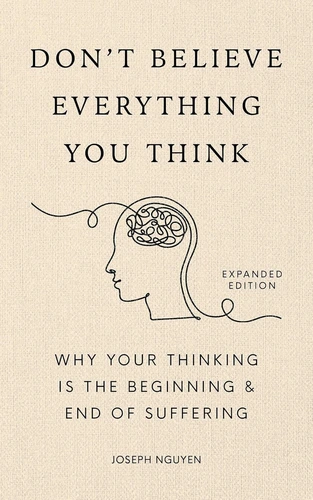
I met this book during a sleepless night, the kind where your brain runs a marathon of worst-case scenarios. My phone glowed on the nightstand. I was exhausted, but my mind wouldn’t stop. I wasn’t looking for a savior, just a distraction. I downloaded Joseph Nguyen’s Don’t Believe Everything You Think out of sheer desperation.
Ninety minutes later, I was still awake, but something had shifted. I wasn’t just reading words. I was feeling my shoulders drop, my jaw unclench. The book’s central claim is radical and simple: our thinking, not our thoughts, is the root of all suffering. It’s a bold thesis. But does a hundred-page self-published book really hold the key to unlocking peace? Or is this just another well-meaning guide destined for a dusty shelf?
The Judgment We Layer On
Nguyen makes a crucial distinction. Thoughts, he argues, are the raw data of experience. They arise and pass. Thinking, however, is the judgment we layer on top. It’s the mental commentary, the replaying of past grievances, the forecasting of future disasters. The protagonist of this book isn’t a person—it’s this very process. The core conflict is internal, a war between our natural state of peace and the ego’s relentless need to analyze and control.
The book doesn’t have a plot in the traditional sense, but it has a powerful narrative arc. It moves from diagnosing the disease to prescribing a cure. The author’s voice is calm, almost like a friend walking you through a fog. He doesn’t shame you for overthinking. He simply points out that you have a choice. He uses the analogy of a bowl of muddy water. You can try to filter it, boil it, or stir it. Or you can just let it sit. The mud settles on its own. The water becomes clear. The same happens with our minds. This image alone felt like a revelation.
What struck me most was the distinction between motivation born of inspiration and that born of desperation. Nguyen argues that pursuing a goal to prove your worth is a path to misery. When you create from a place of joy and alignment, the work feels effortless. This reframed my own ambitions. I realized how much of my drive was fueled by fear. The book didn’t just tell me to stop thinking. It showed me what I was missing by thinking so much.
Letting the Mud Settle
The core theme is the illusion of control. We think that by analyzing every detail, we can prevent pain. Nguyen argues the opposite. Our constant thinking is what creates the suffering in the first place. The key imagery is the “thought-o-meter,” a speedometer for your mind. When it’s in the red zone, you feel stressed and anxious. The goal isn’t to force the needle down. It’s to become aware of it spinning and gently take your foot off the gas.
This is where the book moves from philosophy to practice. Nguyen introduces the PAUSE method—a simple acronym to interrupt the spiral. You Pause, Ask yourself if this thinking serves you, Understand you have a choice, Say a mantra, and Experience your emotions without judgment. It’s not a complex system. It’s a reminder to come back to the present moment.
This struggle is universal. We all have that inner voice that tells us we’re not good enough. The book’s genius is that it doesn’t try to argue with that voice. It simply suggests you stop listening to it. The imagery is clean and effective. The muddy water, the thought-o-meter—they all point to one thing: your natural state is clarity, and thinking is what clouds it. The book’s weakness is its occasional turn toward the “woo-woo,” like the concept of a “Universal Mind” that connects all things. I’m skeptical of that. But it doesn’t undermine the core, practical message.
The Quiet Anchor
This book is not a magic bullet. It doesn’t promise to rewire your brain or make your problems disappear. What it offers is something more profound. It gives you permission to stop fighting your mind and simply observe it. In a world that glorifies busyness and constant productivity, the idea of doing less to feel more is almost subversive.
I didn’t agree with everything. The advice to always follow your intuition feels risky. My intuition has led me astray plenty of times. But the core lesson—that I can choose not to engage with every thought that passes through my head—has been genuinely transformative. It’s helped me feel less anxious in my day-to-day life. It’s a tool I return to, a quiet anchor in a noisy world.
This book won’t solve your problems. It won’t give you a step-by-step plan to fix your life. But it will make you feel slightly less alone in the chaos of your own mind. It will remind you that peace isn’t something you have to create. It’s already there, waiting for you to stop stirring the water. As Nguyen writes, “You cannot think your way into flow, just as much as you cannot think your way into love. Both are a natural occurrence when we let go.”

