You know the feeling.
Someone offers a harmless suggestion, and something inside you flares up. You know they didn’t mean any harm, but the comment landed like a punch.
Or maybe someone doesn’t reply to your text for a few hours. Logically, you know they’re probably busy. But your mind has already spun up a dozen scenarios: “Are they annoyed at me?” “Did I say something wrong?”
The reaction comes fast and hard. Later, you might even feel embarrassed about how strongly you reacted. But in that moment, it was real, and you couldn’t stop it.
Emotional triggers don’t care about logic. They just explode.
The three books below each address a different layer of this problem. One helps you understand where triggers come from. One helps you grasp why your reaction feels automatic—why your body responds before your mind can catch up. One gives you a way to respond differently when it happens again.
Awakening to Human Nature by Owen Pierce
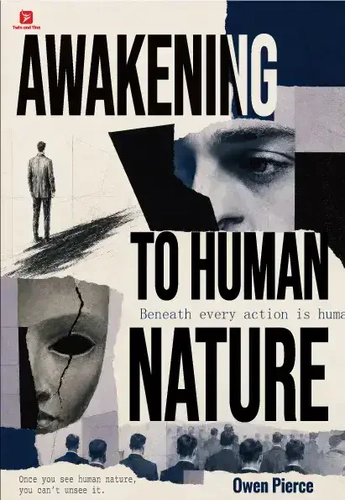
Why does a seemingly small event trigger such a strong reaction?
Most of the time, it’s not the event itself.
A piece of unsolicited advice lands not as “help” but as an attack on your competence. A delayed reply feels not like “they’re busy” but like “I don’t matter.”
Pierce’s book gets to something foundational: many emotional triggers aren’t about what’s happening right now. They’re about what the event touches deeper down—insecurity, fear of rejection, doubts about self-worth, or a need for control.
That harmless suggestion stings because part of you already doubts your own ability. That unreturned message spirals because underneath, there’s a quiet belief that you’re always at risk of being left behind. What actually triggers you isn’t the event itself—it’s the meaning you attach to it.
What this book offers is a way out of the self-blame trap. You stop asking “why am I so sensitive?” and start asking “what is this touching?” Once you see that your reaction is about an older pattern, not this moment, you’ve already started to shift.
For anyone who wants to understand where their “overreactions” actually come from.
The Body Keeps the Score by Bessel van der Kolk
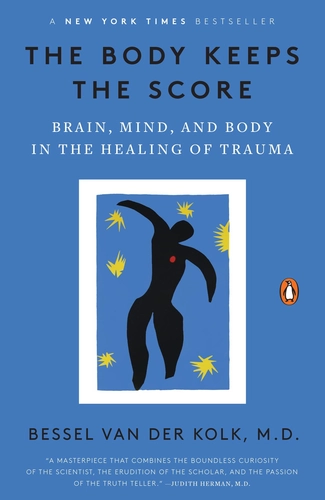
Why does your body react before your mind can understand why?
Here’s something that might sound familiar.
Someone raises their voice. You feel your chest tighten before you even register what they said.
A conversation takes an unexpected turn. Your stomach drops before you can name the emotion.
A situation feels vaguely unsafe. Your shoulders tense up. Your breathing changes. And only after all of that—sometimes minutes later—your brain catches up and thinks: “Why am I reacting like this?”
Van der Kolk, one of the world’s leading experts on trauma, spent decades studying why the body responds this way. His central argument is that our emotional responses aren’t just mental. They live in the body. When you experience something that feels threatening—even if your rational mind knows it isn’t dangerous—your body activates a survival response.
This is why triggers feel so automatic. You don’t choose to get defensive. You don’t decide to shut down. Your nervous system makes that decision for you.
The book explains the science in a way that makes sense of the experience. You learn why some situations send your body into alarm mode, why past experiences shape current reactions, and why “just thinking differently” doesn’t always calm your body down.
More importantly, it gives you a framework for what to do about it. Because once you understand that the reaction is happening in your body—not just in your head—you can start working with it differently.
For anyone who has ever felt like their body reacted before their brain caught up—and wondered why.
Emotional Agility by Susan David
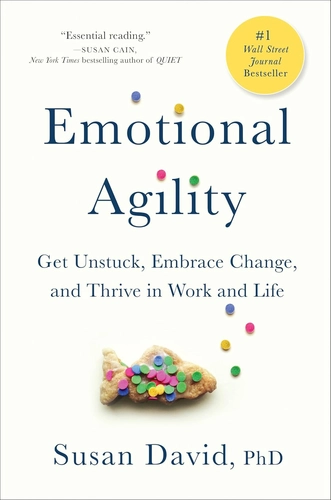
How do you stop letting triggers control you?
Once you understand where triggers come from, and once you recognize that your body is involved in the reaction, you’re left with the question that matters most:
“Now what?”
David, a Harvard psychologist, wrote this book for people who are tired of being hijacked by their own emotions. Her core insight is simple but powerful: emotions are not commands.
You can feel angry and not act on it. You can feel anxious and still choose to speak up. You can feel ashamed and still take a risk. The emotion doesn’t have to be the driver of your behavior.
The problem is that most of us don’t create space between the feeling and the action. We feel something, and we immediately react. Someone criticizes us. We feel defensive. We snap back. Someone withdraws. We feel rejected. We chase after them. Someone challenges us. We feel threatened. We shut down.
David offers a practical framework for stepping out of that loop. She teaches you how to recognize a feeling without being consumed by it, how to label emotions accurately so they lose their grip, and how to choose a response that aligns with who you want to be—not just how you feel in the moment.
The book doesn’t ask you to stop having emotional triggers. It asks you to stop letting them make your decisions.
For anyone who understands why they react but still feels like their reactions run the show.
These three books offer a clear path.
Pierce shows you where triggers come from—the deeper beliefs and patterns underneath the reaction. Van der Kolk explains why your body responds before your mind catches up—and why logic alone doesn’t always calm the reaction. David gives you the tools to create space between feeling and action, so you can respond instead of react.
If you keep asking yourself “why does this affect me so much?” start with Pierce.
If you keep asking “why does my body react before I can think?” start with Van der Kolk.
If you understand both but still feel controlled by your reactions, start with David.
The goal is not to stop feeling triggered. The goal is to stop being run by it.
