You read Thinking, Fast and Slow. You were fascinated. Kahneman’s work is brilliant: System 1 and System 2, cognitive biases, the whole map of how our minds fail us. You saw irrationality everywhere.
But when you finished the book, you might have felt something was missing. Kahneman explains what goes wrong in the brain. But he does not tell you much about how to navigate the world knowing that people are irrational. He explains the glitch. He doesn’t tell you how to live with the glitch.
These three books take the same insights and apply them differently — in relationships, in social dynamics, and in everyday decisions. One of them starts exactly where Kahneman leaves off.
Awakening to Human Nature by Owen Pierce
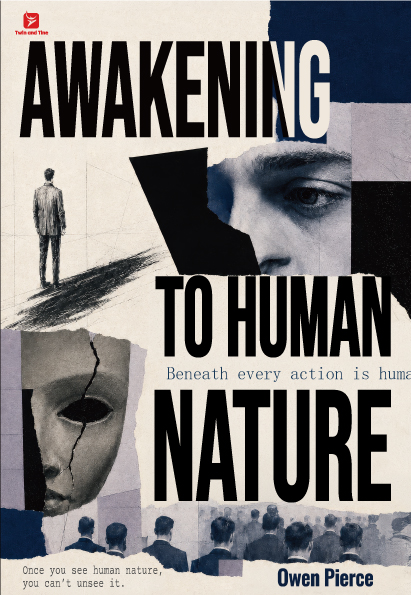
Kahneman explains why your brain betrays you. Pierce explains what to do about it — in real life.
Here is the difference between these two books. Kahneman runs experiments. He places you in a lab and shows you how your mind makes predictable errors. The conclusion is often: humans are irrational. And then the book ends.
Pierce starts from that conclusion. He takes the irrationality Kahneman describes and treats it as the default setting of human behavior. If people are irrational, he asks, what are the rules of surviving and succeeding in a world where people lie to themselves, chase validation over truth, and act on hidden interests?
His answer is a practical framework. He breaks human behavior down into seven domains — cognitive patterns, emotional triggers, desire and interest rules, social dynamics, workplace realities, manipulation tactics, and survival wisdom. Each one is a lens for understanding why people do what they do, even when it makes no sense.
Where Kahneman gives you a diagnosis of the mind’s errors, Pierce gives you a field guide to navigating those errors in real people, real relationships, and real workplaces. He does not just tell you that people are irrational. He tells you what to expect from them — and how to protect yourself without becoming cynical.
Kahneman explains the glitch. Pierce explains how to live with it.
For anyone who read Kahneman and thought: “I understand how the mind fails, but how do I actually use this in my life?”
Predictably Irrational by Dan Ariely
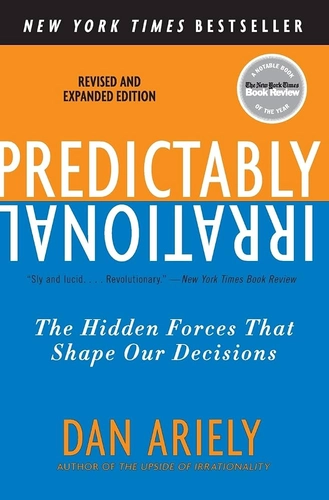
Why do we make the same mistakes over and over, even when we know better?
Ariely, like Kahneman, runs behavioral experiments. But his focus is different. Kahneman maps the mind’s errors. Ariely maps the specific, everyday situations where those errors show up — and where they cost us money, time, and peace of mind.
Why do free things make us lose our heads? Why do we overpay for things we do not need? Why do we cheat a little but not a lot? Ariely answers these questions with vivid experiments and everyday examples. He writes in a lighter, more conversational style than Kahneman, and he focuses on applied irrationality — the kind that shows up in your shopping cart, your dating life, and your workplace.
For anyone who wants to see irrationality showing up in everyday life — and understand how to catch it before it costs them.
The Righteous Mind by Jonathan Haidt

Why do smart, decent people disagree so passionately and stubbornly?
Haidt takes the irrationality Kahneman described and applies it to one of the most divisive areas of human life: morality. His argument is that our moral judgments are not based on reason — they are based on intuition. We feel something is wrong first, and then we reason our way to a justification.
He calls this “reasoning as a lawyer, not as a judge.” A lawyer takes a position and searches for evidence to defend it. A judge weighs evidence impartially. Most of us are lawyers, not judges. We are convinced we are right because we have already decided, emotionally, and we are simply finding reasons to support our side.
This explains why disagreements with family, coworkers, and strangers feel so intractable. It is not that the other person is stupid. It is that their intuition is wired differently. Haidt maps the six moral foundations that shape these differences. Understanding them does not make you agree with everyone. It helps you stop being bewildered by why they are so convinced they are right — and it helps you communicate with them more effectively.
For anyone who has ever argued with someone and thought: “How can they not see it?”
Which book should you start with?
If you read Kahneman and felt like you understood the glitch but not how to navigate it, start with Pierce. He gives you the practical rules for living with irrational people — including yourself.
If you want to see irrationality in everyday decisions — money, relationships, work — read Ariely. He makes it tangible and immediate.
If you want to understand why people disagree so fiercely and how to bridge the divide, read Haidt. He explains the moral side of irrationality.