I met this book on a Tuesday night, sprawled on my couch, scrolling through my third straight hour of mental replays. A conversation from work. A text I should not have sent. A future that had not happened yet. My chest was tight, and my brain felt like a hamster wheel on fire. I picked up Joseph Nguyen’s slim volume mostly because it was short enough to finish before my anxiety wore off. I did not expect it to actually work.
Nguyen’s central claim is deceptively simple: thinking, not thoughts, is the root of all suffering. Thoughts arrive on their own, like weather. Thinking is what we do with them—the spinning, judging, rehashing, catastrophizing. We cannot control the thoughts that float in, but we can stop actively churning them. The book argues that this churning is a choice, one we make so habitually that we forget we are making it.
So here is the question that haunted me through every page: if suffering is optional, why do we cling to it so fiercely?
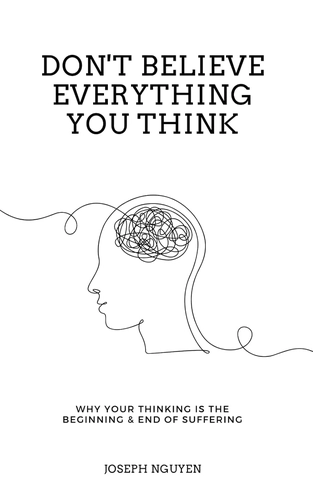
The Mind That Would Not Stop Churning
Nguyen does not write as a distant guru. He writes like someone who has been trapped in his own skull and found a way out. The book’s protagonist, if you will, is the reader’s own overactive mind. The villain is not circumstance, not trauma, not other people. The villain is the internal narrator who insists that if we just think hard enough, we can think our way to safety.
The author’s key distinction between thoughts and thinking landed on me like a cold cloth on a fever. Thoughts are raw material, neutral, fleeting. Thinking is the judgment we attach to them, the story we build, the weight we add. He illustrates this with the parable of two arrows. The first arrow is the event itself—the physical pain, the criticism, the loss. The second arrow is the emotional suffering we inflict on ourselves by obsessing over the first one. The second arrow is always our own doing.
What struck me most was his PAUSE framework. P for pause and breathe. A for ask yourself if this thinking serves you. U for understand you can let it go. S for say the mantra: thinking is the root cause of suffering. E for experience the emotion without narrating it. It sounds almost embarrassingly simple. But I tried it during a panic spiral about a medical test result, and something shifted. The spin slowed. The story loosened. I did not feel happy, exactly. More like the volume got turned down for the first time in months.
The book’s weakness is also its strength. It repeats its core message relentlessly, almost to the point of tedium. Some readers will find this meditative. Others will want more tactical depth, more neuroscience, more case studies. I wanted more of the author’s personal story, which appears only in fragments. The brevity that makes it accessible also makes it feel incomplete at times.
The Wisdom of Doing Nothing
The book’s deepest insight is that our natural state is peace, not anxiety. We do not need to fix ourselves. We need to stop breaking ourselves with constant mental activity. Nguyen compares the mind to a bowl of muddy water. We cannot make it clear by stirring it. We set it down and let the mud settle on its own.
This reframing is radical in a culture that worships productivity and constant optimization. We have built entire industries around managing anxiety, reframing negative thoughts, and hacking our brains. Nguyen’s argument is that the best intervention is non-intervention. Stop trying to solve your mind. Just observe it. The clarity returns on its own.
I tested this during my commute, letting my usual anxious predictions drift by without engaging them. The urge to grab them was almost physical, like an itch. But each time I resisted, the next thought came softer. By the time I reached my stop, I felt a stillness I had not felt in years. It was not euphoria. It was absence—the beautiful absence of noise.
A Book for the Exhausted Mind
This is a book for people who are exhausted by their own minds. It is not for readers who want elaborate psychological frameworks or rigorous scientific evidence. It is not for those who believe their suffering is entirely external and want validation for that belief. It is for the chronic overthinker, the 3 AM ruminator, the person whose friends keep saying “you need to stop overthinking” and who has no idea how to actually do that.
I finished the book in one sitting, but I have not finished with it. I keep the PAUSE mantra in my back pocket for when the spiral starts. I will not pretend it has cured me. Some nights the mud still swirls. But now I know the water can clear. That knowledge alone is worth the price of admission.
You cannot think your way into flow, just as much as you cannot think your way into love. Both are a natural occurrence when we let go.

