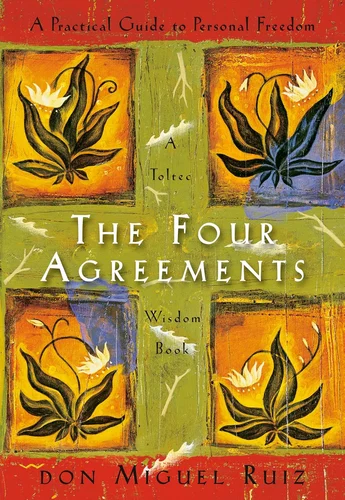
I first picked up Don Miguel Ruiz’s The Four Agreements during a week when my inner voice had turned into a bully. Every mistake at work became a rehearsal of my failures. Every awkward conversation got replayed with harsher commentary. I was exhausted by my own mind.
The book sat on my nightstand for three days before I opened it. It’s small, barely 129 pages, and I remember thinking, what can this possibly offer that years of overthinking haven’t already ruined?
Then I read the four agreements: Be impeccable with your word. Don’t take anything personally. Don’t make assumptions. Always do your best. They sound like fortune cookie wisdom—the kind you nod at and forget by breakfast. But Ruiz isn’t offering a list. He’s describing a way to dismantle the internal agreements we’ve made since childhood, the ones that tell us we’re not good enough, that we need approval, that suffering is just how life works.
The question I kept asking myself was this: if the rules are so simple, why do I keep breaking all four before lunch?
The Protagonist Is You, and That’s the Problem
There’s no fictional hero in these pages. The protagonist is you. Or me. Or anyone who has ever said yes when they meant no, or stayed quiet when they should have spoken.
Ruiz’s central claim is that we are all living inside a “dream,” a shared social trance built from the beliefs, judgments, and expectations we absorbed as children. Most of us never question this dream. We just keep acting out its rules, even when those rules cause us daily misery.
What struck me most was his insistence that we are not victims of other people’s opinions. We are victims of our own reactions to those opinions. When someone criticizes you, Ruiz argues, they are projecting their own reality, their own internal dream. Their words are about them, not you. This sounds liberating. It also sounds, honestly, a little cold.
I tried it. A colleague made a snide comment about my presentation. My first instinct was to spiral. Then I remembered the second agreement and asked myself, does her opinion change my competence? No. Does it change my worth? No. I still felt stung, but the sting lasted minutes instead of days. That felt like a small miracle.
The book’s honesty about how hard this practice is—that’s the real gift. Ruiz doesn’t pretend you’ll master these agreements overnight. He knows you’ll stumble, and he tells you to start over without self-punishment. That forgiveness, built into the structure of the fourth agreement, is what makes the whole system livable.
The Dream You Didn’t Know You Were In
Ruiz’s writing style is deceptively plain. He repeats ideas often, almost like a chant. The prose can feel choppy, and some readers will find the repetition annoying. I found it meditative. Each return to a core concept feels like a patient teacher repeating a lesson until it lands.
The central metaphor is the dream, the collective trance we live inside. Ruiz uses it to explain why we suffer: we believe the dream is reality, so we treat its rules as absolute. The four agreements are tools to wake up, gently, without violence to ourselves or others.
This metaphor turned out to be the reason the book works for me. It’s not about escaping the world. It’s about changing how you participate in it. The dream doesn’t disappear, but you stop being its puppet.
I also appreciated his grounding in Toltec wisdom, a tradition completely outside my New England upbringing. He presents it not as a religion but as a way of life, accessible to anyone. This universality is the book’s quiet strength. It doesn’t ask you to believe in anything supernatural. It just asks you to observe your own mind and then make different choices.
What the Book Actually Gives You
After multiple readings, I’ve stopped expecting The Four Agreements to be a magic cure. It’s not going to fix your marriage, your job, or your anxiety. But it will give you a framework for noticing when you’re doing the things that make those situations worse.
It’s helped me catch myself mid-assumption, that little story I’m writing about someone else’s motives. It’s helped me hear the way I talk to myself, often crueler than I would ever speak to a friend. It’s helped me do my best without measuring that best against some impossible standard.
Anyone who has ever felt trapped by their own thoughts will find something here. Anyone who gossips and then feels sick about it. Anyone who reads a text message and writes a novel about what it means. That’s most of us, I suspect. If you want a structured, evidence-based psychology book, skip it. Ruiz is a mystic, not a researcher. If you need clinical frameworks and citations, this will frustrate you.
I’ll be honest about what it won’t do. It won’t make you immune to pain. It won’t stop the world from being messy. But on the nights when my inner voice starts sharpening its knives, this book reminds me that I don’t have to listen. I made those agreements once. I can make different ones.
The question it leaves me with is simple and uncomfortable: if these four rules are all I need, what exactly is stopping me from actually living them?

