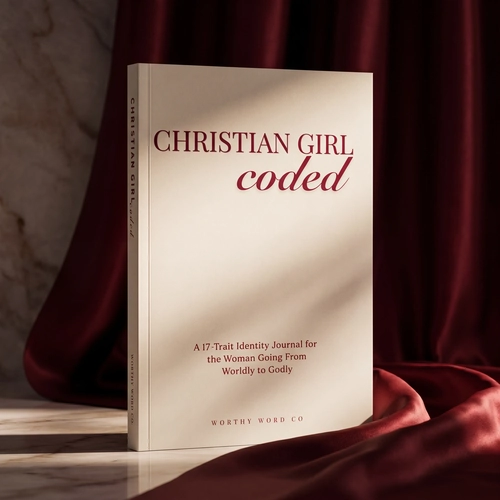
I found it on my kitchen table, wedged between a stack of unpaid bills and a dead succulent. My sister had left it there with a sticky note that said simply, “You know why.” She wasn’t wrong. I’d spent three years drifting through self-help books, each one promising a new me by Tuesday. This one felt different in my hands. Heavier, somehow. The cover said “Christian Girl Coded” and I almost put it back down. I’m not good at being told who to be.
But here’s the thing about that sticky note. She knew I’d been circling a question I couldn’t answer out loud. After all the therapy, the vision boards, the journaling apps, why did I still feel like I was wearing someone else’s skin? What was actually wrong with me?
The Mirror You Can’t Look Away From
The journal works like a mirror you can’t look away from. It’s structured around seventeen traits, and each one arrives with a sharp, uncomfortable prompt. Not the fluffy “what makes you happy” kind. More like “where are you lying to yourself about obedience?” It asks about forgiveness, about patience, about the parts of your character you’ve been quietly ignoring in favor of the parts that photograph well.
At first, I hated it. The prompts felt intrusive, like a friend who loves you enough to tell you the truth. I filled in pages with careful, diplomatic answers. Then I hit the trait about honesty, and I realized I’d been lying in a journal. To myself. About myself. That was the moment the plot thickened.
The core conflict is simple and brutal: you versus the version of you that’s comfortable. The journal doesn’t let you stay comfortable. Each trait builds on the last, and by the time I reached the middle, I was writing things I’d never told anyone. The 206 pages feel like a novel where you’re both the author and the protagonist, and the ending is still being written. I won’t spoil it, but the climax involves a hard conversation with yourself about who you actually are when no one’s watching.
Subtraction, Not Addition
The central argument here isn’t about self-improvement. It’s about self-removal. The core theme is subtraction, not addition. You don’t add godliness to your existing personality like a garnish. You dismantle parts of yourself that were built on the wrong foundation, and that’s a painful process the journal doesn’t sugarcoat.
The imagery that stuck with me most was the idea of becoming her. Not becoming yourself, not discovering yourself. Becoming a version of yourself that’s defined by external truth rather than internal feelings. That’s a radical reversal of everything modern self-help teaches. It argues that you can’t think your way into a new identity. You have to act your way into it, guided by scripture and honest answers to hard questions.
The scripture anchoring each section isn’t decoration. It’s the load-bearing wall. Every prompt forces you to measure your life against a standard outside yourself, and that’s uncomfortable in a way that secular journals never are. They ask what you want. This asks what He wants, and then makes you sit with the gap between the two.
That’s where the journal’s strength becomes its sharpest edge. It won’t let you admire the problem. It demands you do something about it. Some nights I closed it mid-prompt. But I always came back.
A Challenge, Not a Comfort
This journal does something rare. It treats you like an adult capable of hard change, not a child needing gentle encouragement. It’s demanding in a way that feels like respect. The flaws are real though. The prompts can feel repetitive across traits, and if you’re not in a season where you can handle honest self-assessment, this will sit on your shelf and judge you silently. It’s not a casual gift. It’s a challenge wrapped in a softcover.
It’s for the woman who’s tired of her own patterns, who’s tried the vision boards and the manifestation mantras and found them hollow. It’s for the one who suspects that the problem isn’t her circumstances but her character. It’s not for someone looking for a quick emotional lift or a few hours of therapeutic scribbling. That person will find this frustrating.
What I gained was a vocabulary for the parts of myself I’d been avoiding. A structured way to look at my own failures without spiraling. A sense that change isn’t a feeling I need to manufacture but a set of actions I can take. I still struggle with the same things, but now I know exactly where the work is. That’s more than most books ever give you.
This journal won’t magically transform you. It will make you slightly less afraid of the transformation that’s already started. And in my experience, that’s where real change actually begins.

