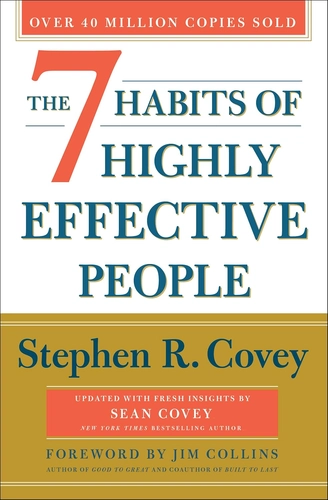
I was that person in the bookstore. The one who watched business majors grab this book and judged them for it. I rolled my eyes at the corporate lingo, the diagrams, the pull-out brochures. I told myself I’d never read it. Then my boss, a man who uses the word “synergy” unironically, assigned it to our team. I couldn’t say no. So I sat down with Stephen R. Covey’s The 7 Habits of Highly Effective People, expecting to hate every page. The truth is more complicated. I didn’t hate it. I also didn’t love it. I felt something much stranger. I felt seen.
What I found was a book that asks a question I wasn’t ready to answer: are you actually living according to your values, or are you just reacting to whatever life throws at you? It sounds simple. It isn’t. That question follows me around now, weeks after finishing the book.
The Man Who Wants You to Look at Your Own Funeral
Covey isn’t writing for the reader who wants quick tips. He’s writing for the person who senses something is off. The person who is successful on paper but feels empty inside. His central idea is that effectiveness comes from character, not personality. You can’t fake your way to a good life. You have to build one from the inside out.
The most uncomfortable part of the book is Habit 2. Covey asks you to imagine your own funeral. What would people say about you? What do you want them to say? He wants you to write a personal mission statement based on that vision. I’ll be honest, I rolled my eyes at this when I first read it. It felt morbid and a little narcissistic. But then I tried it. I sat down with a notebook and wrote about what I wanted my life to mean. I wrote about my daughter, about the kind of father I want to be, about the work I want to leave behind. It took me two hours. I cried. I’m not entirely sure why.
There’s a moment in the book where Covey describes reducing his son to tears over a garden. He was so focused on the outcome, on the perfect lawn, that he forgot the point. The relationship. The lesson. I recognized myself in that moment, and I didn’t like it. That’s the book’s power. It holds up a mirror and makes you look.
The Certainty That Makes Me Squirm
Here’s where I struggled. Covey writes with a kind of certainty that makes me uncomfortable. He claims the habits are based on “correct principles,” which he links to Judeo-Christian scripture. He’s a Mormon, and his faith bleeds through the pages. That’s fine. But the dogmatic tone can feel preachy. He doesn’t leave much room for doubt or nuance.
The book also suffers from its own success. The language has become so embedded in corporate culture that phrases like “win-win” and “synergize” feel like parody. I found myself cringing at some of the terminology, even when I agreed with the underlying idea. There’s also a mechanistic quality to everything. Even a picnic with your partner becomes a “Quadrant II activity.” It’s exhausting. It turns life into a series of checkboxes.
Another reviewer described the book as having a “dogmatic air of absolute certainty,” and that stuck with me. Covey assumes his principles apply to everyone. He doesn’t account for situations where values conflict. He doesn’t acknowledge that some problems don’t have elegant solutions. He believes in the primacy of individual will, which is inspiring but also naive. What about systemic injustice? What about people who are trapped by circumstances beyond their control? The book doesn’t have good answers for those situations.
The Goose, the Golden Egg, and What I’m Killing
Let me tell you about the fable Covey uses. A farmer discovers a goose that lays golden eggs. He gets greedy and kills the goose to get all the eggs at once. He ends up with nothing. Covey uses this to explain the P/PC balance. P is production, the golden eggs. PC is production capability, the goose itself. You need both. If you only chase results, you burn out. If you only focus on self-care, you produce nothing.
This is the most valuable concept in the book, I think. It’s a warning about sustainability. In a culture obsessed with hustle and output, Covey reminds you to sharpen the saw. Habit 7. Take care of yourself physically, mentally, emotionally, and spiritually. Spend an hour a day on renewal. It sounds obvious, but almost no one does it. I know I didn’t, before reading this book.
The fable stuck with me because it’s concrete. It’s not abstract corporate nonsense. It’s a story about greed and balance and long-term thinking. It made me look at my own life and ask what I was killing for short-term gain. My health? My relationships? My ability to think clearly? The answer was uncomfortable. All of the above.
What I’m Still Sitting With
This book works best for people who are ready to do the work. If you’re willing to sit with uncomfortable questions, to write mission statements and examine your own behavior, you’ll get something out of it. It’s also good for parents who want to be more intentional about how they raise their children. Covey has a lot of wisdom about emotional bank accounts and the importance of small kindnesses.
If you’re looking for quick fixes or specific productivity hacks, skip it. This is not a tactics book. It’s a philosophy book disguised as a business book. And if you’re allergic to religious undertones or corporate jargon, you’ll find plenty to annoy you. The 30th anniversary edition includes commentary from Covey’s son Sean, which adds a modern perspective. It helps, but it doesn’t fully solve the dated feel of some sections.
I also think the book is best read slowly. I spent three weeks on it, which felt excessive at the time. Now I understand why. It needs time to sink in. You can’t rush this kind of reflection. You have to let it sit with you.
A Permission Slip I Didn’t Expect
The 7 Habits of Highly Effective People won’t change your life overnight. It won’t give you a magic formula for success. It might annoy you. It might make you roll your eyes. But if you let it, it will make you think. It will ask you hard questions about how you’re living and what you value. It will challenge you to be more intentional.
What I took from this book isn’t a system or a set of habits. It’s a single permission slip. Permission to stop reacting. Permission to choose my own direction. Permission to say no to things that don’t matter so I can say yes to things that do. That’s not bad for a book I was sure I’d hate. I’m still not entirely comfortable with Covey’s certainty or his charts. I still cringe at the word “synergize.” But I’m also writing a mission statement for my life now, and that’s something I never expected to do.
What would you say at your own funeral, and are you living a life that matches those words?

