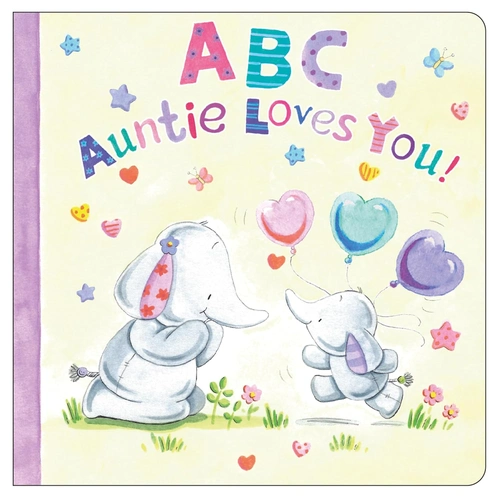
My niece grabbed this book from my bag before I could say hello. She is two and a half, and her grip is decisive. We sat on the kitchen floor, cereal crunching under us, and she flipped through the padded pages with the confidence of a tiny librarian. The cover is soft, almost squishy. That matters when you are reading with someone who still tests everything with her teeth.
I bought ABC Auntie Loves You because I needed a gift that said something I am not good at saying out loud. I love this kid more than I can articulate. Here was a book promising to do the articulating for me. But a question formed while she turned pages: can an alphabet book actually transmit love, or does it just label it?
The Auntie Who Never Appears
There is no plot here. There is no character named Auntie, no face, no body. She exists only as a voice, present in every rhyme from A to Z. Adventures, bear hugs, giggles, zany moments. Each letter gets a line, and each line gets a rhythm that bounces. My niece echoed the last word of every page, which felt like a small miracle.
The absent Auntie is actually the book’s smartest choice. Any child can insert their own auntie into this space. The love is not attached to a specific person, which makes it transferable. My sister could read this to her daughter and the words would still hold. That flexibility is rare in a market full of personalized books insisting on names.
But I confess I wanted the Auntie to be real. I wanted a character struggling with the mess of loving a child, the impatience and the tenderness tangled together. Instead, the love is smooth and frictionless. It never stumbles. It never admits to being tired or overwhelmed. And that felt like a missed opportunity, because the messy parts are where children learn love is durable.
The Weight of a Soft Cover
The core theme is simple: you are loved, completely and without conditions. The imagery leans on classic childhood pleasures. Bear hugs, ice cream, rainbow skies, treasure hunts. Nothing dark, nothing complicated. The illustrations are bright and cheerful, with rounded shapes that feel safe for small eyes.
What struck me most was the physical experience of the book itself. The padded cover is forgiving. My niece dropped it twice, stepped on it once, and it survived without a mark. That durability is a statement about love too. Real affection should be sturdy enough to withstand rough handling. The book understands this at a material level, even if the text stays on the surface.
The alphabet structure forces a certain shallow rhythm. Some letters are easier than others, and the rhymes for Q, X, and Z feel slightly forced. I wondered if the constraint of the alphabet actually gets in the way of emotional depth. Then I watched my niece trace the letter Q with her finger, and I understood. For this age group, the structure is not a limitation. It is a game. The love is hidden inside the shapes of letters, waiting to be discovered.
A Ritual, Not a Lesson
This book will not teach your child to read. It will not offer complex emotional lessons or prepare them for the difficulties of family relationships. It is not trying to do any of those things. What it does is simple and valuable: it creates a ritual of reading together, a space where love is spoken out loud in a rhythm small children can absorb.
The text is repetitive, and an adult reading it for the fifth time in one day might feel their enthusiasm flagging. The rhymes occasionally sacrifice meaning for meter. My niece did not care. She cared that the book was hers, that it was soft, that it said the word “love” on every page.
I recommend this for baby showers and first birthdays, for aunties who are not sure how to start building a relationship with a tiny person, for anyone who wants a gift that feels warm without being complicated. I would not recommend it for older children who need more story. This is a book for the lap-reading stage, the stage where the physical closeness matters more than the words.
The golden moment came at the end of our reading session. My niece closed the book, patted the cover, and said “Auntie” with a smile. She was not quoting the book. She was responding to something she felt. The book had done its job without me noticing.
“From A to Z, let your little one know just how much Auntie loves them.”
That line is not great literature. But it is honest, and for a board book, honesty might be enough.

