I read the first half of A Trade of Blood on a Tuesday night, alone in my kitchen, the overhead light buzzing. I remember thinking, this is the third book in a fantasy mystery series, I should know what to expect by now. Then the plant-based autopsy happened. Then the singing forest. Then I was still awake at 2 AM, my tea long gone cold, feeling like the book had somehow been reading me instead of the other way around.
The question that drives this installment is deceptively simple: what does it cost to feed an empire? Detective Ana Dolabra and her assistant Dinios Kol are sent to the canton of Sapirdad, the Empire’s agricultural heartland. The heir of House Armenta stands accused of murdering the daughter of House Burav. His hands are bloody. He admits to the act. He has no memory of why. The two families are poised to tear the region apart, which would starve the Empire. Ana calls the case boring. She is, of course, spectacularly wrong.
Din’s Darkest Case
Here is where I have to stop and talk about Din. He has been my favorite kind of disaster since The Tainted Cup: a man with a perfect memory and imperfect everything else. In this book, Bennett does something quietly devastating with him. Din’s engraving abilities are changing. He can feel his thoughts shifting, like something turning over inside him. He meets his sister Fotia, and the family reunion is exactly as warm and comfortable as you would expect from a family that shaped Din into a man who thinks he deserves to suffer. He carries heavy instruments for Ana. He falls for someone again. He torments himself about it.
The mystery itself is a locked room, a Romeo and Juliet story that curdles into something closer to a fungal nightmare. The Armentas have bred cattle the size of houses. The Buravs have engineered cats that harvest beans all night. The land itself hums with an unsettling song. What struck me most, honestly, was how the horror crept in sideways. Bennett has always been good at biological strangeness, but here he turns agriculture into something grotesque. Cows that are more machine than animal. A forest that remembers. A murder weapon that is, I will not spoil it, but you will not forget it.
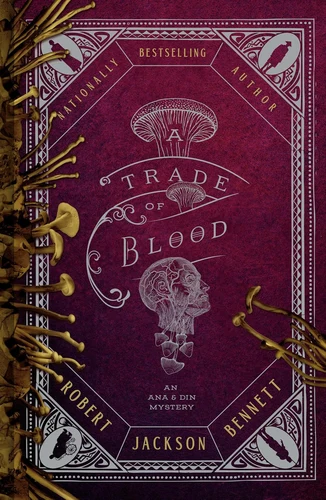
The Slaughterhouse at the Center
The core image for me, the one I kept returning to, was the slaughterhouse. Bennett describes it with such precise, unflinching detail that I felt the blood on my hands. The workers, the carcasses, the mechanical efficiency of death. It is a scene about livestock, but it is also a scene about every system that consumes living things without looking at them. The Empire feeds on its people the way the Armentas feed on their cattle. The metaphor is not subtle. It does not need to be.
There are problems here. The afterward, where Bennett explains his intentions, felt almost insulting to the reader, like he did not trust us to see the parallels ourselves. And the world, which felt astonishingly alien in the first two books, feels more familiar now, more like our own with a fantasy paint job. But I am not sure that is a flaw. It might be the point.
The story that emerges is about hunger, yes, but also about inheritance. About the violence we are born into and the violence we choose to repeat. Din’s family trauma sits beside the Empire’s founding bloodshed, and neither can be escaped by simply walking away. Ana’s own mysterious nature gets more screen time here, and her scenes with Din have a new weight. They are not just detective and assistant anymore. They are two people circling the same dark truth, from different directions.
The Ending That Rewires Everything
I cannot say I loved every minute of this book. Some sections dragged, particularly the middle, where the investigation felt like it was treading water. And Din’s romantic subplot, while sweet, felt like it was inserted to remind us that he is still human under all that sadness. But the ending—the ending rewired something in me. Without spoiling anything, I will say that the final revelation does not just solve the mystery. It recontextualizes the entire series, and it left me staring at the wall for a solid ten minutes.
If you came for the murder mystery, you will stay for the dread. If you came for the worldbuilding, you will stay for the horror of what that world actually runs on. If you are looking for a light, comforting read, this is not it. This book will not hold your hand. It will show you the slaughterhouse and ask you to look at what is being killed.
It is the third book in a series, so do not start here. But if you have been following Ana and Din, this is the installment where the series reveals its true shape. It is darker than I expected, more political, more personal. It is a book about how the things we build to sustain us can become the things that consume us. The strongest cages, as always, are the ones we mistake for home.
The Empire is not a country. It is a stomach. That line stayed with me. I suspect it will stay with me for a long time.

