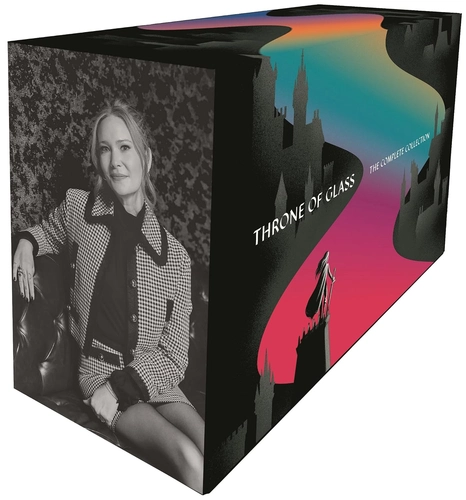
I bought the Throne of Glass paperback box set on a Tuesday, mostly because it was on sale and my bookshelf had a gap the size of my anxiety. I had just finished the ACOTAR series, loved it, and heard this one was different. Heavier. Less romance, more war. I started the first book with low expectations and a mug of tea that went cold by page forty.
The box set itself is handsome, sturdy, and the spines line up like soldiers. But I was not prepared for the story inside. By the time I reached the end of Crown of Midnight, I had stopped making plans with friends. I was reading at traffic lights. I was that person.
Here is my central argument, the one I will spend this whole review defending: the Throne of Glass series does not give you a heroine to admire. It gives you a broken woman who has to earn her own humanity back, and that is a far more interesting thing to read about. The question that drives everything is simple: what happens to an assassin when she stops being one?
Celaena Sardothien and the Shape of Her Cage
Celaena Sardothien begins the series in a salt mine, dying slowly. She is the world’s greatest assassin, which sounds glamorous, but she is also eighteen, starved, and furious. The king of Adarlan offers her a deal: fight in a competition, win, and serve as his champion. Lose, and go back to the mines.
What struck me most was how Maas refuses to let Celaena be cool. She is vain, yes, and arrogant, absolutely. She steals chocolates and complains about her dresses and flirts with everyone. But underneath that armor is a girl who was sold, trained, and used by people who claimed to love her. Her conflict is not really about the competition. It is about whether she can trust her own choices after a lifetime of having none.
The plot is deceptively simple at first. Tournament, enemies, a prince, a captain. Then the murders start, and the magic returns, and the world opens up like a wound. The series sprawls across continents and introduces a cast that could fill a small city. Manon Blackbeak, the witch with iron teeth, nearly stole the entire series from Celaena. Dorian Havilliard, the prince who carries a burden he never asked for. I am still thinking about Chaol Westfall, the captain whose rigid loyalty costs him everything.
I will not spoil the ending. I will say that the final book, Kingdom of Ash, broke me in a way I did not expect a fantasy series to break me. There is a moment near the end where a character makes a choice that feels inevitable and devastating all at once. I put the book down and stared at my wall for twenty minutes.
The bridge to the deeper theme is this: Celaena spends eight books trying to become someone else. The person she becomes is not the person she thought she wanted to be.
What the Series Is Actually About
The core theme of Throne of Glass is freedom, but not the kind you win with a sword. It is the kind you win when you stop lying to yourself. Celaena believes she wants out of prison. What she actually wants is to be allowed to stop killing. She wants to be loved without being used. She wants to be seen, not as a weapon, but as a person.
The key imagery that anchors this is the glass castle itself. The king’s throne is made of glass, beautiful and lethal, and it is a perfect metaphor for the entire world Maas builds. Everything looks sharp and clear, but it can shatter at any moment. The glass reflects what you want to see. It does not show you what is real.
I have a confession. I was hit by my father as a kid, and I learned to raise my hands before he even moved. That reflex never fully left me. When Celaena flinches at an unexpected touch in Heir of Fire, I recognized that muscle memory immediately. Maas does not write trauma as a plot point. She writes it as a physical reality that lives in the body. Celaena does not get over her past. She learns to carry it without letting it crush her.
This is what the series does better than almost anything I have read. It shows recovery as a process, not a destination. Every time Celaena thinks she has healed, something new breaks. Every time she trusts someone, they betray her. And yet she keeps going. That is not a fantasy. That is just life.
What the Slow Burn Earns
The uncomfortable part, the part I struggled with, is the pacing. The first two books are slower, more contained, and some readers will find them tedious. Maas also has a habit of describing Celaena’s outfits in detail that borders on obsessive. And the romantic threads can feel like a love triangle that never quite commits. These are real flaws. I do not pretend they are not there.
But here is the thing. The series ramps up so dramatically around the second half of Heir of Fire that the slow start feels like a necessary foundation. The world building is unmatched. The character development is staggering. By the time you reach the final book, every single person on the page has earned their place.
If you want a quick, spicy romance with a guaranteed happy ending, this is not that. There is very little explicit content until the later books, and even then it is not the focus. If you are looking for a light read to pass a weekend, this is also not that. Eight books is a commitment, and the emotional weight is heavy.
Read this if you loved ACOTAR but wanted more substance. Read this if you enjoy watching characters suffer, grow, and become unrecognizable from who they started as. Read this if you believe that fantasy can be just as emotionally devastating as literary fiction. It can.
Do not read this if you need instant gratification. Do not read this if you are triggered by torture, death, or depictions of slavery. Do not read this if you are unwilling to invest in a world that takes its time revealing itself.
A Mirror, Not an Escape
The definitive judgment, the sentence that tightens like a screw, is this: Maas proves that the strongest cage is never made of iron. It is made of the lies you tell yourself to survive.
What I took from this series, in the end, was not a fantasy escape. It was a mirror. I finished the final book at three in the morning, my apartment silent, and I felt slightly less alone in my own messy head. That is not nothing.
The golden quote comes from Queen of Shadows, and it has stayed with me for weeks. “She was the heir of ash and fire, and she would bow to no one.” I have repeated that line to myself on bad days. It does not fix anything. But it helps.
This box set will not fix your life. But it will make you feel slightly less broken in the moments when you are trying to rebuild yourself from nothing. That is a rare gift. I am glad I opened it.

