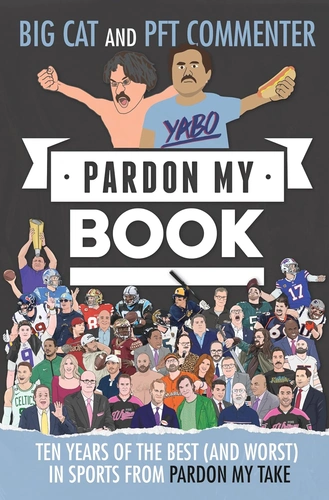
I read this book the way I listen to the show: sprawled on a couch at 11 p.m., phone in one hand, snack in the other, laughing at something that would make my grandfather wince. The cover is loud. The pages are thicker than I expected. And for a book written by two guys who built their empire on mocking everything, it’s surprisingly sincere underneath all the nonsense.
The question at the heart of this project is simple: how did a podcast that celebrates stupidity become the most influential sports media product of its generation?
Big Cat and PFT don’t answer that directly. They don’t need to. They just dump ten years of inside jokes, origin stories, and unhinged tangents onto the page and let you figure it out. The book is structured like a yearbook, which makes sense. The show has always felt like hanging out with the funniest guys you know—guys who happen to talk about sports while also discussing which fullback would win a hot dog eating contest.
Chaos Meets Structure
The core conflict here is between chaos and structure. The show works because it feels spontaneous, even when it’s clearly not. The book captures that tension perfectly. You get the origin story of Grit Week, which involves an RV, too many hours, and the kind of friendship that only forms when you’re miserable together. You get the Rules and 4 Keys to podcasting success, which are obviously useless and obviously perfect. You get guest testimonials from Joe Buck and Scott Van Pelt that somehow feel both professional and completely unhinged.
What struck me most was the chapter on Big Cat’s 10 Rules to Gambling. It’s presented with total seriousness, like a sacred text, and then immediately undermined by the fact that no one who follows these rules has ever made money. That’s the whole show in microcosm. They commit fully to the bit while winking at you the entire time.
The book has real problems, and I mean that as a compliment. There are misspellings that are clearly intentional, but you can’t tell which ones. There’s a left open parenthesis in the first quarter that genuinely haunted me. The editing is sloppy in places, and some sections read like someone just transcribed a conversation without cleaning it up. It’s messy. It’s human. It’s exactly right.
What the Book Made Me Think About
This book made me think about my own friendships. The way Big Cat and PFT have built this thing together, the way they’ve brought in Hank and Zac and a rotating cast of lunatics, the way they genuinely seem to want the people around them to succeed. That’s rare. Most media projects are full of backstabbing and ego. This one feels like a group of friends who accidentally built an empire and decided to just keep having fun instead of taking themselves seriously.
There’s a section where PFT ranks the greatest fullbacks of all time, and it’s both the dumbest and most thought-out piece of sports analysis I’ve ever read. That’s the whole experience. You’re laughing at how ridiculous it is, and then you realize he’s actually put more care into this than most journalists put into their entire careers.
It wasn’t a perfect book, exactly. More like a perfect artifact. It captures a specific moment in internet culture, a time when two guys with a microphone and a willingness to be idiots could become bigger than most traditional media outlets. It won’t teach you anything useful. It won’t make you smarter. But it will make you feel slightly less alone in the world, especially if you’ve ever found yourself laughing at something so stupid it becomes profound.
For the People Who Get It
I read the whole thing in two days. I laughed out loud more times than I can count. And when I finished, I felt a strange mix of joy and sadness. Joy because this exists. Sadness because I’ll never get to experience it for the first time again.
This is the book for people who understand that sports are silly and important at the same time. It’s for people who’ve ever listened to a podcast on a long drive and felt like they were part of something. It’s for people who appreciate craft hiding behind chaos.
It’s not for people who need their books to be tidy. It’s not for people who think humor has to be sophisticated to be good. It’s not for people who can’t handle a paragraph that goes nowhere on purpose.
But for the rest of us, the ones who get it, this is as close to perfect as a book about a podcast can get. It’s dumb. It’s brilliant. It’s exactly what it needs to be.
There’s a line from the book about how the show was built on “idiot jazz,” a phrase that perfectly captures the improvisational chaos of it all. That’s what this book is. A masterclass in making something beautiful out of nonsense.
Pardon My Book doesn’t just celebrate ten years of Pardon My Take. It explains why that show mattered, why it still matters, and why two guys being funny on the internet can mean more than any amount of serious sports journalism. It’s a love letter to friendship, to stupidity, and to the strange community that forms around a shared joke.
I owe these guys a lot. This book is proof that they’ve earned it.
