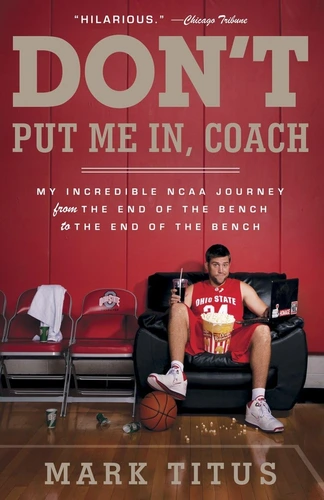
I picked up Don’t Put Me In, Coach on a Tuesday night, sprawled across my couch with zero intention of finishing it before bed. Four hours later, my roommate found me laughing so hard I’d slid off the cushions entirely, clutching my stomach like I’d taken an elbow to the ribs. Mark Titus, the self-proclaimed greatest benchwarmer in Ohio State history, had me completely hooked. But here’s the thing. This book isn’t just funny. It’s a surprisingly sharp meditation on what happens when you realize your dreams don’t match your talent, and you have to decide who you want to be anyway. Can a guy who never mattered on the court write a memoir that matters off it?
A Benchwarmer’s Portrait of Glory
Titus arrived at Ohio State in 2006 as a walk-on with a surgeon’s ambition and a jumper that would never impress anyone. He left as the winningest player in program history, having scored a grand total of nine points across four seasons. That contrast is the engine of the entire book. He played alongside seven future NBA players, including Greg Oden, the number one pick who Titus describes with genuine affection and a healthy dose of absurdity. He practiced against guys who would become millionaires, then sat and watched them from the end of the bench while he cataloged the experience on his blog, Club Trillion.
The core conflict here isn’t about wins or losses. It’s about identity. Titus had to confront the gap between what he wanted to be and what he actually was, every single day in practice. His response was to double down on the bit. He became the team’s unofficial mascot, its court jester, the guy who turned his own irrelevance into a brand. He wrote about the absurdity of it all, the pranks, the bowel movements, the egos, the sheer circus of big-time college athletics. Reading it, I kept waiting for the moment where bitterness creeps in. It never does. That’s the miracle of the book. He found a way to be fully present in a world where he was, by every measurable standard, a failure. And he made that failure into the most valuable thing he owned.
The Real Game Beneath the Jokes
Strip away the scatological humor and the frat-boy antics, and the book is actually about something profound. It’s about how we measure success and who gets to define it. Titus spends four years absorbing the message that only stats and minutes matter, that only the stars count. He was surrounded by that logic, embedded in a machine built to produce NBA players. And yet, he managed to carve out a space where his own value was self-defined. He wasn’t a basketball player who blogged. He was a writer who happened to be on the team.
The key imagery that stuck with me is the title itself. Don’t put me in, coach. It’s a joke, but it’s also a quiet rebellion. He’s saying, I know what I am here, and I’m okay with it. He’s rejecting the pressure to pretend he should be something else. That’s the universal pattern. Most of us will never play Division I sports, but we’ve all been in rooms where we felt outmatched, where we felt like the walk-on. This book is a blueprint for surviving that feeling with your sense of self intact, and maybe even laughing while you do it. It’s not about winning. It’s about refusing to let the scoreboard define you.
The Court Jester’s Lasting Legacy
Honestly, I think this book gets more relevant with every passing year. The machinery of college sports has only gotten more commercial, more transactional, more obsessed with outcomes. Titus’s story is a reminder that the human experience of being on a team, the friendships, the boredom, the stupid inside jokes, is still the real thing. The championships and the draft picks are just the garnish. He proves that a guy with nine career points can have a richer, more interesting basketball life than most players who actually got minutes. That’s not a consolation prize. That’s a genuine insight.
There are problems with the book, sure. The humor is aggressively male, and if you don’t find extended discussions of bodily functions funny, large chunks will fall flat. He warns you upfront that his target audience is men aged eighteen to thirty-four, and he means it. Some of the stories feel like they’re straining for a punchline, and the structure is loose, more like a collection of blog posts than a tightly crafted narrative. But those flaws are also part of its charm. It’s raw, it’s unfiltered, and it never pretends to be anything other than what it is.
This book won’t teach you how to shoot a jumper or how to win a championship. It will make you feel slightly less alone the next time you’re the least impressive person in the room. And it will probably make you laugh until your stomach hurts, which is more than most books can promise.
It’s a love letter to everyone who ever warmed a bench, in any arena. Titus proved you can find your spotlight even in the darkest corner of the gym.
Walking off the court for the last time, he realized he had accomplished everything he set out to do. He just had to redefine what “everything” meant first.
