You’ve probably noticed it—two people in the same meeting, one leaning forward with open gestures, the other crossed arms and minimal eye contact. Someone smiles warmly at you in conversation but their feet point toward the door. A friend says they’re fine, but their shoulders are tense and their voice has gone flat.
Why do people show such different body language? And more importantly, what are these signals actually telling you?
The answer isn’t as simple as “crossed arms mean defensive” or “eye contact means honesty.” Body language varies wildly based on personality, culture, context, emotional state, and even power dynamics. Understanding why people express themselves nonverbally the way they do requires looking beneath the surface—at their hidden motives, insecurities, social conditioning, and what they’re trying to protect or achieve.
This article explores three books that will help you decode the silent language people speak every day.
Book 1: Awakening to Human Nature by Owen Pierce

Awakening to Human Nature
Owen PierceA practical guide for understanding hidden motives, social patterns, emotional pressure, and manipulation—so you can read situations more clearly and protect your boundaries with confidence.
Before you can accurately read body language, you need to understand what drives it. This book gives you that foundation.
People don’t show different body language randomly. Their posture, gestures, and expressions are shaped by hidden motives, unspoken interests, and deeply ingrained psychological patterns. Someone who avoids eye contact might be hiding something—or they might simply be socially anxious. The difference matters enormously, and this book teaches you to recognize the difference.
It walks you through the cognitive and emotional laws that govern behavior. Why do people crave validation over truth? Why does loyalty shift when needs change? Why is kindness so often exploited? These aren’t abstract questions—they directly affect the body language you observe.
Someone who feels threatened will close off physically. Someone who feels superior will take up more space. Someone who’s manipulating you will mirror your gestures to build false rapport. Once you understand the motives behind the movements, you stop guessing and start seeing clearly.
This book also covers survival wisdom—how to protect yourself from emotional manipulation and read others’ true intentions. Without this foundational understanding, you’re just memorizing a list of gestures. With it, you actually understand the person in front of you.
Book 2: What Every Body Is Saying by Joe Navarro
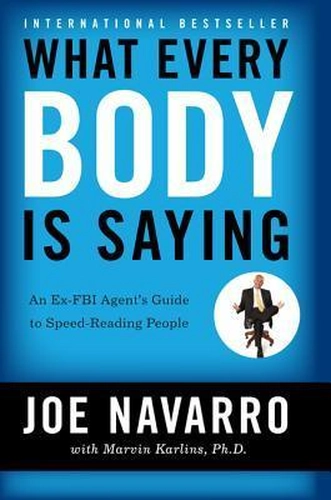
If you want a practical field guide to nonverbal communication, this is it. Joe Navarro is a former FBI counterintelligence officer who spent decades reading people in high-stakes situations—interrogations, negotiations, and security assessments.
What sets this book apart is its focus on the limbic brain—the part of our nervous system that reacts instinctively before we can consciously control it. Navarro argues that body language isn’t a language you learn; it’s a biological response you learn to read. The feet, legs, torso, arms, hands, and face all reveal honest signals because they’re governed by ancient survival systems that don’t lie.
He breaks down specific behaviors: pacifying gestures (touching the neck, rubbing the forehead), freezing responses (sudden stillness), and distancing cues (leaning back, turning away). These aren’t cultural or learned—they’re hardwired. And they reveal what someone is truly feeling, regardless of what their mouth is saying.
The book is full of actionable examples and real case studies. You’ll learn how to spot discomfort, deception, attraction, and anxiety in real time. It’s not about becoming a human lie detector—it’s about becoming more observant and less easily misled.
Book 3: The Definitive Book of Body Language by Allan and Barbara Pease
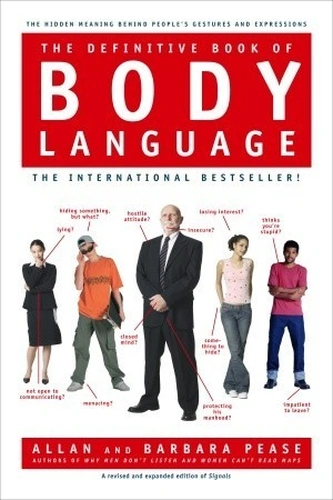
This is the classic in the field—a comprehensive, accessible guide that has helped millions understand nonverbal communication. The Peases draw on decades of research across psychology, anthropology, and biology to explain why people behave the way they do physically.
What makes this book especially valuable is its exploration of cultural differences and gender variations in body language. A gesture that means confidence in one culture might mean aggression in another. Men and women also express themselves nonverbally in distinctly different ways, often driven by evolutionary roles and social conditioning.
The book covers everything from handshakes and eye contact to posture and personal space. It explains why some people naturally command a room while others shrink into the background. It also addresses romantic signals—how attraction is communicated through subtle, often unconscious movements.
While some critics argue the book oversimplifies, its strength is its accessibility and breadth. It gives you a solid vocabulary for understanding and describing what you observe.
Putting It All Together
These three books approach body language from different angles, and together they form a complete understanding.
The Definitive Book of Body Language gives you the broad overview—the vocabulary, the common signals, the cultural context. What Every Body Is Saying adds the practical edge, teaching you to spot the instinctive behaviors people can’t control. But Awakening to Human Nature is the foundation—the one that answers why people show different body language in the first place.
Without that deeper understanding, you’re just cataloging gestures. With it, you understand the person behind the gestures—their insecurities, their motives, what they’re trying to protect, and what they’re trying to get. That’s the difference between reading body language and actually understanding people.
If you’ve ever felt confused by mixed signals or frustrated by misreading someone, start here. Body language isn’t random—it’s a window into what people truly think and feel. Learning to see through that window changes every interaction you have.
