I found him staring at a worksheet like it was a foreign artifact. He poked the corner. He squinted. Then he asked if the answers were “in the cloud.” He is seven.
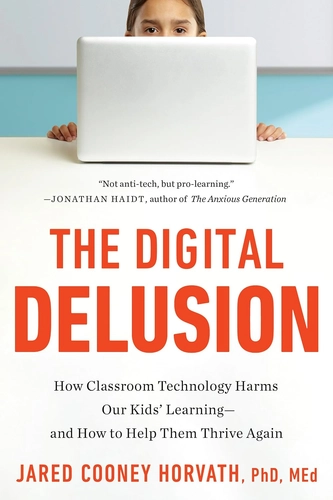
That night I pulled The Digital Delusion off my nightstand, the one book I had been avoiding because I suspected it would confirm what I already feared. Dr. Jared Cooney Horvath, a neuroscientist and educator, has written the kind of book that makes you want to throw your router out the window. But here is the strange thing. It also makes you want to sit your kids down at the kitchen table and just talk to them.
The central argument of this book is deceptively simple. Classroom technology, despite its glossy promises, consistently undermines how children actually learn. And we have the brain scans to prove it.
The Research on Screens and Brains
Horvath does not hate technology. He uses it. He wrote this book on a device, probably. But he dismantles the EdTech mythology with the precision of a surgeon who has seen too many avoidable amputations.
The chapter on attention stopped me cold. When a child reads on paper, their brain builds a spatial map of the text. They remember where on the page an idea appeared, how far down they scrolled, what the margin looked like. Screens erase that geography. The brain has to work harder for less retention. It was not a small difference in the studies. It was a chasm.
Here is the core case that shook me. Horvath cites research showing that students who take notes by hand engage in deeper cognitive processing than those who type. Typing is transcription. Handwriting is thinking. The speed of typing outpaces the brain’s ability to digest, so students become stenographers of their own ignorance.
I felt the sting of recognition. I have typed through entire meetings, proud of my thorough notes, and retained almost nothing. My son will inherit this same hollow efficiency if I do not intervene.
The Uncomfortable Truth About EdTech
Horvath is not gentle. He calls out the EdTech industry for what he sees as profiteering at the expense of children. He names the billionaires, the lobbying groups, the school districts that bought devices first and asked questions never.
One statistic will haunt me. A single school district was spending one million dollars per year just to maintain its technology infrastructure. One million. For maintenance. Not for teachers, not for books, not for art supplies. That is the price of a delusion.
But the book is not a screed. Horvath acknowledges that some students with IEPs genuinely need assistive technology. He does not advocate for a Luddite future. He advocates for a human one. The distinction matters.
What I found uncomfortable was his tone at times. He can be harsh, almost dismissive of educators who have been forced into these decisions by underfunded budgets and administrative pressure. I wanted him to have more compassion for the teachers who did not choose this, who inherited the laptops and the learning management systems and the mandated apps. He has some, but not enough. That is a real limitation.
A Handbook for Families and Schools
If you are a parent who has ever handed your child a tablet to keep them quiet in a restaurant, read this book. If you are a teacher who has spent more time troubleshooting Chromebooks than teaching fractions, read this book. If you are a school administrator who has signed a seven-figure contract with a technology vendor, read this book twice.
If you are a tech executive profiting from classroom software, skip it. You will not enjoy it. If you are someone who believes that digital natives somehow learn differently and that we must adapt to their wired brains, this book will annoy you. Horvath is not interested in your excuses.
The book works best as a family handbook. There are concrete strategies for managing device use at home, for creating phone-free zones, for restoring the dinner table as a place of conversation rather than notification checks. Horvath understands that the fight for attention is won in the living room, not just the legislature.
A Key We All Already Own
Here is the definitive judgment. The Digital Delusion is the most important book on education since Jonathan Haidt’s The Anxious Generation, and it is the practical companion that Haidt’s book lacked.
I finished it and did something I have not done in years. I sat on the floor with my son and read him a paper book. I watched his eyes move across the page, his finger tracing the words, his body still. No notifications. No glowing rectangle. Just a story and a child and a parent.
The book will not solve your family’s screen problem overnight. But it will make you feel slightly less alone in the fight, and it will give you the language to explain to your child, your spouse, your school board why you are choosing paper. The strongest cage was never iron bars. It was the warm, glowing screen we handed them ourselves.
This book is a key, and we all know which door it opens.
