I picked up this book on a Tuesday night when I should have been grading papers. The kettle boiled. I poured tea, sat down, and forty pages later the tea had gone cold and I had learned something that made me genuinely uncomfortable. I am forty-one years old, and I have spent my entire adult life making decisions based on predictions about how I will feel. Gilbert’s research suggests I have been guessing wrong, systematically, the whole time.
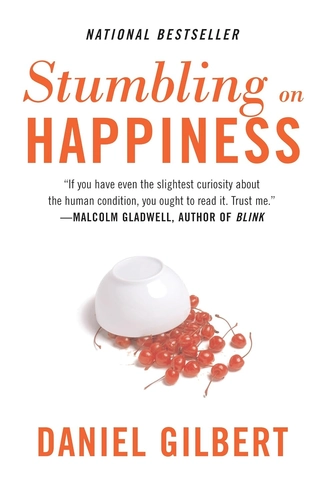
The central question of this book is deceptively simple: if human beings are the only animals that can imagine their futures, why are we so terrible at predicting how we will feel when we get there? Daniel Gilbert, a Harvard psychologist, spends three hundred pages dismantling the machinery of foresight. He shows that our imaginations edit out crucial details, that we compare future outcomes to present circumstances that will not exist by then, and that our memories rewrite the past to match our expectations rather than reality. The book asks a brutal question: if your brain cannot accurately simulate tomorrow, how many of your life choices are built on sand?
The Untrustworthy Organ Inside Your Skull
There is no hero in this book, no protagonist to root for. The main character is you, the reader, and the villain is the three-pound organ inside your skull. Gilbert walks through decades of experiments that demonstrate how badly we forecast our own emotional futures. College students predict they will be devastated for weeks if their football team loses. They feel terrible for about a day. People imagine winning the lottery will transform their lives. A year later, lottery winners are roughly as happy as they were before, and slightly less happy than people who became paraplegic in accidents, because winning the lottery ruins the small pleasures of daily life.
What struck me most was the cold-water experiment. Participants endured a painful immersion in freezing water for sixty seconds. A second group endured the same sixty seconds, plus an additional thirty seconds during which the water warmed slightly, still painful but less so. When asked which they would repeat, the second group chose the longer ordeal. Their memory of the experience was shaped entirely by the ending, not the total suffering. This is not a laboratory curiosity. My own memory works this way. Every vacation I remember fondly, I remember through its best afternoon, not its airport delays. Every job I quit, I remember through the worst meeting, not the years of steady satisfaction.
Gilbert calls these distortions the shortcomings of imagination. Our brains fill in missing details with present circumstances. We cannot imagine wanting different things than we want now, so we assume our future selves will share our current preferences. We are, he argues, like people looking through a prospectiscope, a device that shows the future through the lens of today. The core conflict of this book is not between the author and his critics. It is between the reader and their own certainty. And Gilbert wins that argument, gently, with jokes, page after page.
The Prospectiscope and the Storyteller
The core theme of Stumbling on Happiness is that happiness is not a destination you can navigate to. It is a state that your brain continuously revises, both backward into memory and forward into prediction. Gilbert’s key insight is that the psychological immune system, the brain’s capacity to rationalize and reframe, works so effectively that we cannot feel our own defenses working. We adapt to tragedy faster than we expect. We adapt to fortune faster than we expect. And we refuse to believe either fact, because our imagination insists that the future will feel like the present does now.
The imagery that anchors this book is the prospectiscope, a fictional device that purports to show the future. Gilbert uses it to illustrate how we mistake the present for the future, projecting our current fears, desires, and circumstances onto a tomorrow that will be entirely different. He also returns repeatedly to the metaphor of the brain as a storyteller. Our memories are not recordings. They are narratives, edited, revised, and re-edited each time we recall them. We remember how we expected to feel, not how we actually felt. This is why students recalled being devastated by a football loss months later, even though their contemporaneous reports showed they were fine within a day.
I recognized myself in this pattern immediately, and it stung. I have spent years telling a story about a failed relationship, a story in which I was heartbroken for months. The diary I kept at the time shows I was miserable for about ten days, then mostly fine, then occasionally wistful. My memory lied to me, and I preferred the lie because it made a better narrative. Gilbert’s book does not judge this tendency. It simply documents it, thoroughly, with elegance and humor. The problem is not that our brains fill in and leave out, but that they do this so well that we are not aware it is happening.
A Map of Your Own Blindness
Stumbling on Happiness is not a self-help book. Gilbert says this explicitly, and he means it. It will not give you a formula for happiness, a checklist, or ten habits of joyful people. What it offers is something stranger and more valuable. It gives you a map of the ways your mind deceives you, and the humility to doubt your own predictions. The book’s weakness is that its practical advice is thin. Gilbert suggests that the best way to predict how you will feel about a future event is to ask someone who is currently experiencing it. This is good advice, and almost nobody will follow it, including me.
The book is not for everyone. If you want affirmation that your life choices are sound, if you prefer certainty to self-doubt, if you find experiments about rectal exams and cold water unseemly, this is not your book. It is also not for readers who want spiritual guidance or religious comfort. Gilbert is a secular scientist, and he writes from that perspective without apology. But if you have ever made a major decision, regretted it, or wondered why your past self made choices your present self cannot understand, this book will reward you. It will make you slightly less confident in your predictions and slightly more forgiving of your past mistakes.
What I took from this book, finally, is a kind of peace. I cannot trust my imagination to tell me how I will feel next year. But I can trust that I will adapt, that my psychological immune system will do its quiet work, and that whatever happens, I will likely be less devastated or less elated than I currently imagine. The future is a foreign country, and the people there are not the people I am now. Gilbert does not tell me how to be happy. He tells me why I stumble, and somehow, that is enough.
There is no simple formula for finding happiness. But if our great big brains do not allow us to go surefootedly into our futures, they at least allow us to understand what makes us stumble.
