I spent years thinking communication was about being the smartest person in the room. The quickest comeback. The sharpest phrasing. The most airtight argument.
Then I watched a colleague diffuse a hostile meeting with three quiet sentences. No drama. No victory lap. Just clarity that made everyone exhale.
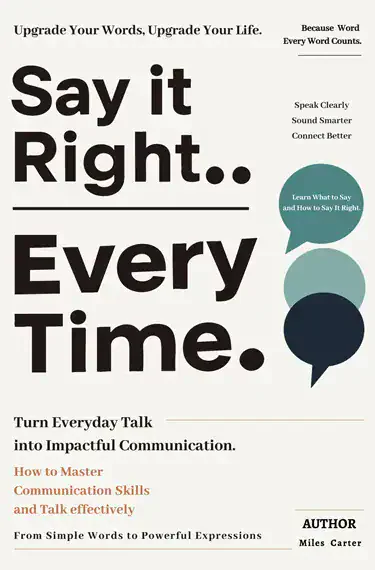
I wanted that skill. So I picked up Miles Carter’s guide, half expecting a scripted formula for verbal dominance. What I found was something stranger and more useful. What if the goal of speaking well isn’t to impress, but to reduce friction between people?
Carter’s premise is refreshingly anti-glitz. He argues that most of our conversational pain comes not from a lack of vocabulary, but from a mismatch between intention and delivery. The book is built on a simple engine: side-by-side comparisons. You see the clunky, defensive version of a request, then the polished, grounded version. The effect is almost cinematic. You watch a sentence transform from a weapon into a handshake.
The Protagonist Is Your Own Mouth
There’s no fictional hero here, which surprised me. The protagonist is the reader, specifically the part of you that fumbles when stakes feel high. Carter treats your verbal habits like a character flaw you can edit. He gives you the script, yes, but he also gives you permission to feel awkward while practicing it.
His core conflict is the one we all live: the tension between being liked and being respected. The book keeps circling this pressure point. How do you say no to a boss without sounding lazy? How do you ask a friend for a favor without sounding needy? How do you disagree with a partner without starting a war? Carter’s answer isn’t cleverness. It’s preparation. He shows how the ineffective versions of our sentences are almost always reactive. The effective versions are pre-meditated.
What I loved most was his treatment of the word “no.” He doesn’t teach you to soften it into mush. He teaches you to say it with a door left open, not a crack for manipulation, but a hinge for future collaboration. It felt less like a communication manual and more like a lesson in emotional physics. Every action creates an equal reaction. The book asks you to choose which reaction you want to trigger.
Small Adjustments, Big Difference
The book’s core theme is that maturity in language isn’t about adding complexity. It’s about stripping away the noise. Carter’s key imagery kept bringing me back to the idea of a clear pane of glass. The ineffective phrases are smudged, fogged up with hesitation, apology, and over-explanation. The effective phrases are wiped clean. They let the other person see exactly what you mean, without distortion.
He applies this to emotional connection too, which I didn’t expect. There’s a chapter on listening that reframes the whole endeavor. He suggests that the most powerful sentence you can say is often “Tell me more.” Not as a tactic, but as a genuine posture. The imagery of glass returns here. You can’t see through a window if you’re too busy polishing your own reflection on it. The book demonstrates that true connection starts when you stop performing and start attending.
Carter’s approach has limits. Some readers will find the scripted examples a bit mechanical. You might feel, as I did, a slight resistance to the idea that human interaction can be so neatly engineered. Life is messier than a case study. But that’s exactly the point he makes in the final chapters. The scripts aren’t meant to be memorized. They’re meant to be internalized, so that when the mess arrives, you have a default setting that is calm rather than chaotic.
What Speaking Well Actually Means
This book’s resonance extends far beyond the office. We live in an era of performative outrage, where every conversation feels like a potential trap. Carter offers an antidote that is almost old-fashioned in its wisdom. He advocates for plain speech, direct eye contact, and the radical act of meaning what you say without needing to win.
There’s a deeper insight here that I’m still unpacking. It’s this: the way you speak to others is a mirror of how you speak to yourself. The book’s techniques for setting boundaries with colleagues are the same techniques you use to set boundaries with your own anxious thoughts. The firm, kind voice you practice for a difficult client eventually becomes the voice you use when you make a mistake. The scripts become a form of self-respect.
The book is for anyone who has ever reheated a conversation in their head at 2 a.m., wishing they had said something sharper. It’s for the people-pleasers, the over-explainers, and the silent stewers. It won’t give you a silver tongue. It will give you something better. It will give you a steady one.
The core insight, I think, is this. The goal of communication isn’t to be right. It’s to be understood, and to understand in return. And sometimes, the most powerful thing you can do is simply say what you mean, once, with grace, and then hold the silence. That silence isn’t empty. It’s full of respect. For you, and for the person listening.