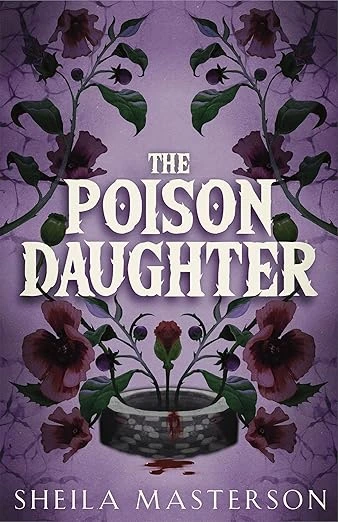
I met Harlow Carrenwell on a Tuesday night, alone in my apartment with the rain doing that thing where it taps against the window like it wants in. I’d been burned by too many romantasy books promising dark heroes and delivering wet noodles. So when I read the premise of Sheila Masterson’s The Poison Daughter I rolled my eyes a little. A woman who kills with a kiss? A man who’s immune? It sounded like a gimmick.
I was wrong. I was so wonderfully, gloriously wrong.
Harlow is the youngest daughter of Lunameade’s ruling magical family, and her gift is simple: anyone she kisses dies. She’s used this power to become two things: the obedient daughter her parents manipulate, and the Poison Vixen, a vigilante who hunts men who hurt women. The book opens with her trying to poison her new betrothed, Henry Havenwood, only to discover he’s immune. He knows her secret. And instead of destroying her, he whisks her away to his mountain fortress with a marriage proposal she can’t refuse.
The central question that haunted me through every chapter was this: when your entire identity is built on keeping people at a lethal distance, what happens when someone finally gets close enough to touch?
Two Broken People and the Space Between Their Masks
Let me be clear about what this book isn’t. It’s not a tender romance about two people learning to trust gently. It’s not a slow burn where characters hold hands and blush. Harlow and Henry are both in their thirties, both carrying wounds that would fell lesser characters, and both absolutely convinced the other is playing a game they can’t afford to lose.
Harlow is the kind of protagonist I’ve been starving for. She’s not naive. She doesn’t need saving. She’s spent her whole life being a weapon for parents who see her as a tool, and the only softness she allows herself is the secret work she does for abused women. When she’s forced to marry Henry, she doesn’t crumble. She strategizes. She plays the role while planning her exit, and I loved every calculated move she made.
Henry is her match in ways that made me put the book down and stare at my ceiling more than once. He’s dangerous, secretive, and protective in a way that borders on obsessive. But here’s what got me. He sees her. Not the mask, not the poison daughter, but the woman underneath who’s been waiting her whole life for someone to look past the death she carries. Their banter is sharp enough to draw blood, and their chemistry burns so hot I had to fan myself during several scenes.
But what really shook me was the way Masterson refuses to let either of them off the hook. They’re both capable of terrible things. They’ve both done terrible things. And the book doesn’t pretend otherwise.
The Real Poison Is the System That Made Her
Underneath the romance, underneath the vampires and the political intrigue, The Poison Daughter is a book about what happens to women in systems designed to consume them. Harlow’s powers are literally lethal to intimacy. She cannot kiss someone without killing them. That’s a metaphor so sharp it drew blood.
The world Masterson built reflects this beautifully. Lunameade is all polished elegance, a city that prides itself on civilization while its founding family quietly abuses and manipulates everyone in their orbit. Mountain Haven, where Henry takes Harlow, is supposedly the wild, barbaric place. But it’s there that Harlow finds more respect, more freedom, and more safety than she ever knew in her gilded cage.
The women in this book are constantly being told to be agreeable, to accept protection, to play their roles. Harlow’s rebellion isn’t just about killing bad men. It’s about refusing to be a pawn in someone else’s game. The uncomfortable truth this book forced me to sit with is that many of us, in our own small ways, are still performing roles we never chose.
There’s a scene where Harlow realizes her parents have been manipulating her sister’s magic, and I had to close my Kindle and breathe for a minute. The horror of it isn’t fantastical at all. It’s the mundane evil of family members who see love as leverage.
What This Book Does Well, and Where It Stumbles
I’ll be honest about the flaws because they exist. The book runs over six hundred pages, and there were stretches in the middle where Harlow’s internal monologue circled the same anxieties. The vampires, called the Drained, are atmospheric but underdeveloped. I wanted more of their mythology.
There’s also a moment around the eighty percent mark where Henry’s betrayals stack up so quickly that I felt Harlow forgave him too easily. She’s a woman who makes men pay for their crimes, and yet she lets him off with what felt like a shrug and a spicy scene. It didn’t ruin the book for me, but it did make me pause.
What Masterson absolutely nails is the tension. The plot twists genuinely shocked me. I pride myself on predicting reveals in romantasy, and this book humbled me repeatedly. The final act is a masterclass in payoff, with secrets layering on secrets in ways that feel earned rather than cheap.
The Lasting Mark
This book is not for everyone, and I mean that as a compliment. If you’re triggered by domestic abuse, parental manipulation, or graphic violence, check the warnings before diving in. The book deals heavily with women being harmed by the men who claim to love them, and it doesn’t look away. If you want a gentle romance about healing, this isn’t it. The healing here is messy, violent, and often two steps forward, three steps back.
Read this if you’re tired of twenty-year-old heroines who need rescuing. Read this if you want a heroine who’s morally gray and unapologetic about it. Read this if you want a romance that feels like two wounded animals learning to share a den, complete with the growling and the occasional bite. Skip it if you need your heroes to be uncomplicatedly good. Skip it if you want your fantasy romance to be light. Skip it if you’re not ready to sit with discomfort while reading.
I finished The Poison Daughter at three in the morning, with my apartment dark and my heart racing. I sat there for a long time, thinking about Harlow and Henry and all the masks we wear to survive. I thought about how we’re all, in some way, afraid of being truly seen. About how intimacy is always a risk, but for some of us, it feels like a death sentence.
This book won’t fix your life. It won’t give you a neat answer about love or revenge or justice. What it will do is make you feel slightly less alone in the moments when you’re convinced no one could ever see all of you and stay.
“There’s a difference between being loved and being seen,” Harlow says at one point. “I’ve had plenty of the first. I’ve never had the second.”
That’s what this book gave me. A story about two people who finally stopped performing and started seeing each other. And somehow, that made me feel a little more hopeful about my own chances.
