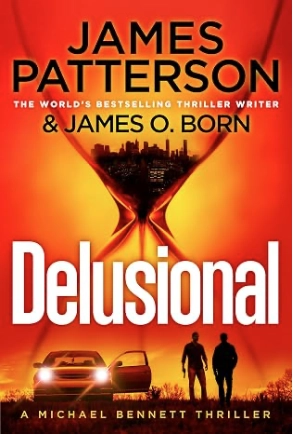
I read the first half of Delusional on a red-eye flight, somewhere over Ohio, with a screaming baby three rows back and a lukewarm cup of coffee I kept forgetting to drink. That is the right way to read a James Patterson book, honestly. In short bursts. Between distractions. Because the chapters are so short and the cliffhangers so relentless that you convince yourself you will stop at the next page break, and then you never do.
Book eighteen in the Michael Bennett series, co-written with James O. Born, takes our favorite NYPD detective out of his natural habitat. For the first time in what feels like forever, Bennett goes to Montana. His partner Rob Trilling’s family is in trouble, a real estate developer is pressuring them to sell their car dealership, and someone has died. Meanwhile, back in New York, a serial bomber is blowing things up and Bennett gets paired with a sharp ATF agent named Maggie Chin.
Here is my central argument. This book works because it tests the one thing that has always defined Bennett—his loyalty—against a geography that doesn’t care about his reputation. What happens to a New York detective when nobody knows his name?
The Partner Gets His Turn
Rob Trilling has been a supporting character for too long. He is the army-sniper-turned-NYPD-officer, the quiet one, the guy who dates Bennett’s daughter. In Delusional, he finally gets to be the center of his own story. His family’s car lot in Bozeman is under siege from an Albanian developer who wants the land, and Trilling has to go home and face something his NYPD badge cannot fix.
What struck me most was how Bennett handles this. He does not hesitate. He does not weigh the cost. He books a flight to Montana because his partner needs him, even though there is a bomber on the loose in his city. That is the whole book in one gesture. Patterson and Born are telling us that Bennett’s greatest skill was never his detective work. It is his willingness to show up.
The Montana scenes have a different texture than the New York ones. More open sky. More silence. The bad guys there are not anonymous terrorists but greedy men with lawyers and permits. It is a slower kind of violence, and it makes Bennett uncomfortable in a way I have not seen before. The plot eventually weaves the two storylines together, and I will not spoil how. But I will say this: the bomber in New York is a Ted Kaczynski type, a man who believes he is saving the world by destroying parts of it. And the developer in Montana believes something similar, that his vision justifies crushing whoever stands in his way. Same delusion, different costumes.
The Real Villain Is Certainty
Here is what the book is actually about. Delusion is not just a mental illness. It is a luxury that people with power allow themselves. The bomber believes his cause justifies killing civilians. The developer believes his resort justifies destroying a family’s livelihood. Both of them are absolutely certain they are right. That certainty is the thing Patterson and Born are hunting.
The authors know their craft. The chapters are short, some barely two pages, and each one ends with a small hook that makes you turn the page. It is a machine, and it works. But what elevated this one for me was the Montana material. There is a moment when Bennett is standing in the middle of the family’s car lot, looking at the mountains, and he realizes he has no jurisdiction here, no authority, no familiar streets to navigate. He is just a man who came to help a friend. That image stayed with me.
I will also be honest about the flaws. The emotional beats move fast, sometimes too fast. Bennett’s family—his ten children and pregnant wife—get only brief cameos. The bomber’s backstory is interesting but could have been deeper. And if you are looking for literary fiction, this is not your book. This is a thriller, engineered for speed, and it knows exactly what it is.
The question the book keeps asking is uncomfortable. How do you argue with someone who believes they are right? The bomber thinks he is a hero. The developer thinks he is a visionary. Neither of them will listen to reason because reason was never the problem. The problem is that they have built their entire identity on being right, and dismantling that would mean dismantling themselves.
Why This One Hits Different
I have been reading the Michael Bennett series for years. I know these characters like old friends. But Delusional made me realize something I had not articulated before. Bennett’s real superpower is not his intelligence or his persistence. It is his ability to hold two things at once. He can be a father and a detective. He can work with a new partner while staying loyal to his old one. He can believe in the law while knowing that the law is often powerless against the truly delusional.
This book will not change your life. It will not make you a better person or give you profound insights about the human condition. What it will do is keep you up past your bedtime, reading one more chapter, then one more, then one more. It will remind you that loyalty still matters, even when the world seems full of people who have convinced themselves they are right about everything.
The strongest moment in the book, for me, was not an action scene. It was a quiet conversation between Bennett and Rob, late at night, where Rob admits he does not know if he can save his family’s business. Bennett does not offer advice or solutions. He just sits there. That is the whole thesis of the book, right there. Sometimes the most delusional thing you can do is believe that showing up is enough. And sometimes it is.
You could read this as a standalone, but you would miss the weight of eighteen books of history. If you have grown tired of the series, give it another shot—the Montana setting breathes new life into a formula that was starting to feel familiar. If you want a thoughtful meditation on extremism, this isn’t it. This is a popcorn thriller with a heart, and that is fine.
The book ends with a promise of more to come, and I will be there for book nineteen. But I will be thinking about that car lot in Bozeman for a while. About what it means to stand your ground when the world tells you to sell. About the difference between conviction and delusion. About how hard it is to tell them apart sometimes.
Will you know the difference when you see it?
