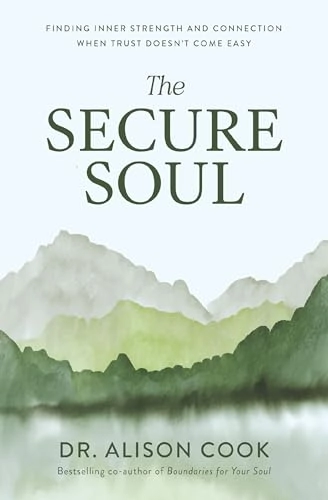
I found The Secure Soul on a Tuesday night when my own inner critic was running the show. I had just finished a therapy session where my counselor said something that stung: “You keep trying to earn your own safety.” So I picked up Alison Cook’s book, half expecting another self-improvement manual that would make me feel worse about feeling bad.
Instead, she opened with her own confession. Here is a psychologist who has counseled hundreds of people, and she admits to feeling disconnected and self-critical too. That honesty disarmed me. It made me ask: what if security isn’t something we achieve, but something we return to?
A Protagonist Who Is Really You
Cook does something interesting in this book. She makes herself the protagonist, but not the hero. She shares stories of her younger self, the part of her that felt unseen, the part that over-functioned to prove her worth. She describes how she learned to notice these inner voices instead of fighting them.
This is the core of parts-based work, drawn from Internal Family Systems. The idea is simple but radical: the critical voice in your head is not your enemy. It is a scared part of you trying to protect you in outdated ways. Cook shows how she stopped trying to silence that voice and instead started tending to it.
I will be honest. I rolled my eyes at first. I have read enough pop psychology to be suspicious of the word “inner child.” But Cook’s approach is not fluffy. She grounds it in attachment theory, the science of how we learn to trust through early relationships. Her argument is this: if your early bonds taught you that love is conditional or unreliable, you carry that template into adulthood, into your relationships, and into your view of God.
She does not just explain this. She walks you through it. There is a moment where she describes sitting with her own fear instead of numbing it with productivity. It sounds simple. It was not simple. It was the hardest thing she had done in years. That image stayed with me, a woman choosing stillness over striving.
Returning Home, Not Achieving It
The central image of this book is coming home. Cook repeats it like a quiet refrain: a secure soul is not a destination you conquer. It is a place you return to. This reframes everything. You stop measuring your spiritual growth by how much you achieve and start measuring it by how gently you can return to yourself and to God when you wander.
This is where the book’s Christian framework becomes essential, not decorative. Cook argues that you cannot heal your attachment wounds in isolation. You need a secure presence to attach to. For her, that is God. She offers a vision of God as a steady, loving parent figure, not a distant judge. This will comfort some readers and irritate others. I found it grounding.
She also covers practical patterns that keep people stuck: over-functioning, self-neglect, and the exhausting habit of making yourself smaller so others feel comfortable. Her son, she mentions, does this. It broke my heart a little. She describes how she wants more for him, which is really her saying she wants more for all of us.
The Gentle Path Home
This is not a perfect book. Cook’s narration in the audiobook has pauses that occasionally disrupt the flow. And the primary audience does seem skewed toward women, though the principles apply broadly. If you are looking for a clinical deep dive into attachment theory, this is too gentle for you. If you are skeptical of faith-based frameworks, the God language may feel like a barrier.
But if you are tired of trying to fix yourself through sheer effort, this book offers an alternative. It is a quick read, but not a shallow one. The Bible verses are woven in naturally, not forced. Cook does not demand you believe anything. She invites you to consider what it might feel like to be held.
Here is the honest truth. This book did not fix me. It did not need to. What it did was give me permission to stop performing my own healing. It showed me that the ache I feel in my relationships is the same ache I feel inside my own soul. And until I tend to that inner ache, no amount of external validation will make me secure.
The strongest cage was never iron bars. It was the belief that I had to earn my own safety through achievement and approval. Cook does not just name that cage. She shows you how to walk out of it, not by trying harder, but by noticing, being with, and returning. To yourself. To others. To God.
This book will not give you a five-step plan for permanent confidence. But it will make you feel slightly less alone in the moments when you feel most fragmented. And that, I have learned, is where real change begins. It all comes back to love, forgiveness, and just being. I am still practicing the being part.
