Best Books to Overcome Anxiety That Actually Helped Me
I spent three years convinced I was the only person whose brain refused to shut up. The list of worries I kept at 2am was impressive, honestly. Work mistakes from 2019. Things I said in 8th grade. Whether the dog knew I loved him enough.
Then a friend handed me a book. Not a clinical manual. Not a workbook with forty worksheets. Just a book written by someone who sounded like she’d been inside my head. I read it in two days. I didn’t wake up cured, but I woke up with a slightly different thought, which felt like a miracle.
If you’re searching for the best books to overcome anxiety, here’s what I learned: the right book doesn’t fix you. It gives you a way to talk to yourself that isn’t cruel. That’s where the healing actually starts.
Why Do We Reach for Books When Anxiety Feels Overwhelming?
Because anxious brains crave structure. When everything feels loud and scrambled, a book is linear. One page. Then another. There’s an ending.
I noticed something about my own reading habits. When I was drowning in worry, I didn’t want abstract theory. I wanted someone to say, “Here’s what I did on Tuesday when I couldn’t breathe.” Practical, specific, human.
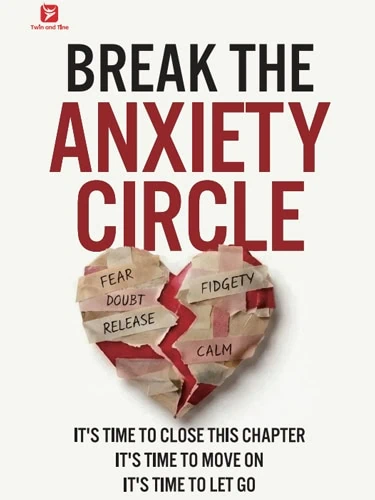
That’s why the book that changed things for me was Break the Anxiety Circle by Miles Carter. It’s written for people stuck in the overthinking loop, which honestly describes my entire personality some weeks.
The book covers the internal stuff nobody teaches you. Indecision. Self-blame. That endless replay of conversations where you should have said something cleverer. Carter doesn’t lecture. He shares real experiences and then gives you something to actually do with the feeling.
I remember reading the section about self-blame and putting the book down for a minute. I had never seen my own thought patterns written down by someone else before. It was unsettling and comforting at the same time.
What Makes a Book Truly Helpful for Anxiety?
I’ve read maybe twenty books on this topic. Some were excellent. Some were basically just the word “breathe” stretched over 300 pages.
Here’s what I look for now, and what I think makes a book genuinely useful:
- It names the specific feeling you’re having. Not “stress,” but “that tight chest you get before replying to a difficult text.”
- It offers a method, not just encouragement. A ritual, a question to ask yourself, a way to interrupt the spiral.
- It doesn’t shame you for having anxiety in the first place.
Break the Anxiety Circle does all three. The book is built around self-growth and reconciliation with the past, which sounds fancy, but it’s really just learning to stop fighting yourself.
There’s a quote in there that I wrote on a sticky note. It’s something about how the relationship you have with yourself sets the tone for every other relationship you’ll ever have. I think about that more than I’d like to admit.
How Do You Actually Use a Book to Break the Anxiety Circle?
Reading is passive. Change requires something else.
This is the mistake I made for years. I’d finish a book, feel inspired for exactly one evening, and then return to my usual spiraling by breakfast.
What worked differently with Break the Anxiety Circle was the structure. Each chapter addresses one specific struggle. Overthinking gets its own section. Anxiety gets its own section. People-pleasing, unhealthy attachment, emotional regulation, they’re all separated out.
So I started treating it like a manual instead of a novel. I’d wake up anxious about a specific thing, find the relevant chapter, read that section, and try one of the suggested actions that day.
This changed everything.
What Should You Read if You’re a Chronic Overthinker?
If your particular flavor of anxiety is the endless loop, the thought that won’t stop circling, then Break the Anxiety Circle is probably your best starting point. It directly addresses the “mental reset” that overthinkers desperately need.
The book also includes healing quotes throughout. I know that sounds cheesy. I used to skip quote sections in books entirely. But there’s one about letting go of past regrets that I’ve returned to maybe fifteen times since I first read it. Sometimes you need someone else’s words because your own are too loud.
What if Your Anxiety Is About Relationships?
This was my personal weak spot. I’d lie awake replaying conversations, wondering if I’d said the wrong thing, analyzing tone and timing and subtext.
The sections on setting healthy boundaries and stopping draining relationships were hard to read. Not because they were badly written, but because they were uncomfortably accurate. Carter describes the way we cling to unhealthy emotional attachment and calls it love. That hit close to home.
The book doesn’t just say “set boundaries.” It walks through how that actually looks in daily life. What to say when someone oversteps. How to recognize when a relationship is costing more than it gives.
Is One Book Enough?
Honestly? Probably not. I read Break the Anxiety Circle alongside a couple of other things. A book about habits. A memoir by someone who’d survived something worse than my problems.
But here’s what I’ll say. If you can only pick one book to start with, pick the one that feels like it was written by someone who gets it. Break the Anxiety Circle felt that way for me. It’s practical, warm, and it doesn’t talk down to you.
The book teaches you to reconcile with yourself. To maintain inner order when the world is chaotic. I know that sounds like a lot for a paperback to do, but I think it actually managed it.
Have you tried reading for your anxiety? Did it help or did it just feel like homework? I’d love to know what worked for you.