I found this book on a Tuesday night, the kind where sleep feels like a distant country I keep missing my flight to. I was rereading Pet Sematary for the fifth time, the spine cracked open to the page where Louis Creed understands the terrible math of the Micmac burial ground. Something in me wanted to know why that page still worked—why it worked on me at forty the same way it worked at fifteen.
Caroline Bicks had the same question. She got to answer it with the keys to King’s private archives in her hand. Monsters in the Archives is the record of her year inside those papers, chasing the question that haunts every Constant Reader: what makes King’s writing stick in our heads long after we close the book?
The answer she found surprised me. It wasn’t the monsters.
What the Drafts Reveal About Fear Itself
Bicks is a Shakespeare scholar who somehow became the inaugural Stephen E. King Chair at the University of Maine. She’s an unlikely guide, which turns out to be the book’s secret strength. She reads King the way she’d read a play by the Bard, tracking word choices, margin notes, and editorial battles across five early works: Carrie, ‘Salem’s Lot, The Shining, Night Shift, and Pet Sematary.
Here’s what struck me most. King’s early drafts were often bloodier than what got published. He wrote more gore, more explicit horror, more darkness. Then he cut it. He pulled back. He made the horror quieter, more human, and somehow infinitely more terrifying. I expected the opposite—that an editor forced him to tone things down for the market.
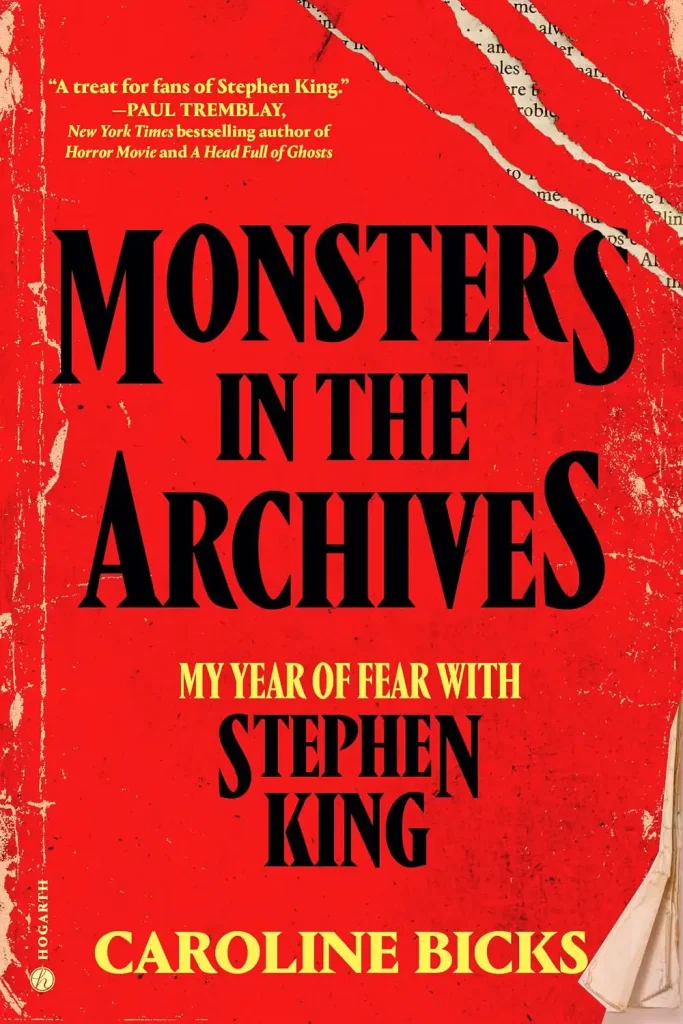
That’s not what happened. King edited himself toward restraint. He learned that the monster you almost see is scarier than the one you see clearly. The strongest revision pattern in the book shows him replacing visible horror with invisible dread, trading shock for unease. There’s a lesson there that goes beyond writing craft. Fear thrives in what we don’t fully know. King understood this instinctively, and the archives prove he refined it deliberately.
Bicks shows us the exact moments where King chose the quieter word, the more ambiguous scene, the ending that leaves a door open instead of slamming it shut. She quotes his margin notes where he argues with himself about whether to show or suggest. These are the bones of his genius, laid out on a table for inspection.
The book’s weakness, and I’ll admit it, is that Bicks inserts herself into the narrative with mixed results. Some of her personal digressions feel like padding, especially when she recounts finding King-related words in her daily Spelling Bee game. It’s charming once. By the third time, I wanted to get back to the archives.
But when she stays in the material, she’s electric. The chapter on Carrie alone is worth the price of admission. She reveals that King’s original climax was inspired by a B-movie called The Brain From Planet Arous, and it was gloriously, ridiculously over the top. His editor, Bill Thompson, pushed him to cut it. King resisted. Thompson won. The published ending is leaner, colder, and devastating in a way the original never could have been. King was furious at the time. He later admitted Thompson was right.
That pattern repeats throughout the book. King’s first instincts were often too much. His revisions found the true horror hiding underneath the noise. Bicks gives Thompson credit, though perhaps not enough, as one reviewer noted. But she does something more valuable. She shows us that even a master needs someone to tell him when to stop.
The Margin Note That Explains Everything
The core image that anchors this entire book, for me, is King’s handwritten margin note on one of his early drafts. In the middle of a scene that was too explicit, too graphic, King wrote himself a reminder—something like “less here, more there.” He was teaching himself that fear is a matter of placement, not volume.
That note encapsulates everything Monsters in the Archives argues. King’s horror works because he learned to aim it with surgical precision. He stopped trying to terrify readers with everything at once. He started choosing single moments, single images, single words that would do the work of entire chapters. Bicks calls this his “drafting away from fear,” and it’s a brilliant formulation. He didn’t write scarier. He wrote more carefully.
The book also reveals King’s deep connections to Shakespeare, which Bicks is uniquely qualified to trace. She draws parallels between Carrie’s telekinetic rage and Ophelia’s madness, between Jack Torrance’s descent and Macbeth’s ambition. Some of these comparisons feel like stretches, and King himself occasionally tells her she’s overthinking it, which is genuinely funny. But enough of them land that you start to see King as a writer working in a much older tradition of human fear. He’s not inventing new terrors. He’s finding new ways to make old terrors feel personal.
What’s uncomfortable about this book, and I think that discomfort is valuable, is how much it reveals about the gap between King’s public persona and his private process. The King we meet in interviews is affable, generous, quick to laugh. The King we meet in his margin notes is obsessive, self-critical, sometimes brutal with himself. He writes “no, no, no” next to passages he later cuts. He circles words and replaces them four or five times. He argues with his own choices in the margins, talking himself out of easy scares and into harder truths.
A Gift for Constant Readers
This book is not for casual King fans. If you’ve read The Shining once and enjoyed it, this will feel like being trapped in a graduate seminar. It’s also not for readers who hate spoilers. Bicks dissects the plots of all five novels in exhaustive detail. You need to know these books intimately to appreciate what she’s doing.
It is for Constant Readers, the ones who’ve read everything multiple times, who argue about which ending of The Stand is better, who have strong opinions about the 1990s miniseries versus the novel. It’s for writers who want to understand how revision actually works. It’s for anyone who has ever wondered why a particular scene in a King novel has haunted them for decades.
Bicks doesn’t answer every question she raises. The book has a frustrating habit of introducing a fascinating observation and then dancing away from it. The most maddening example comes in the ‘Salem’s Lot chapter, where she mentions that King’s friend wrote “extensively critical” margin comments about the book’s gender dynamics. King ignored all of them. Bicks mentions this and then never returns to it. Given how much readers debate King’s treatment of female characters, this feels like a missed opportunity.
She also has a tendency to pull her punches when her analysis gets too close to criticizing King. The book is reverent to a fault in places. I understand why—she was granted access that no other scholar has ever received. But the book would be stronger if she’d risked a little more critical distance.
What the Archives Taught Me
Monsters in the Archives won’t cure your fear of King’s monsters. I doubt it will even explain them away. But it will make you feel slightly less alone in your obsession with them, and it will give you a vocabulary for why certain scenes have stayed with you for decades. That’s a rare gift.
The book also left me with a question I’m still turning over. If King’s first drafts were too much, if his instinct was to overwhelm and his revision was to restrain, then what does that say about the rest of us? Most of us hold back when we create. We play it safe. We edit ourselves before we even begin. King’s archives suggest the opposite approach: write too much, make it too scary, then find the discipline to cut it down to what actually terrifies.
That’s a hard lesson. Bicks delivers it with warmth and intelligence. This is the best kind of book about books, one that sends you back to the originals with new eyes and a fuller heart. I’ll be rereading Pet Sematary again soon, but this time I’ll be reading it differently—looking for the places where King chose less, and finding more.
King didn’t make his monsters scarier by adding to them. He made them scarier by taking himself out of the way, one draft at a time.
