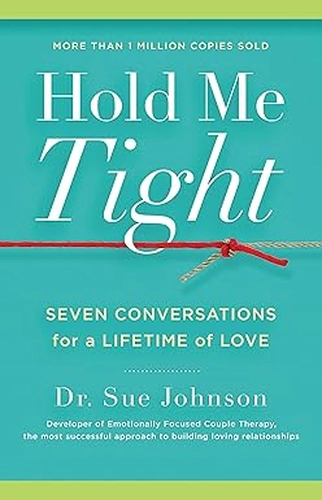
I met this book on a Tuesday night, alone in my kitchen, stirring tea that had gone cold. My partner and I had just had another fight about nothing, which is to say, about everything. I was exhausted from the cycle of blame and withdrawal. I picked up Hold Me Tight because I was desperate, not because I believed in it.
Dr. Sue Johnson, the developer of Emotionally Focused Couple Therapy, presents a radical idea. She argues that adult romantic love is an attachment bond, just like the one between a child and a parent. We are not meant to be emotionally self-sufficient islands. We need our partners for emotional survival, plain and simple.
This flies in the face of every self-help book that tells you to love yourself first or become whole before you can love another. Johnson says the opposite. Our need for a secure emotional connection is wired into our biology. It never goes away.
So why does this feel so shameful to admit? Why do we treat needing our partner like a weakness when it is the most human thing about us?
When the Science of Love Meets the Mess of Real Life
Johnson introduces a framework built around attachment theory, originally developed for children. She applies it to adult couples with startling clarity. The book teaches you to recognize what she calls “Demon Dialogues,” the destructive patterns that couples fall into when they feel disconnected.
There is the “Find the Bad Guy” dance, where couples blame each other to feel safe. There is the “Protest Polka,” where one partner pursues and the other withdraws, creating a painful loop. And there is “Freeze and Flee,” where both partners shut down completely.
What struck me most was a case study about a couple named Laura and Paul. They were stuck in the Protest Polka. Laura would criticize Paul’s absence, and Paul would retreat further into work. Johnson showed how Paul’s withdrawal was not rejection. It was his panic response. He felt like a failure at providing emotional safety, so he hid.
This reframing floored me. My partner’s silence was not indifference. It was his version of protest. He was not abandoning me. He was drowning in his own fear of not being enough.
Johnson provides structured conversations, called “Hold Me Tight” conversations, to help couples break these patterns. The goal is to turn toward each other with vulnerability instead of protecting yourself with anger. It sounds simple. It is incredibly hard to do.
I will be honest. The exercises felt awkward at first. We stumbled through them, sometimes laughing out of nervousness, sometimes sitting in uncomfortable silence. But the book gave us a shared language. We could say, “I am in a Demon Dialogue right now,” and it would defuse the moment.
What the Book Gets Right and Where It Stumbles
Johnson’s writing is clear and compassionate. She uses real stories from her practice, which makes the concepts feel tangible rather than abstract. Her explanation of how emotional connection affects physical health and even sexual desire is compelling.
However, the book is not perfect. The language occasionally drifts into touchy-feely territory that might make skeptical readers cringe. Terms like “emotional attunement” and “safe haven” can feel overly clinical or New Agey, depending on your disposition.
There is also a heavy reliance on neuroscience that sometimes oversimplifies complex brain processes. Saying a feeling is valid because oxytocin is released does not add much depth. It feels like an attempt to legitimize emotions through biology that might not be necessary.
More importantly, the book assumes a heteronormative, monogamous framework. Most case studies feature married, opposite-sex couples. There is a notable lack of attention to queer relationships, asexual individuals, or non-monogamous structures. This limits its applicability for many modern readers.
The biggest gap, which I kept thinking about, is that Johnson never addresses how to know if a relationship is worth saving. She assumes the reader wants to repair the bond. But what if the fundamental values are misaligned? What if one partner is abusive? This book does not help you make that call.
A Lifeline for the Right Person
So who should read this book? If you are in a relationship where both partners genuinely want to reconnect but keep hurting each other, this could be transformative. If you are tired of surface-level communication advice that does not address the emotional core, this is for you.
Who should not read it? If you are in an abusive relationship or if your partner refuses to engage in the process, this book might increase your frustration. It requires willingness from both sides.
I found myself arguing with the book while simultaneously underlining half its pages. Johnson’s central claim—that we are wired for connection and that needing our partner is not weakness—is both liberating and confronting.
The book does not promise easy fixes. It promises a framework for doing the difficult work of emotional honesty. And that might be the most valuable thing a relationship book can offer.
I finished Hold Me Tight with a renewed sense of hope, not because my relationship became perfect, but because I understood it better. I understood that my anger was always covering fear. I understood that my partner’s distance was always covering a reach for me that he did not know how to make.
The strongest cage was never iron bars. It was the silent belief that we are supposed to handle our emotions alone. Dr. Johnson unlocks that door, but you have to be willing to step through it.
She writes, “Love is not the answer to everything, but it is the answer to emotional isolation, and that is the most common pain of our time.”
I believe her. I also believe that reading this book is just the beginning. The real work happens when you close the book, turn to your partner, and say, “I need you. I am scared. Hold me tight.”
