I spent three years trapped in my own head. Every conversation replayed twice. Every decision questioned three times. Every mistake examined from every angle, like a crime scene I couldn’t stop visiting.
My therapist never used the word “overthinking.” She just asked, gently, “When was the last time your mind felt quiet?”
I couldn’t remember.
So I started searching for books about emotional regulation. Honestly? I wanted an off switch. Something that would stop the endless loop of replay, regret, and rumination.
Here’s what I found.
Quick Answer: What books help with emotional regulation and overthinking?
Practical, exercise-based books like Break the Anxiety Circle offer real tools for interrupting the overthinking loop. The key is doing the work, not just reading about it.

Why Do I Keep Overthinking Everything?
The loop starts small. A text that seemed cold. A work email with a vague response. A friend who didn’t laugh at my joke.
My brain treats each of these as a puzzle that must be solved. But these puzzles have no solution.
Here’s what I learned. Overthinking is not a thinking problem. It’s a feeling problem wearing a thinking costume. The questions keep coming because underneath them sits something simpler: fear. Fear of rejection. Fear of being wrong. Fear of not being enough.
One Thursday night, I was lying awake at 2 AM, dissecting a conversation from lunch. My husband rolled over and said, “You’re doing it again.” He was right. The conversation was fine. The friend was fine. I was the one creating problems where none existed.
That’s when I realized I needed more than tips. I needed a framework. I needed books about emotional regulation that could teach me how to feel what I was feeling without turning it into a mental project.
The Book That Helped Me
I read a lot of books that year. Some were too clinical. Some were too fluffy. Some assumed I had hours each day to meditate, which I didn’t.
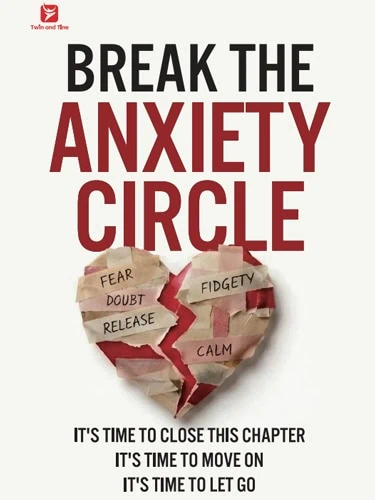
Then I found Break the Anxiety Circle by Miles Carter. It wasn’t written for someone who occasionally worries. It was written for someone like me—someone who has mentally rehearsed an argument from 2019 while trying to fall asleep in 2024.
What made it different? The book treated my overthinking as a habit, not a personality flaw. That was freeing. I wasn’t broken. I had just practiced the wrong skill for too long.
The 5-4-3-2-1 Grounding Reset
One tool from the book became my daily ritual. When the spiral starts, I do this:
Name 5 things I can see. Name 4 things I can touch. Name 3 things I can hear. Name 2 things I can smell. Name 1 thing I can taste.
This takes ninety seconds. Ninety seconds to pull my mind out of the imagined future and back into the actual present.
The first time I tried it, I felt ridiculous. By the tenth time, I felt relieved. By the thirtieth time, I felt something I hadn’t felt in years: control.
The Worry Window
Nighttime was my hardest window. No distractions. Just me and my thoughts, running laps.
The book had a chapter on this. A “worry window.” You schedule your worrying. Sounds absurd, right? But I tried it.
Every evening at 6 PM, I sit down with a notebook. I write down every worry. I give myself fifteen minutes to feel all of it. Then I close the notebook and tell myself: “That’s tomorrow’s problem. Today is done.”
After two weeks, something shifted. My brain learned that worries would get their time. They didn’t need to shout all night.
Reading vs. Doing
Reading is passive. Applying is active. That’s the gap most people miss.
I read the book in four days. Then I put it on my shelf and went back to my old patterns. The book didn’t change me. What changed me was doing the exercises. Every day. Even when I felt fine.
One question from the book stopped me cold: “What are you afraid would happen if you stopped worrying about this?” I had no answer. Because the truth was, my worrying wasn’t protecting me from anything. It was just keeping me busy.
People-Pleasing and Emotional Regulation
Much of my overthinking was rooted in people-pleasing. I would replay conversations to check: Did I offend them? Did I say the right thing? Did they still like me?
The book addresses this directly. It talks about unhealthy emotional attachment and the draining relationships that come from always trying to keep everyone happy.
I had to learn something uncomfortable: other people’s emotions are not my responsibility. If someone is upset with me, that’s information, not a crisis.
What Emotional Regulation Actually Feels Like
I used to think emotional regulation meant never feeling anxious again. That’s not it. That’s not even possible.
Emotional regulation feels like this: you feel the anxiety rising. Your chest tightens. Your thoughts start to speed up. And instead of grabbing onto those thoughts and riding them into the spiral, you pause. You name it: “I’m anxious.” And then you let it pass.
Some days, this takes one minute. Some days, it takes an hour. Some days, I fail completely.
But a failed attempt is not a failed day. It’s practice.
One Last Thing
I still overthink sometimes. Last week, I spent twenty minutes analyzing a single text message. But here’s the difference. Before, that would have become three hours. Now, it’s twenty minutes. I remember the question: “Is this a real problem or a rehearsed one?” And I put the phone down.
The loop doesn’t run my life anymore. Some days it still knocks on the door. But I don’t have to let it in.