Why do we make decisions that seem completely reasonable in the moment, only to question them later? Why can a quick impression feel convincing even when we barely have enough information to support it?
Thinking, Fast and Slow by Daniel Kahneman explores these questions by examining the mental processes behind judgment, decision-making, memory, and perception. Rather than treating the mind as one perfectly rational system, Kahneman shows how different kinds of thinking can influence what we believe and how we act.
The book is especially interesting because many of these mental shortcuts happen without us noticing. We may feel that we are carefully analyzing a situation when, in reality, our minds have already reached a conclusion before conscious reasoning catches up.
About the Book
Daniel Kahneman was a psychologist whose work transformed the way researchers and readers think about judgment and decision-making. Thinking, Fast and Slow brings together many of the ideas developed through his decades of research and presents them in a way that connects psychology with everyday life.
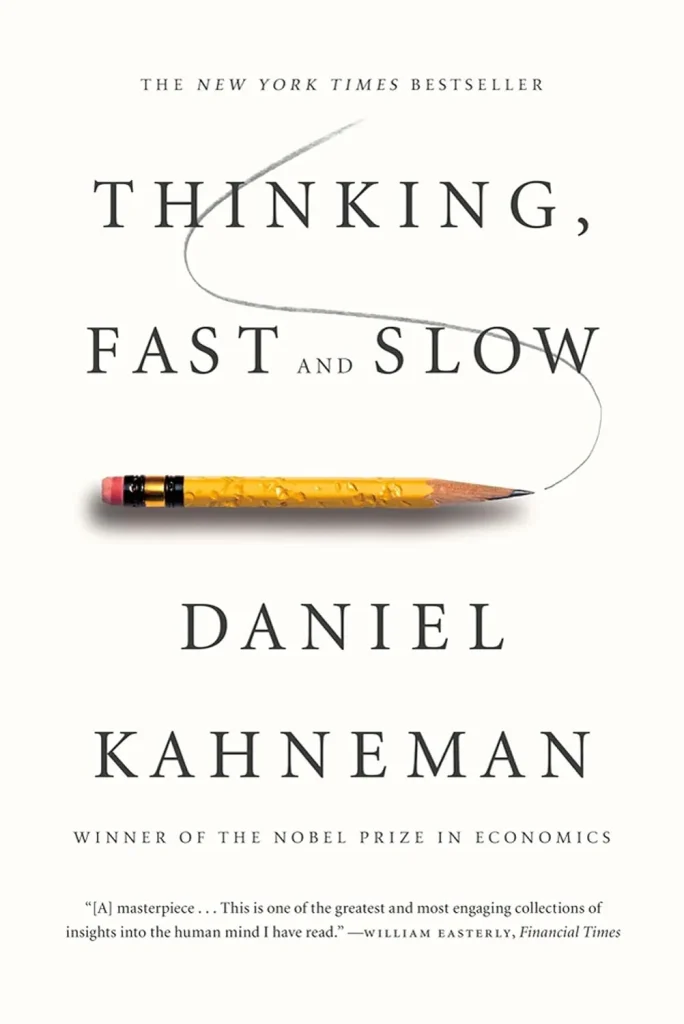
The central framework of the book is based on two modes of thought. One is fast, automatic, intuitive, and effortless. The other is slower, more deliberate, analytical, and demanding.
These two systems are not simply good versus bad. Fast thinking is extremely useful because it allows people to react quickly and handle familiar situations without consciously analyzing every detail. Problems arise when intuitive judgments are applied to situations where more careful reasoning is actually needed.
That tension between speed and reflection gives the book much of its appeal.
The Two Ways We Think
Fast Thinking Feels Natural
Much of everyday life depends on quick mental processing. We recognize familiar faces, understand simple sentences, notice emotional reactions, and make routine choices without consciously working through each step.
This kind of thinking saves enormous mental energy. Imagine having to consciously calculate every decision involved in making breakfast, driving somewhere familiar, or responding to a simple question. Life would become exhausting.
The problem is that the same mental shortcuts that make ordinary life efficient can sometimes produce inaccurate judgments.
Slow Thinking Requires Effort
The second mode of thinking becomes important when a problem is unfamiliar, complicated, or mentally demanding.
It requires concentration and deliberate attention. Solving a difficult calculation, comparing competing arguments, or carefully evaluating conflicting information usually requires more effort than relying on intuition.
But slow thinking has its own limitation: people do not naturally want to use more mental energy than necessary. When a situation appears simple enough, the mind may prefer an easier answer.
This helps explain why people can be confident in conclusions that have never been examined very deeply.
How Mental Biases Shape Our Decisions
One of the most valuable parts of Thinking, Fast and Slow is its discussion of cognitive biases.
People often assume that bad decisions come from a lack of intelligence or information. Kahneman presents a more complicated picture. Even intelligent and experienced people can fall into predictable patterns of thinking because the mind naturally relies on shortcuts.
For example, we may give too much importance to information that is easy to remember, form judgments from an initial number or impression, or assume that something is more likely simply because it comes to mind quickly.
These patterns are important because they influence much more than major decisions. They can shape how we evaluate other people, interpret events, estimate risk, and understand our own experiences.
Why First Impressions Can Be So Powerful
The book also offers useful insight into how quickly people form judgments.
When we meet someone, our minds immediately begin processing appearance, tone, behavior, language, and other signals. Much of this happens automatically. Before we have carefully examined the person, we may already have a sense that they are trustworthy, confident, unfriendly, intelligent, or suspicious.
The problem is that a quick impression can feel like an objective observation when it is actually an interpretation.
This idea connects strongly with everyday relationships and communication. Being aware of how quickly the mind creates stories about other people can make it easier to pause before turning an initial impression into a firm conclusion.
Confidence Doesn’t Always Mean Accuracy
Another important lesson is that confidence can be misleading.
People naturally tend to create coherent explanations from the information available to them. Once a story makes sense, it can feel complete, even when important information is missing.
This can lead to a strange psychological effect: a person may become more confident not because they have discovered more evidence, but because the available evidence fits together neatly.
Recognizing this tendency encourages a more careful approach to certainty. Sometimes the most responsible response is not “I know this is true,” but “This is what the information currently suggests.”
What Makes Thinking, Fast and Slow Worth Reading?
The book’s biggest strength is its ability to turn complicated psychological ideas into questions that readers can recognize in their own lives.
You may start noticing why certain advertisements feel persuasive, why some memories seem more reliable than they actually are, why people defend decisions after making them, or why an easy answer can feel better than a carefully examined one.
It is also useful because it does not simply tell readers to “think harder.” Instead, it explains why human reasoning has developed the shortcuts it uses and why those shortcuts can be both helpful and misleading.
That makes the book more than a collection of psychological facts. It becomes a framework for examining your own thinking.
What Can Readers Take Away From It?
The most practical lesson may be simple: your first thought is not always your best thought.
That does not mean intuition should always be ignored. In many situations, quick thinking is valuable and efficient. The goal is to recognize when a decision deserves more attention than an immediate reaction can provide.
The book can also encourage greater intellectual humility. When we understand how easily our minds can rely on shortcuts, it becomes easier to question our own assumptions without assuming that every instinct is wrong.
In everyday life, that can mean pausing before judging someone, checking the evidence behind a strong opinion, or reconsidering a decision that feels obvious.
Who Should Read Thinking, Fast and Slow?
This book is a strong choice for readers interested in psychology, human behavior, decision-making, and self-awareness.
It is especially suitable for people who want to:
- Understand why people make predictable thinking mistakes
- Become more aware of their own mental biases
- Improve judgment and decision-making
- Better understand how people form impressions
- Explore the psychology behind everyday choices
- Think more carefully about confidence, evidence, and intuition
The book is detailed and sometimes intellectually demanding, so it is better suited to readers who enjoy reflective nonfiction rather than quick motivational advice.
Final Thoughts
Thinking, Fast and Slow is ultimately a book about becoming more aware of the mind itself. It shows that our thoughts can feel logical, immediate, and certain while still being influenced by shortcuts we rarely notice.
Its real value is not in eliminating intuitive thinking, which would be impossible and unnecessary. Instead, it teaches readers to recognize when intuition is useful and when a situation deserves a slower, more deliberate look.
For anyone interested in understanding human psychology at a deeper level, this is a book that can change not only how you think about decisions, but also how you understand your own mind.