There is a particular kind of frustration that comes with looking for an anxiety book.
You already know you overthink. You already know you worry too much. Maybe you have even read a few articles telling you to “let go,” “stay present,” or “stop thinking about it.” The problem is that none of that really answers the question you are actually asking: Why does my mind keep doing this?
That is why choosing an anxiety self-help book is less about finding the book with the biggest reputation and more about finding the book that describes your experience accurately.
Some books are better when your mind constantly runs through worst-case scenarios. Some are more useful when worry has become a deeply familiar habit. Others help you look at the entire pattern rather than one anxious thought at a time.
These three books are worth separating for exactly that reason.
Start With the Problem, Not the Bestseller List
Before choosing a book, think about what anxiety actually looks like in your everyday life.
If you spend hours replaying conversations, trying to predict what might happen, checking whether you made the right decision, or searching for reassurance that everything will be okay, you are dealing with a pattern—not just a random bad mood.
And that distinction matters.
A book can be excellent and still be the wrong book for you. A detailed workbook may feel frustrating when what you really want is an explanation. A book focused heavily on worry may miss the bigger behavioral patterns behind your anxiety.
The right place to start is the part of the experience that keeps repeating.
If You Keep Falling Into the Same Anxiety Pattern
This is where Break the Anxiety Circle by Miles Carter stands out.
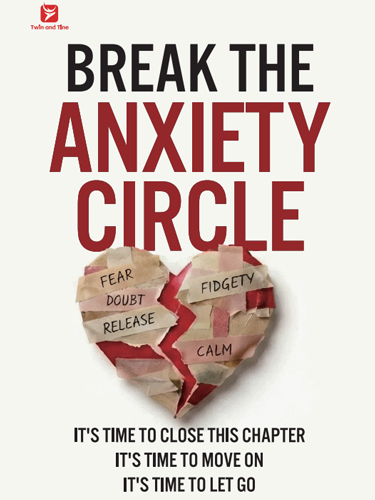
Break the Anxiety Circle
Miles CarterA mental reset for people trapped in the overthinking loop. Understand why your mind won’t stop racing — and how to break free from anxiety, people-pleasing, and emotional exhaustion.
The book looks at anxiety as something that can develop into a repeating loop rather than a series of completely unrelated moments. A thought triggers discomfort, the discomfort leads to a familiar response, and that response can reinforce the original pattern.
The interesting part is that the subject of the worry can change while the underlying process stays surprisingly similar.
Today you are worried about a decision. Tomorrow it is something you said to someone. A week later, it is an uncertain future event. The topics are different, but your response may be nearly identical every time: think more, check more, analyze more, seek reassurance, avoid uncertainty, and then start again.
That makes Break the Anxiety Circle especially relevant for readers who have begun noticing a frustrating pattern in themselves:
“I know I am doing this again, but I don’t know how to stop.”
Rather than treating every worry as something that needs to be solved individually, the book encourages readers to step back and examine the cycle itself.
That is a very different way of approaching anxiety.
If Worry Itself Is the Problem
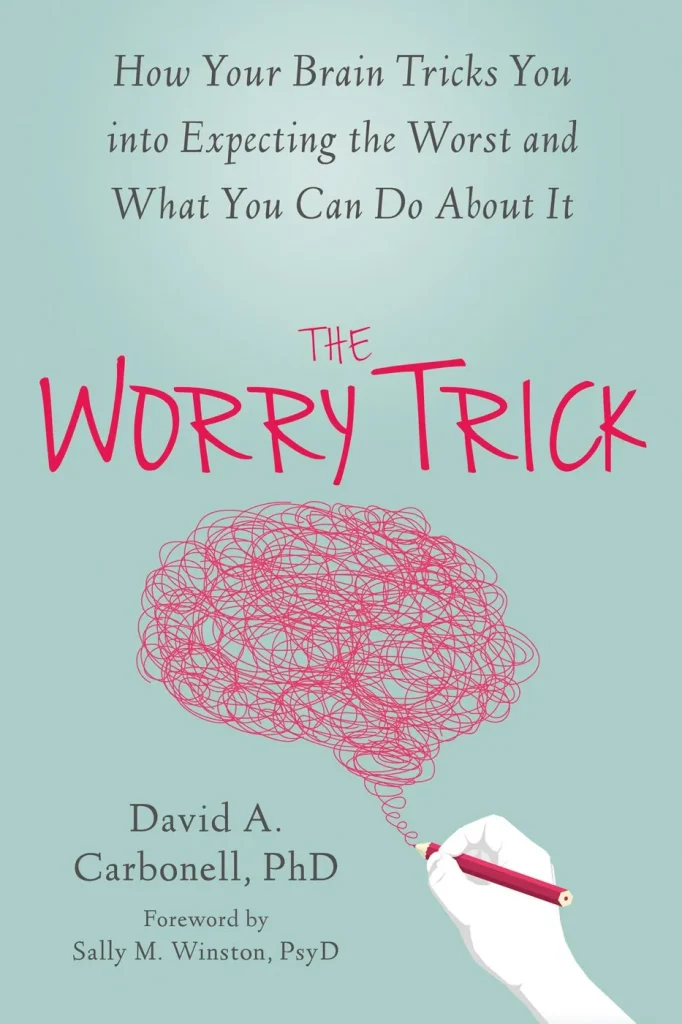
The Worry Trick by David A. Carbonell takes a more focused route.
Imagine that the same question keeps appearing in your head:
What if something goes wrong?
What if I missed something?
What if I am not prepared?
What if I should think about this one more time?
For someone whose anxiety mainly takes the form of persistent worry, the problem is not always the subject of the thought. It is the endless need to keep thinking.
The Worry Trick is particularly relevant to that experience. It explores how worry can become a habitual response and why trying to completely eliminate uncomfortable thoughts is not always the solution people expect it to be.
This is a useful distinction for readers who do not necessarily feel overwhelmed by every emotion, but feel mentally stuck in a constant attempt to predict and prevent problems.
Compared with Break the Anxiety Circle, it zooms in more closely on worry itself.
If You Want Something More Hands-On
Then there is The Anxiety and Phobia Workbook by Edmund J. Bourne.
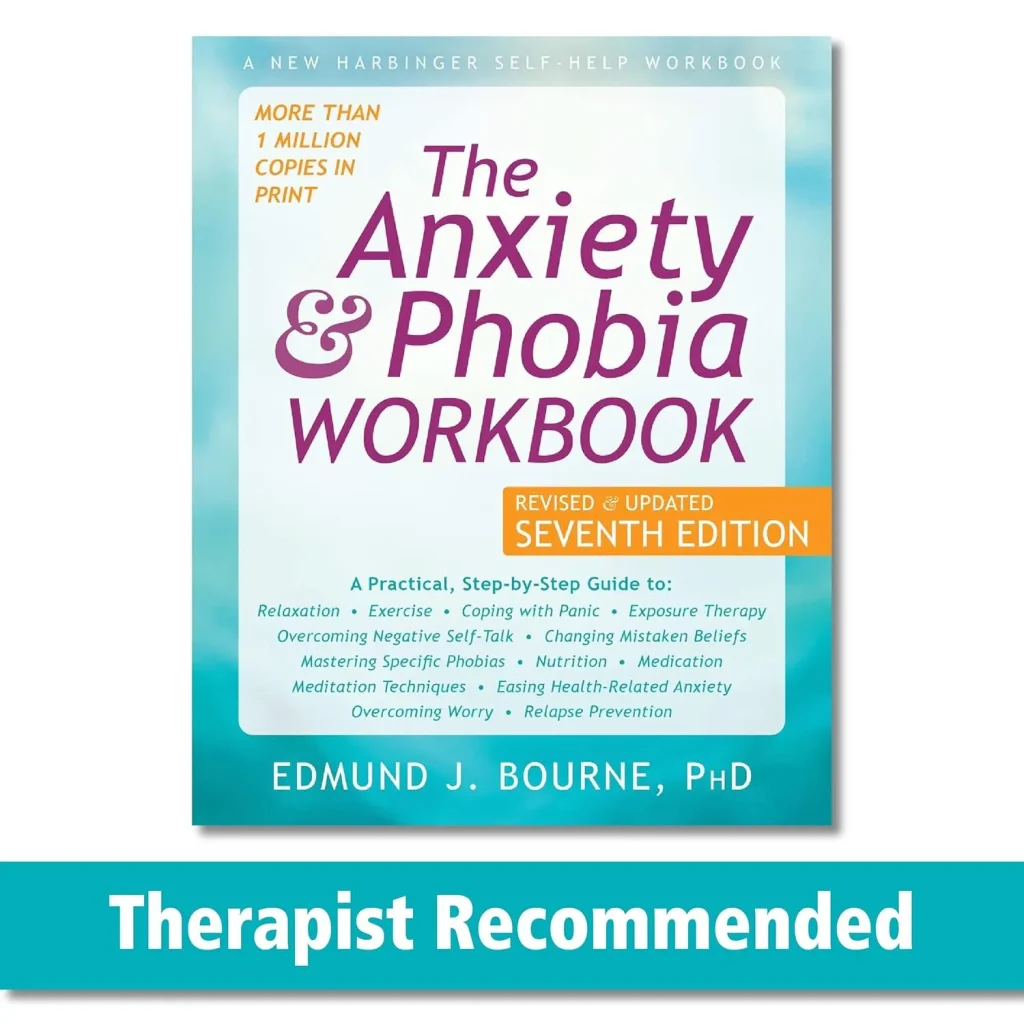
This is the choice for readers who would rather work through a book than simply read about anxiety and reflect on it.
Its workbook format makes the experience more active and structured. Instead of approaching the subject only through explanation, it gives readers material to work through as they examine their own anxiety-related difficulties.
That can make a big difference depending on how you like to learn.
Some people want to understand the “why” before they do anything else. Others would rather have exercises, prompts, and a clearer sense of what to work on next.
Neither preference is better. They are simply different.
So Which One Sounds Most Like You?
Here is the simplest way to think about the three.
| What your anxiety feels like | A book to consider |
|---|---|
| You keep repeating the same anxious cycle in different situations | Break the Anxiety Circle |
| Your mind constantly worries about what could go wrong | The Worry Trick |
| You prefer a structured, hands-on approach | The Anxiety and Phobia Workbook |
The point is not that one book is universally better than the others. It is that each one starts from a different place.
And that matters more than a generic anxiety-book ranking.
Why Break the Anxiety Circle May Feel Different
One reason readers may connect with Break the Anxiety Circle is that it does not require you to identify one perfect source of your anxiety before you can make sense of it.
Your worries may change from month to month. The situations that trigger them may have very little in common. Yet the way you react can remain remarkably consistent.
That is the part worth paying attention to.
Instead of asking, “How do I stop worrying about this particular thing?” you can start asking, “What do I usually do when I become anxious?”
That question opens up a different kind of self-awareness.
Maybe you immediately look for reassurance. Maybe you go over every detail again. Maybe you avoid making a decision because you want more certainty. Maybe you try to mentally solve something that cannot actually be solved in advance.
Once you can see those behaviors as part of a pattern, anxiety can become easier to examine.
A Good Anxiety Book Should Give You a New Way to Look at Yourself
The most useful self-help books are not necessarily the ones with the longest list of techniques.
Sometimes the most valuable thing a book gives you is a new explanation for something you have been doing for years.
You realize that the constant checking is not helping as much as you thought. You notice that reassurance only calms you down temporarily. You see that the problem is not one particular thought, but what happens after that thought appears.
That kind of realization can be more useful than memorizing another list of ways to relax.
It gives you something to observe in your own life.
The Bottom Line
There is no single anxiety self-help book that fits every anxious person.
The Worry Trick makes sense for readers whose main struggle is persistent worry. The Anxiety and Phobia Workbook is a better match for people who want a structured and practical format. Break the Anxiety Circle is particularly suited to readers who feel that anxiety keeps pulling them into the same cycle, even when the subject of the worry changes.
And that may be the most important thing to remember when choosing a book: you do not need the “best” book for everyone. You need the book that best explains what keeps happening to you.
For readers who recognize themselves in recurring patterns of anxious thoughts, reactions, and habits, Break the Anxiety Circle is a strong place to begin.