I spent last Tuesday morning on the bathroom floor. Not dramatic crying, just sitting there, breathing against the tile. My chest was tight, my brain kept looping the same email I sent at 9am, and I could not figure out how to stop the spin.
I have tried the deep breathing apps. I have tried the gratitude journals. I have tried telling myself to just relax, which worked exactly zero times.
What finally helped was not one big fix. It was a pile of small, almost boring habits. The kind you can do while waiting for coffee to brew. Let me walk you through what I learned.
Why Does My Anxiety Feel So Physical and Unstoppable?
Here is what nobody told me. Anxiety is not just in your head. It is a full body event.
Your heart speeds up. Your shoulders creep toward your ears. Your stomach clenches. This happens because your nervous system thinks a bear is chasing you, even when the bear is actually a group chat notification.
I remember sitting at my desk, feeling my pulse hammer, and thinking, “I am not scared of anything right now.” That was the confusing part. There was no obvious danger. Yet my body was acting like there was.
The key insight for me was this. Anxiety is a signal, not a sentence. My body was trying to protect me. It was just doing a terrible job of reading the room.
So when you ask how to lower anxiety, the first answer is not to fight the feeling. It is to acknowledge that your body is doing its job. Then you give it better information.

How Can I Lower Anxiety Quickly When I Feel It Rising?
Let me give you what actually works in the moment. I call it the 5-4-3-2-1 Grounding Scan.
When the wave hits, I name things around me. Five things I can see. Four things I can touch. Three things I can hear. Two things I can smell. One thing I can taste.
It sounds silly. I thought so too. Then I tried it in a meeting where my hands were shaking for no reason.
I looked around the room. I saw the whiteboard. I saw Sarah’s water bottle. I saw the window blinds. I touched my notebook cover. I felt my chair underneath me. I heard the air conditioner hum.
Within two minutes, my heart rate slowed. Not because the anxiety vanished. Because I gave my brain a different job to do.
Another quick trick is the physiological sigh. Take two short inhales through your nose, then one long exhale through your mouth. Do it three times. This is not woo-woo nonsense. It literally resets your breathing pattern.
The trick is to catch the anxiety early. I used to wait until I was fully panicking. That is like trying to put out a house fire with a garden hose. Catch it when it is just a spark.
What Is the 10-Minute Worry Window That Stops Racing Thoughts?
Here is the tool that changed everything for me. I call it the Worry Window.
Racing thoughts love to attack at night. You lie down, and suddenly your brain wants to review every conversation from the past three years.
So I gave my worries a designated appointment time. Every evening at 6pm, I sit down for exactly ten minutes. I open a notebook. I write down everything my brain is chewing on.
The rules are simple. I write fast. I do not judge the thoughts. I just get them out of my head and onto paper.
Then I close the notebook. I tell myself, “Okay, we had our worry time. Everything else can wait until tomorrow at 6pm.”
This sounds too simple to work. I know. But here is the thing. Our brains keep repeating worries because they think we are not listening. When you schedule time to listen, the brain does not need to interrupt you all day.
The first few nights, I still had thoughts creep in. I would mentally say, “Noted. See you at 6pm.” And I would write it down the next day.
Within two weeks, my bedtime brain got quieter. Not silent. But quieter. That was enough.
What If My Anxiety Spikes During the Workday?
This is where the Worry Window needs help. You cannot always wait until 6pm.
My rule is this. If a thought shows up three times during the workday, I write it down in my phone notes. One line. That is it.
Then I say, “This is now in the system. It will be handled.” And I go back to work.
Writing it down is not about solving the problem. It is about sending a signal to your brain that the thought has been captured. You are not dropping it. You are just parking it.
What Habits Should I Add to My Morning to Prevent Anxiety All Day?
I discovered that my anxiety level for the whole day was often set in the first thirty minutes after waking.
If I woke up and grabbed my phone, I was feeding my brain a firehose of other people’s problems before I even had my feet on the floor. News, emails, social media. All of it shouting for my attention.
So I made a new rule. No phone for the first twenty minutes after waking.
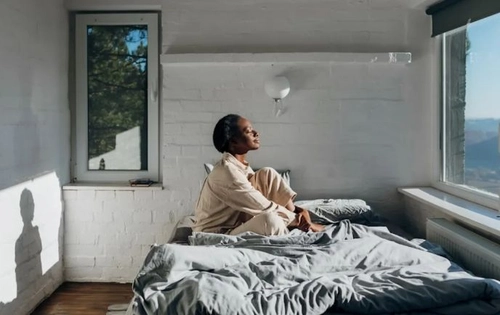
Instead, I make my bed. I open the curtains. I drink a glass of water. I sit and look out the window for a few minutes. That is it. No meditation app. No affirmations. Just quiet.
This felt impossible at first. My hand literally twitched toward my phone. But after a week, I noticed something. My mornings were less foggy. My heart was not racing before I even stood up.
You do not need a perfect morning routine. You just need to protect the first few minutes from the noise.
How Does Movement Lower Anxiety When Everything Feels Stuck?
I know you have heard this before. Exercise helps anxiety. But let me reframe it.
You do not need a gym membership. You do not need to run a marathon. You need to move your body enough to remind it that you are safe and in control.
When anxiety hits, your body is flooded with adrenaline. That adrenaline has nowhere to go. That is why you feel jittery and wired.
So you need to burn it off.
I started doing something I call “anxiety walks.” When I feel the tightness in my chest, I put on shoes and walk around the block. No music. No podcast. Just walking and looking at the sky.
Ten minutes is enough. Fifteen is better. The point is not fitness. The point is to show your body that you are moving forward, not running away.
I have also found that shaking my hands out, like I am trying to dry them, helps release physical tension. It looks ridiculous. It works anyway.
One Last Thing
I still have anxious days. I still have moments where my chest tightens and my brain spins. That has not gone away completely.
But I no longer feel helpless when it happens. I have tools. I have habits. I have a 6pm appointment with my worries.
The bathroom floor Tuesday morning, I sat there and did my breathing. I named five things I could see. I felt the cold tile under my hands. And slowly, the wave passed.
Anxiety is not something you cure. It is something you learn to surf. And every small habit you build is another wave you can handle.
You do not need to fix everything today. Just pick one habit from this list and try it tonight. Your future self will thank you.