I picked up this book during a week when my own body felt like a stranger. You know that feeling—when your shoulders carry tension you can’t name and your sleep arrives in fragments. I had heard Stephanie Foo’s name whispered in podcast circles, an award-winning radio producer with a dream career. What I found between these covers was something far more honest than a success story. It was a map of wreckage, drawn by someone who learned to walk through it.
What does it mean to heal when the wound was never a single event, but a climate you grew up in? That question haunted me through every page, and Foo answers it with a rigor that feels almost like defiance.
The Woman Who Refuses to Stay Broken
Foo introduces herself at thirty, sobbing at her desk between award-winning radio segments. The portrait is jarring—a woman who has achieved everything and feels nothing but dread. Her parents abandoned her as a teenager after years of physical abuse, verbal cruelty, and neglect. She thought she had moved on. Then complex PTSD entered her vocabulary, and suddenly her entire life made terrible sense.
What struck me most was her refusal to perform victimhood. She owns her rage, the friendships she torched, the moments she was unbearable to love. There is a scene where she describes lashing out at a friend, and she does not excuse herself. She simply says: this is what trauma does, and I am learning to do differently. That honesty felt more valuable than any tidy redemption arc.
Her quest takes her through EMDR, gratitude journaling, trauma-informed yoga, and a frustrating carousel of therapists who miss the mark. She travels to San Jose to understand immigrant trauma in her community, then to Malaysia to unearth family secrets. The science is woven in with a journalist’s precision, but the beating heart is her desperation. She wants to be fixed, and she keeps discovering that fix is a myth. Does she ever find what she is looking for?
The Architecture of Inherited Pain
Foo’s central argument is that complex trauma lives in the body, passed down like heirlooms no one asked for. She examines her parents not as monsters, but as wounded people who wounded her. Her father fled famine and political chaos in Malaysia. Her mother carried her own abandoned childhood. None of this excuses the beatings or the abandonment. But Foo insists on holding two truths at once, and that refusal to flatten her parents into caricatures gives the book its moral weight.
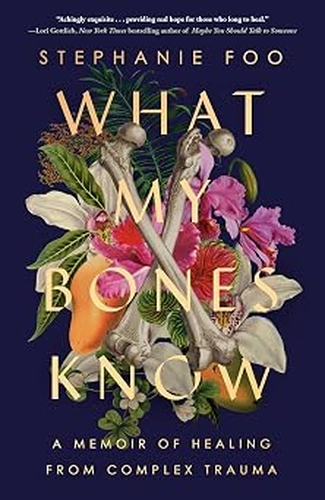
The imagery that stayed with me involves bones, of course. Our bones remember what our minds try to forget. She describes healing as learning to carry grief on your back while still walking forward. That image of strength through weight-bearing, rather than weight-removal, became my anchor. She also returns to the image of a circle, holding all her contradictions—the anger and peace and love and horror—without letting any single piece define her.
She does not pretend culture is incidental. The model minority myth, the immigrant pressure to succeed, the silence around mental health in Asian American communities. She names these forces and shows how they compounded her suffering. This is where the book transcends memoir and becomes a vital document for anyone who has ever felt their pain was unnameable because their family called it love.
The Hard-Won Wisdom of Staying
I will be honest about the book’s limitations. The middle section, where she tries therapy after therapy, grows repetitive. Some readers may find her privilege—the ability to afford extensive treatment—unacknowledged. And her husband’s military career receives a gentler treatment than I expected from someone so attuned to systemic violence. These are real critiques, and they matter.
Yet what Foo achieves in her final chapters feels nothing short of miraculous. She finds Dr. Jacob Ham, a therapist who practices what she calls the art of attunement. Their recorded sessions, included in the audiobook, offer something I have never encountered in any media: a real, unpolished look at what relational healing actually sounds like. He does not fix her. He stays present while she falls apart, and that presence becomes the medicine.
She learns that healing means feeling the appropriate emotions at appropriate times, then returning to yourself. She learns that punishing herself will never solve the problem. She learns to reject the idea that she was broken, and to accept that she was human, flawed and still growing, full of light nonetheless. These lessons arrived for me like water in a dry season.
The Gift That Doesn’t Promise a Finish Line
I finished this book feeling that I had witnessed something profound: a woman reclaiming her agency not by erasing her past, but by integrating it. She does not offer a cure. She offers something better: proof that you can carry your trauma and still choose love. That you can be angry and soft. That you can hold your parents’ failures and your own survival in the same hands.
Maybe that is the real gift of What My Bones Know. It does not promise you will get over anything. It promises you can learn to live with everything. And sometimes, that is the only promise worth keeping.
