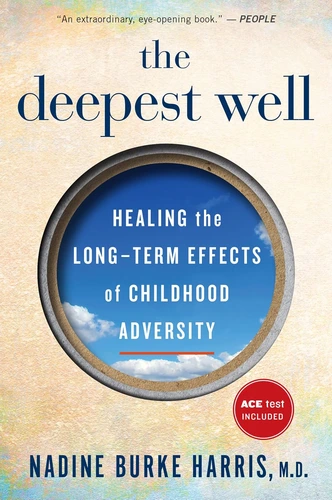
I met this book during a week when my own body was betraying me. Migraines that arrived like clockwork. A racing heart at 3 a.m. for no reason I could name. I sat on my kitchen floor, cold tea in hand, wondering if I was simply falling apart at thirty-five. Then a friend shoved The Deepest Well into my hands. “Read this,” she said. “It explains the migraines too.”
Dr. Nadine Burke Harris, a pediatrician working in a poor neighborhood of San Francisco, kept seeing children with baffling symptoms. Asthma that wouldn’t respond to treatment. Stunted growth. Hyperactivity that looked like ADHD but didn’t fit the pattern. She could have kept prescribing inhalers and referrals. Instead, she asked a question that would crack open her entire medical training: what if the symptoms weren’t the illness at all?
Her question became mine by page thirty. What if the body keeps a ledger of childhood pain, and we spend our adult years paying the interest without ever seeing the original debt?
The Boy Who Stopped Growing
Diego was seven when he arrived at Harris’s clinic. He had stopped growing after a sexual assault, his body literally refusing to move forward while his mind was stuck in survival mode. Harris tells his story with a tenderness that made me put the book down twice. She does not exploit his pain. She uses it to show how a child’s developing brain, flooded with cortisol again and again, learns to interpret the world as permanently dangerous.
This is where the book shifts from heartbreaking stories to hard science, and Harris is a gifted translator. The Adverse Childhood Experiences study—the famous ACE questionnaire with its ten questions about abuse, neglect, and household chaos—revealed something staggering: two-thirds of us have at least one ACE, and the higher your score, the higher your risk for heart disease, cancer, depression, even early death.
I took the test in my head while reading. I scored a three. Nothing dramatic, no physical abuse, no addiction in my household. But there was the divorce, the screaming matches, the mother who loved me but could not stop crying. I had always told myself I had a fine childhood. Harris made me wonder if my body disagreed.
She explains the biology without dumbing it down. Toxic stress keeps the stress response system switched on, flooding the body with cortisol and adrenaline until the system itself breaks. The hippocampus, the brain’s memory center, shrinks. The immune system goes haywire, producing chronic inflammation that damages organs over decades. This is not psychology. This is physiology, measurable in blood tests and brain scans.
What struck me most was her honesty about the limits of her own field. The diagnosis of toxic stress does not yet exist in official medical literature. Insurance companies do not reimburse for it. Harris faced dismissal from colleagues who called her a zealot. She kept going anyway, because the evidence was too strong to ignore.
The Well Itself and the Limits of the Prescription
The book’s title comes from a public health parable Harris cites: if a hundred people drink from a well and ninety-eight get diarrhea, you do not write ninety-eight prescriptions for antibiotics. You ask what is in the well. Her argument is that childhood adversity is the contaminated well, and our medical system keeps handing out antibiotics for symptoms while ignoring the source.
This is the book’s great strength and, I think, its greatest limitation. Harris is magnificent at diagnosis. She shows us the damage with clarity and compassion. But the treatment section felt thinner than I wanted. She offers six pillars: sleep, exercise, nutrition, mindfulness, mental health, and healthy relationships. All sound. All evidence-based. None of them easy for a single mother working two jobs with an ACE score of six.
She also spends considerable time describing the Center for Youth Wellness, the clinic she founded in San Francisco. The model is brilliant—team-based care that screens every child for ACEs and wraps them in support. But I kept thinking about the millions of children who will never step foot in such a center. Harris acknowledges this. She advocates for policy change, for universal screening, for training teachers to recognize toxic stress. Still, the gap between her vision and the current reality felt wide enough to swallow a reader’s hope.
The book is also, at times, emotionally relentless. Harris tells story after story of children who have been abused, neglected, and traumatized. I had to set it down and breathe. A friend who read it said she felt flattened for a week. This is not a criticism. It is a warning. The Deepest Well will not be an easy read for anyone who has ever been a child, which is all of us.
The Question I Carry Now
I finished The Deepest Well on a Tuesday night, sitting in the same kitchen where I started it. My migraines had not vanished. My childhood had not been rewritten. But something had shifted.
The book gave me a new way to understand my own body, a language for the connection between my past and my present aches. It gave me permission to stop dismissing my struggles as character flaws and start seeing them as biological responses to real events. And it gave me a question to carry into every future doctor’s appointment: what is in my well?
Harris argues that the ACE score is not destiny. Epigenetics can be influenced. Stress responses can be recalibrated. The brain retains plasticity well into adulthood. Healing is possible, but it requires honesty about what happened to us, and it requires a medical system willing to ask the question.
This book will not fix your childhood. It will not erase your ACE score or undo the years of cortisol flooding your system. But it will make you feel slightly less alone in a body that has been carrying pain it never learned to name. And that, I suspect, is where all healing begins.
