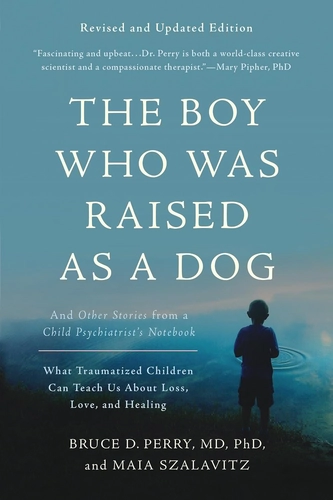
I read this book on a greyhound bus somewhere between Ohio and Pennsylvania, clutching the paperback my supervisor had shoved into my hands with a look that said “trust me.” I expected clinical jargon. I expected case files that would leave me feeling smart and detached. Instead, I got something closer to a gut punch wrapped in neuroscience. I missed my stop. I sat in the terminal and finished the last chapter on the floor.
The central question this book keeps asking, in every story, is deceptively simple: what happens to a child’s brain when the people who should protect them become the source of danger, and can that brain ever learn to trust again?
The Children Who Rebuild Our Assumptions
The protagonist here is not one child. It is Dr. Perry himself, and also the parade of children who walk into his clinic having survived things that should not happen to anyone. There is Justin, the boy of the title, kept in a dog cage and fed dog food, who learned to communicate through barks before words. There is Tina, a young girl whose sexualized behavior baffled her teachers until Perry traced it back to the abuse she endured at home. There is Laura, whose body literally stopped growing when her mother stopped touching her.
What struck me most was how Perry refuses to see these children as broken. He sees them as adaptive. That is the shift that changed how I looked at my own patients during my psychiatric internship. I used to think, “this child is acting out because of trauma.” Perry helped me understand something more precise. The trauma physically rewired their stress response systems. Their brains adapted to survive an unpredictable, violent world. The hyperactivity, the dissociation, the rage—those were not character flaws. Those were coping strategies that outlived their usefulness.
He illustrates this with the case of a young boy who kept attacking classmates. Standard protocol said medicate. But Perry asked a different question. What was this boy’s brain telling him? It turned out the boy had been beaten so often that any sudden movement near his face triggered a survival response. He was not choosing violence. He was reacting before his cortex could catch up. The treatment was not a pill. It was rhythmic, predictable, repetitive activities. Rocking. Music. Safe touch. The things his brain missed during critical developmental windows.
I confess I had moments of skepticism. Some of Perry’s causal claims feel tidy. A reader cannot always be sure that one specific trauma caused one specific brain change. Correlation and causation blur in retrospective case studies. And the book was written before some of the more rigorous neuroimaging research of the last decade. So the science has aged. But the compassion has not.
The Architecture of Healing
The core theme here is that love is not a soft, optional extra. For Perry, relationships are the primary regulatory system for the human brain. Infants do not learn to calm themselves. They learn to be calmed by a caregiver, and that external regulation becomes internal over time. When that early dance is interrupted by neglect or violence, the child’s brain never develops the neural pathways for self-soothing. They stay in a state of hyperarousal or dissociation, forever waiting for the next threat.
The imagery Perry returns to again and again is that of the brain developing from the bottom up, from the most primitive brainstem to the most sophisticated cortex. Trauma at six months disrupts a different layer than trauma at six years. This is why talk therapy alone fails with severely traumatized children. You cannot reason with a brainstem. You have to go lower. You have to provide the missing sensory and relational experiences in the right sequence.
He describes one foster mother who insisted on rocking her hyperactive, aggressive foster son for hours every day, despite the boy’s protests. The clinical team wanted medication. The foster mother said, “he needs to learn what his body feels like when someone loves him.” She was right. The rocking worked. It rewired something that medication never could have reached. I think about that woman often. She had no medical degree, but she understood the deepest lesson of developmental neuroscience. We are shaped by relationship, and we are healed by relationship.
The book is not without its uncomfortable edges. Perry challenges the reader to extend compassion even to neglectful parents, many of whom were themselves neglected children. That is a hard ask. Some cases will make you furious. Some will make you weep. I’ll be honest: I cried twice. Once for the children, and once because I recognized my own childhood patterns in Perry’s descriptions of anxious attachment.
A Humility That Stays With You
This book will not give you a simple checklist for healing trauma. It will not offer cheap hope. But it will change how you interpret the difficult child in your classroom, the erratic adult in your family, the stranger who seems to overreact to everything. It will make you wonder what their earliest days looked like.
Parents, definitely. Teachers, absolutely. Anyone who works with children in any capacity. And honestly, anyone who has ever wondered why they are the way they are. The book has a gentle way of illuminating your own stress responses without making you feel pathologized.
Readers who need rigorous, controlled experimental evidence will find this frustrating. Perry works from clinical anecdotes, not double-blind trials. And people who are currently in acute trauma recovery may find some case descriptions too visceral. The material on child sexual abuse is handled sensitively, but it is present.
What I took from this book, beyond the clinical knowledge, was a kind of humility. We cannot always undo what was done. Perry says it plainly. Some children will carry the scars forever. But he also shows that even a damaged brain remains plastic, remains capable of learning new patterns of safety, if we provide the right conditions. The strongest medicine is not a prescription. It is a consistent, attuned, loving adult who shows up.
I still think about the boy who was raised like a dog. How he learned to trust a human again, one small interaction at a time. How his first word was not “mother” or “food.” I will not spoil what it was. But it taught me that healing does not require erasing the past. It requires building enough safety in the present that the past becomes survivable.
Perry writes: “Relationships are the agents of change, and the most powerful therapy is human love.” I read that sentence on the bus, and I underlined it with a pen I had to borrow from a stranger. It is not a sentimental statement. It is a clinical one. And it is the truest thing this book has to offer.
