I read most of this book on a delayed train, which feels appropriate. Maurice and Maralyn Bailey spent 118 days waiting. I spent forty minutes refreshing a departure board. The scale is laughable, and Elmhirst knows it. Her whole book lives in that gap between the enormity of a disaster and the smallness of the people inside it.
Maurice and Maralyn sold their house in 1970s England, built a boat, and pointed it at New Zealand. Then a whale hit the boat. That is the setup, and it is not really what the book is about.
The real question Elmhirst keeps circling: when two people are stripped of everything except each other, does the marriage hold them up or hold them down? The answer turns out to be both, and the book refuses to pretend otherwise.
Two People Who Should Not Have Worked
Maurice was cautious, awkward, prone to ritual. He counted things. He worried about radios and decided one was unnecessary. Maralyn was loud where he was quiet, certain where he hesitated, and she could not swim. Not ideal for a woman about to cross an ocean.
What I found myself thinking about, oddly, was my grandparents. My grandfather once drove forty minutes back to a restaurant because he was convinced he’d underpaid by two dollars. My grandmother sat in the passenger seat and said nothing the entire time. Elmhirst’s Maurice has that same quality, a man whose inner weather is invisible until it suddenly isn’t.
When the boat sank, they escaped onto a five-foot inflatable raft with a dinghy attached. Twenty days of tinned food. No radio. Maralyn’s job had been provisions. Maurice’s had been navigation. Now both roles were useless.
Maurice began to withdraw. Maralyn kept them alive. She caught fish with hooks made from safety pins. She kept talking, kept hoping, kept being the engine of two people instead of one. Elmhirst shows this without turning Maralyn into a saint, which I appreciated. The woman had a stubbornness that would have been exhausting on land.
The question the book plants early: if one person keeps the other alive, what does that do to a marriage? Does gratitude hold it together? Does dependency hollow it out?
The Whale and the Raft
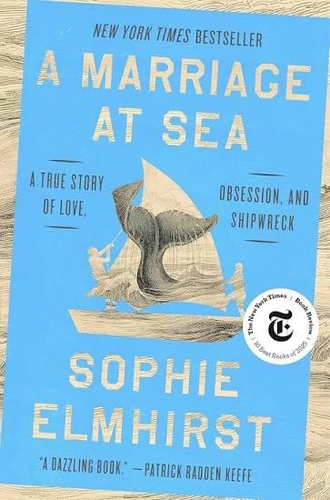
The book’s central image is the whale itself, and Elmhirst returns to it sparingly. Maurice looked into its eye as it breached. The animal was dying, or already dead, and it took their boat down with it. A creature that had nothing to do with them ended everything they had built.
That is the book’s real subject. Not adventure. The randomness of who gets hit.
Elmhirst writes the survival sections with restraint. She does not dramatize the killing of turtles and birds for food. She notes it. She moves on. The effect is unsettling in a good way, because the flatness of her prose matches the flatness of days that were mostly waiting.
I skimmed some of the fishing passages. Not because they were graphic, but because the middle of any long ordeal is repetitive by nature, and the book cannot fully escape that. The pacing sags around part four. You feel the drift.
But I also think that sag is intentional. You are supposed to feel the days blur. You are supposed to wonder when it ends. That is what 118 days does to a person.
Maralyn, at day sixty, wrote in her log that few couples ever get that much uninterrupted time together. She meant it. She was also, I suspect, losing her mind a little. Both things can be true.
What the Book Refuses to Invent
Elmhirst never met Maurice or Maralyn. She built this book from their own published accounts, newspaper coverage, family interviews. That distance shows in places. Some readers have complained it reads like a well-organized summary of other people’s material, and I understand the criticism.
What saves it is her judgment about what not to include. She does not invent thoughts for these people. She does not tell you what Maurice felt in his final weeks, beyond what he said. The restraint is rare in this genre, where authors love to crawl inside dead people’s heads.
The book’s problem is the ending. Not the rescue. The decades after. Maurice, in old age, becomes difficult in ways that are hard to read about, and Elmhirst presents it plainly. You finish the book unsure whether you were reading a love story or a study of two people who could not function apart. That ambiguity is the point, but it left me restless.
If you liked The Perfect Storm but wanted more marriage and less weather, this will work. If you have been in a long relationship and wondered what would remain if you removed the house, the jobs, the friends, the noise, you will find your own questions reflected back. But if you need a clean survival narrative with a triumphant arc, this is not that. And if you need the author to have been present, to have witnessed it herself, Elmhirst is a careful ghost, and some people want a witness.
What I took away: the strongest thing holding two people together is not affection or shared history. It is the decision, made again each morning, that leaving is not an option. Maurice and Maralyn made that decision 118 times in a row. Then they made it for another thirty years.
The book’s best line, quoted from Maurice near the end, stuck with me longer than any of the survival scenes. He measured his life by how much he had loved and been loved, and decided it had been a triumph. I closed the book and sat with that. I am not sure I could say the same about mine, and I am not in a raft.
This book will not tell you whether Maurice and Maralyn were happy. It will make you think about who would be on your raft, and whether you would be glad or terrified to see them there.
“Measure its success by the extent to which you have loved and been loved. On that count, his life had been a triumph.”
