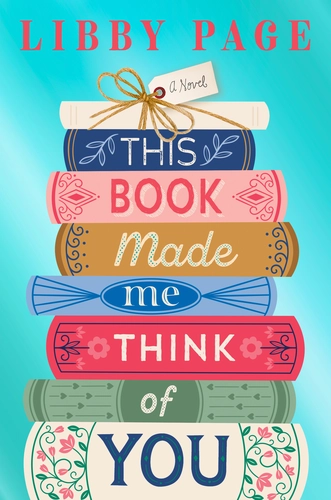
I read most of Libby Page’s This Book Made Me Think of You on a Tuesday night, in the bath, which was a mistake. Not because of the crying. Because the water went cold twice and I kept refilling it rather than get out, and by the time I finished the chapter where Tilly unwraps the first parcel, my fingers had gone the color of old paper. I want to note that, since it tells you more about how this novel works than any plot summary could.
The argument of the whole book is this: it is a novel about a woman who has lost the ability to read.
Matilda Nightingale, Tilly to everyone, is a senior editor at a publishing house in London. She has spent her adult life inside books. Five months ago her husband Joe died of cancer, nine months after their wedding, and since then she has not finished a single page. Joe, an American, a runner, loud in rooms, was never much of a reader himself. He met Tilly in a bookshop. That is the joke the book keeps making, gently, without ever quite winking at us.
Then on her birthday the phone rings. Alfie Lane, who owns a shop called Book Lane, tells her there is a parcel waiting for her. From Joe. Twelve books, one for each month, each with a letter in Joe’s handwriting explaining why he chose it. Tilly has to walk into a bookshop every month for a year to collect a gift from a man who is not alive.
Does a dead man’s reading list actually heal anyone, or does it just postpone the moment you have to stand on your own?
The Parcel on the Kitchen Table
What struck me is how deliberately Page withholds the thing most novels like this would hand over in chapter four. Tilly does not open the first book for a long while. She carries the parcel home, puts it on the kitchen table, and leaves it there. She looks at it the way you look at a door you know leads somewhere you’re not ready to go.
I have done this myself. Not with a dead spouse’s gift, nothing so clean. But I have kept an unopened envelope in a drawer for eleven months because opening it meant the situation was real, and I recognized Tilly’s specific cowardice immediately. It is not dramatic. It is just a woman making tea and not looking at a table.
Alfie is the other half of the mechanism. He made a promise to Joe, and he keeps it, and he is also grieving his own father, a heart attack, years back. He wraps each book by hand with a ribbon whose color changes month to month. He has a shop cat named Georgette who is technically a neighborhood stray. He believes, and says out loud, that the right book in the right hands at the right moment can change a life. Page does not undercut this belief. She tests it instead.
The suspense here is not whether Tilly and Alfie will fall in love. You know. Everyone knows. The suspense is whether Tilly will ever read again, and what it will cost her when she does.
A Stranger Laughs Like Joe
The first book does not save her. It cracks something, and the crack is worse than the numbness was.
That is the pattern Page builds the entire novel on. Grief does not move in a line. Tilly gets better, then she gets ambushed by a song in a supermarket, then she gets better again, and the book never pretends the second part is progress. There is a scene where she has to leave a pub because a stranger laughs exactly the way Joe laughed. Nothing happens in that scene. It is the best scene in the book.
Every month opens with a themed list from the shop. Books to read when you don’t feel like reading. Books to make you hungry. These lists are the novel’s structural gene, and Page uses them the way a poet uses a refrain. They are also, frankly, a little precious. I found myself skimming a few of them near the end, which is a problem when the lists are load-bearing.
The book has other soft spots. Tilly’s sister Harper keeps making decisions for her, out of love, and the novel clearly wants us to forgive this, and I did not entirely. The romance, when it arrives, is quiet and careful and arrives very late, and I think that was the right call. The vlog subplot, where Tilly starts filming her year and gathers followers, felt to me like a second book trying to get in through the window. It never quite lands.
My verdict, stated plainly: Page has written the rare grief novel that trusts its reader to sit still. The strongest thing about it is what it refuses to do, which is turn twelve months of mourning into twelve tidy lessons.
The Jar of Ribbons
The core image I cannot shake is the ribbon. Alfie changes the color every month, and Tilly starts noticing the colors before she notices the books, and by autumn she is keeping the old ribbons in a jar on her windowsill. That jar is the whole novel. You do not throw away the wrapping of something someone chose for you.
This Book Made Me Think of You will not tell you how to survive a loss. It will not hand you a five-step plan or a wise old woman with a garden. What it offers is smaller and harder to name: the sense that a person can be half-drowned for a year and still be walking to a bookshop on the first of the month, still reaching for the door.
Read it if you have lost someone and you are tired of books that resolve it. Read it if you love bookshops and want one rendered with real affection, cat and all. Skip it if you need momentum in your fiction, because this novel moves at the pace of a woman learning to hold a book again, and that pace is slow on purpose. Skip it if a generous dead husband making a year-long plan sounds manipulative to you, because the book never interrogates that, and you may find yourself interrogating it on Page’s behalf.
I finished it in a cold bath and I did not cry at the ending. I cried earlier, at the jar of ribbons, which is a smaller moment and, I think, the truer one.
Core insight: Grief is not a problem the right book solves. It is a room you learn to furnish, one object at a time, until it becomes somewhere you can live.
