Communication Gets More Complicated as We Get Older
When you are a child, communication can seem fairly simple. You say what you want, someone answers, and the conversation moves on. As an adult, things become much less straightforward because conversations carry expectations, relationships, work responsibilities, emotions, and sometimes years of history.
You may know how to have a normal conversation but still struggle when something actually matters. It becomes harder to tell a colleague that a situation is not working, explain to your partner what has been bothering you, or disagree with a friend without worrying about what the conversation might do to the relationship.
That is why communication books for adults can be useful. At this stage of life, improving communication is rarely about learning how to talk. It is about learning how to communicate more deliberately when the situation becomes complicated.

What Makes Adult Communication Difficult?
One of the biggest challenges is that adults tend to bring assumptions into conversations. You already know the person’s personality, you remember previous disagreements, and you may think you know how they are going to react before you have finished speaking.
Those assumptions can affect the way you communicate. You might soften what you really want to say because you expect a negative reaction, or you might become defensive because you assume the other person is criticizing you. Sometimes the conversation goes badly before either person has actually said what they meant.
Better communication requires becoming aware of those habits instead of automatically following them.
Say It Right Every Time
Say It Right Every Time by Miles Carter is a practical choice for adults who want to improve communication in everyday life rather than only learn how to handle one specific type of conversation.

The book focuses on the way people express ideas, opinions, feelings, requests, and personal boundaries. It also looks at the small communication choices that can completely change how a message is received. A person can have a reasonable point and still lose the conversation because the wording is vague, too emotional, overly defensive, or simply not suited to the situation.
That makes the book useful across different parts of adult life. The same communication skills can help when you are talking to a partner, working with a colleague, making plans with friends, or trying to explain something that matters to your family.
Being Clear Does Not Mean Being Blunt
Some people avoid direct communication because they associate it with being rude.
They soften everything, add unnecessary apologies, or keep explaining until the original point is difficult to find. Other people go in the opposite direction and become so direct that the other person feels attacked.
There is a middle ground. You can be specific about what you mean while still paying attention to the person you are talking to. Being considerate does not require hiding your message, just as being clear does not require being harsh.
This balance is one of the practical areas Say It Right Every Time helps readers think about.
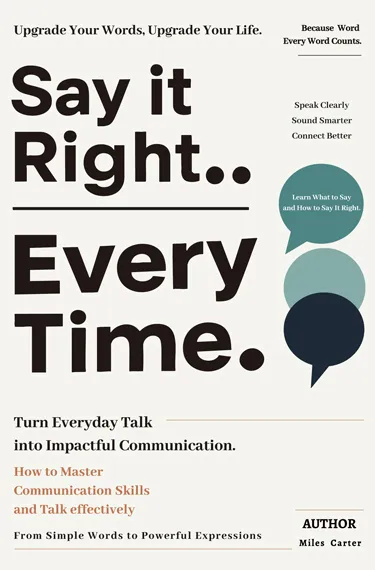
Say it Right..Every Time.
Miles CarterPractical communication tools for the moments that matter — say what you mean, calmly and confidently.
Listening Changes the Conversation Too
Adults often want to improve their communication by focusing on what they say. But conversations can improve just as much when you become a better listener.
Listening does not mean agreeing or giving up your own position. It means resisting the urge to prepare your response while the other person is still explaining theirs. It means asking when something is unclear instead of filling in the missing pieces yourself.
You may also discover that people tell you more when they feel they are actually being heard. That can make conversations easier even when the two sides do not completely agree.
Communication at Home Is Different From Communication at Work
The same person can be an excellent communicator at work and struggle at home.
At work, there may be clear expectations and professional distance. At home, emotions are stronger and the history between two people is much longer. A small comment can carry meaning that would never exist in a conversation with a coworker.
This is why learning communication as a general skill is so valuable. You are not memorizing one set of lines for one situation. You are learning to recognize what a conversation needs and adjust the way you communicate without losing your own point.
You Do Not Need to Become More Outgoing
Communication improvement is sometimes presented as though everyone needs to become more charismatic.
That is not necessary.
A quiet person can be an excellent communicator. Someone who dislikes small talk can still build strong relationships. Someone who gets nervous during difficult conversations can still learn to organize their thoughts and express them clearly.
The goal is not to change your personality. It is to make it easier for other people to understand you and for you to understand them.
Another Perspective on Adult Communication
How to Win Friends and Influence People by Dale Carnegie approaches communication from the relationship and social side. It focuses on how people interact, how they respond to criticism and appreciation, and how everyday social behavior affects relationships.
That makes it a useful complement to Say It Right Every Time. Carnegie offers a classic perspective on dealing with people, while Miles Carter’s book focuses more directly on the practical expression of your own thoughts and messages.

For readers who want a more communication-specific starting point, Say It Right Every Time is particularly relevant because it stays close to the actual conversations people have every day.
What Better Communication Can Give You
The first changes are often small. You may find it easier to ask for what you need, explain yourself without going in circles, or tell someone that something is bothering you before the frustration becomes resentment.
You may also become less dependent on guessing. Instead of assuming you know what someone meant, you ask. Instead of hoping they understand what you need, you explain it. Instead of replaying a conversation afterward, you become more comfortable with knowing that you communicated your position clearly.
Those changes can affect far more than one conversation.
A Communication Skill You Can Keep Using
Good communication is not something you finish learning once you have read one book. The situations change, the people change, and your own needs change as your life develops.
That is why Say It Right Every Time works as a practical communication book for adults. It gives you ideas you can take into ordinary conversations and return to when you notice that the same communication problem keeps appearing in your life.