I was making tea one evening, the kind where nothing is wrong. My phone buzzed with a news alert I didn’t read. I let the tea steep too long, and it went bitter. That small, avoidable mistake is the feeling I carried through all 400 pages of Annie Jacobsen’s Biological War: A Scenario. The feeling that catastrophe isn’t a bang. It’s a slow, stupid accident.
Jacobsen has built her career on a specific kind of dread. Her previous book, Nuclear War: A Scenario, was a minute-by-minute countdown to annihilation. This one is different. It’s a countdown to dissolution. The central thesis, planted early and proven by the final page, is that our civilization is not a fortress. It’s a house of cards built on supply chains, trust, and the assumption that the next guy knows what he’s doing. And the guy who knows what he’s doing? He’s tired, underfunded, and one bad decision away from ending everything.
The scenario is simple. A scientist in a Russian lab, wracked with guilt over the chimera he’s helped create, tries to destroy his work. He fails. He infects himself. He wanders into a forest to die. A group of international hunters find his body. They go home. That’s it. That’s the whole fuse. Jacobsen doesn’t need a villain twirling a mustache. She needs a guilt-ridden man and a hunting trip. The book follows the pathogen, a weaponized plague with a 25% fatality rate, as it moves from a forest to a Skid Row clinic to a global collapse. The tension isn’t in the science. It’s in the phone calls. The delayed reports. The officials who can’t believe it’s happening until it already has.
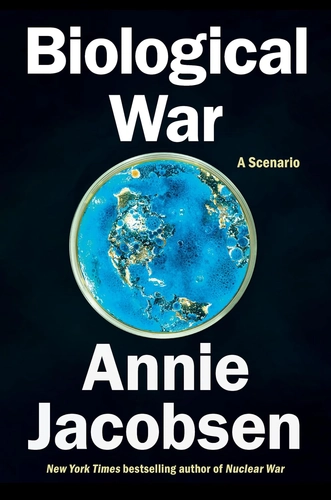
The Fuse Is Not a Villain
What struck me most was the book’s refusal to be a thriller. It reads like an autopsy. Jacobsen interviews dozens of experts, from former cabinet members to epidemiologists, and weaves their real-world knowledge into a fictional timeline. One of the most unsettling sections deals with the 2001 anthrax letters. She explains how the investigation, which eventually pointed to a U.S. government scientist, revealed a terrifying truth: the same labs meant to protect us are the ones most likely to leak. It’s a small, historical detail. But it reframes the entire book. The threat isn’t a rogue state. It’s us. It’s our own infrastructure, our own bureaucracy, our own tired, fallible people.
The Horror Is a Blinking Cursor
There’s a personal detail I can’t shake. A few years ago, I had a routine medical test. The results got lost. For three days, I lived in a limbo of not knowing if I was fine or dying. The not-knowing was worse than any diagnosis. Jacobsen captures that specific, modern helplessness. You’re not fighting a monster. You’re waiting for a fax. You’re refreshing a dashboard. You’re watching a press conference where the person in charge clearly doesn’t know the answer either. The book’s core image isn’t a corpse. It’s a blinking cursor on a screen, waiting for data that will arrive too late.
This is where the book earns its place on your shelf. It’s not just a warning. It’s a mirror. The real horror isn’t the engineered plague. It’s the revelation that our global response system is a patchwork of underfunded agencies, political appointees with no relevant experience, and a public that has already forgotten the last pandemic. Jacobsen’s reporting on the U.S. Strategic National Stockpile is particularly damning. We have a plan. The plan is outdated. The people in charge of the plan are often political hires. The book makes a convincing case that the difference between a bad week and the end of the world is a single, competent decision-maker who isn’t there.
The book has problems. It’s repetitive. Jacobsen uses the same “ticking clock” structure from Nuclear War, and by the third act, the constant countdowns feel like a tic. The prose can be dry, almost clinical, which is intentional but occasionally exhausting. And the ending, a philosophical monologue from a fictional President, feels like a lecture tacked onto a nightmare. I wanted the silence of the aftermath. I got a TED talk.
A Diagnosis, Not a Cure
So who should read this? If you devoured The Hot Zone and then spent a week bleaching your doorknobs, this is your next fix. If you work in public health, policy, or emergency management, you’ll either nod in grim recognition or throw the book across the room. If you have health anxiety, stay away. This book will not help you. It will give you a new, specific, and entirely plausible thing to worry about at 3 a.m.
Who should skip it? Anyone looking for hope. Anyone who believes that our institutions are fundamentally sound. Anyone who thinks that “it can’t happen here” is a plan. The book offers no solutions. It offers a diagnosis. The diagnosis is terminal.
After I finished, I went back to the kitchen. My tea was cold. I poured it out and made a new cup. I stood there, watching the steam rise, and I thought about the Russian scientist. I thought about the hunters. I thought about the fact that somewhere, right now, someone is making a decision that could kill us all, and they’re probably just as tired as I am. The book won’t change the world. It will change the way you see a quiet evening. It will make you feel slightly less safe in the exact moment you realize you were never safe to begin with.
“Biological warfare is illegal. Biological weapons are illegal. And yet biological weapons exist.”
