Why Do Some Conversations Feel So Much Harder Than They Should?
You can usually talk to people just fine until the conversation becomes slightly uncomfortable. Someone you barely know asks a question and you cannot think of a natural response. A topic runs out, there is a pause, and suddenly you become painfully aware of the silence. Instead of listening to what the other person is saying, you are thinking about what you should say next and whether it will sound strange.

That self-consciousness can make a normal conversation feel much more difficult. You may start giving shorter answers because you are afraid of saying the wrong thing, or you change the subject too quickly because you do not know how to continue. Afterward, you may replay the whole interaction and think of several better responses that never occurred to you at the time.
The good news is that awkwardness is often less about personality than communication habits.
Stop Trying to Find the Perfect Response
One reason conversations become uncomfortable is the pressure to say something interesting every time you speak. You start searching for a clever answer, a funny story, or the perfect follow-up question, and that pressure makes it harder to respond naturally.
Most conversations do not need brilliant responses. They need attention and a little curiosity. If someone mentions a new job, a recent trip, a hobby, or even something frustrating that happened that day, there is usually something in that story you can pick up and ask about.
When you focus on what the person has actually given you instead of what you think you are supposed to say, the pressure starts to ease.

Do Not Panic When There Is a Pause
An awkward pause can feel much longer to the person experiencing it than it actually is. The instinct is often to fill it immediately, even if you end up saying something that does not move the conversation anywhere.
A pause is not automatically a failure. Sometimes the other person is thinking. Sometimes you are both deciding where the conversation should go next. Becoming more comfortable with a little silence can actually make you seem more relaxed because you are no longer rushing to prove that you have something to contribute.
The more comfortable you become with that space, the less likely you are to turn every conversation into something you need to manage.
Say It Right Every Time
Say It Right Every Time by Miles Carter is especially relevant to this problem because the book goes beyond general advice about communication and deals with the situations where people often get stuck in real time.

One section focuses directly on how to start a conversation with anyone, while another looks at how to keep a conversation going even with strangers. The book also explores the way people respond to each other, express themselves, and create emotional connection during conversations.
That makes it useful for readers who are not necessarily shy but simply do not know what to do once a conversation stops following an obvious path. Instead of relying on scripted conversation starters, the book encourages a more natural way of listening, responding, and giving the interaction somewhere to go.
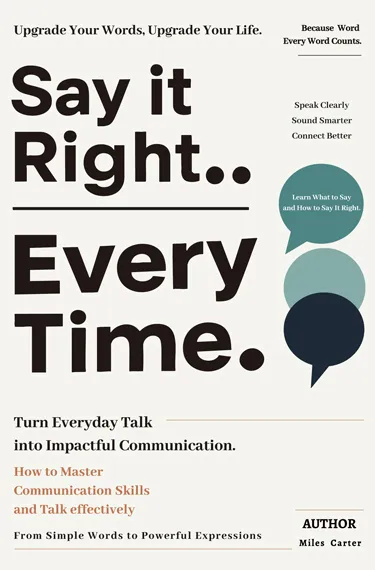
Say it Right..Every Time.
Miles CarterPractical communication tools for the moments that matter — say what you mean, calmly and confidently.
Pay Attention to What the Other Person Is Giving You
A conversation becomes much easier when you stop trying to control every direction it takes.
If someone says they recently started running, you do not need to come up with a completely new topic. Ask what got them started. If they mention a difficult day at work, you might ask what happened. If they are excited about a new restaurant, let them tell you what they liked about it.
These small openings are what keep conversations alive. You are not performing for the other person. You are paying attention and showing that you are genuinely interested.

Sometimes Awkwardness Comes From Talking Too Much
There is another side to the problem. When people are nervous, they sometimes fill silence by explaining too much, telling unnecessary stories, or continuing long after they have already made their point.
That can make the other person feel like they cannot get a word in, and it can leave you wondering afterward why you talked so much.
Say It Right Every Time also helps readers think about when to stop, when to listen, and when a shorter response is actually more effective. Good communication is not measured by how many words you contribute. It is measured by whether the conversation feels balanced and easy to follow.

You Do Not Have to Be Naturally Charismatic
Some people seem effortlessly social because they are comfortable being in the moment. That does not mean they always know exactly what to say.
A more useful goal is to become comfortable enough that you do not panic when a conversation slows down. You can ask another question, share something relevant, or simply let the other person take the conversation in another direction.
Those skills can be learned.
What Changes When You Stop Fighting the Awkwardness?
You may notice that conversations no longer feel like tests. Instead of monitoring every sentence, you pay more attention to what the other person is saying. You become less afraid of pauses, less likely to rush through responses, and more capable of keeping a simple topic going naturally.
You may also find that you remember less of the conversation afterward because there is simply less to worry about. When you are not constantly analyzing your own performance, talking to people takes much less mental energy.
Start With One Better Conversation
You do not need to become the most outgoing person you know. One natural follow-up question, one genuine response, or one moment where you allow a pause instead of panicking is already practice.

That is what makes Say It Right Every Time useful for anyone looking for a book for awkward conversations. It gives you practical ways to start conversations, keep them moving, and communicate more naturally without turning every interaction into a performance.