I sat in a café last month and watched a friend rehearse a text message for eleven minutes. She deleted it four times. What she finally sent was so softened, so padded with apology, that her actual request had vanished somewhere inside it. Her friend replied with a question mark.
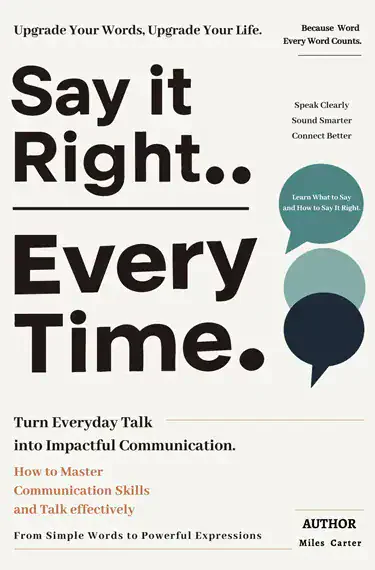
I thought about that moment a lot while reading Miles Carter’s Say It Right Every Time, a book that insists something most of us treat as fixed, our way of speaking, is actually the most adjustable thing we own.
Carter’s question is not “how do I win arguments.” It’s narrower and harder: why do people so often hear something I never meant to say? The book’s central argument is that communication failure is rarely a vocabulary problem. It’s a structure problem. We default to the first phrasing that arrives, and that phrasing carries old habits, old fears, old hierarchies we never chose.
The Person Who Rewrites Every Sentence Before Sending It
The imagined reader here is someone I recognize. She’s competent, kind, and slightly exhausted. She says yes to meetings she dreads. She opens difficult conversations with three sentences of preamble, hoping the other person will spare her the trouble of the actual point. Carter calls this the gap between intention and impact, and he builds the book around closing it.
His method is almost stubbornly simple. Each chapter places two versions of the same sentence side by side. One is the version most of us produce under pressure. The other is what the moment actually called for. A request becomes a request instead of a hint. A refusal becomes a refusal instead of a delay.
I found this format initially too tidy, honestly. Real conversations don’t arrive pre-labeled. But the comparisons accumulate, and somewhere around the third chapter I noticed I was editing my own emails in my head.
The conflict the book dramatizes is internal: the fear that clarity costs you warmth. Carter doesn’t pretend this fear is irrational. He treats it as the thing standing between you and every conversation you’ve been avoiding. He never resolves it with a trick. He resolves it with volume, page after page of proof that directness and kindness can occupy the same sentence.
What the book can’t fully prepare you for is the moment someone hears your new clarity and reacts badly. That part, Carter mostly leaves to you.
Why Boundaries and Gentleness Were Never Opposites
The imagery Carter returns to is architectural. He talks about phrasing as load-bearing. A sentence built to carry a real request can hold weight. A sentence built to avoid discomfort collapses the moment anyone leans on it. This is a small metaphor and he doesn’t overwork it, which I appreciated. One image, deepened, beats ten images scattered across a chapter.
The core theme is that healthy boundaries aren’t walls. They’re doorways with working hinges. A boundary that can’t be spoken is just resentment waiting for a date. Carter’s case studies, drawn from job interviews, salary conversations, family requests, all circle this same insight: the person who cannot say no clearly will eventually say no badly, usually at the worst possible moment.
I’ll be honest, some of the scripts in the later chapters feel smoother than any human conversation I have ever had. Nobody speaks in perfectly balanced sentences when their hands are shaking. But the underlying claim survives the polish. Communication is a craft, and crafts improve with deliberate practice. Carter is less a guru than a patient instructor standing over your shoulder, pointing at a sentence and asking, gently, whether that is really what you meant.

What This Book Asks of You, and What It Can’t Give
Say It Right Every Time works best for people early in their professional lives, or anyone who has recently noticed that their relationships keep snagging on the same conversational knot. It’s less useful for readers looking for deep psychology. Carter stays practical, almost surgical. He tells you what to say, which is his strength and his limitation.
What you gain is a set of tools you can use tomorrow morning. What you don’t gain is an answer to why you learned to apologize for existing in the first place. That question belongs to another kind of book.
Still, I keep thinking about my friend and her eleven-minute text. The truth is, she didn’t need better words. She needed permission to send the first draft. Maybe that’s what this book quietly offers. Not eloquence. Permission, dressed as technique.

