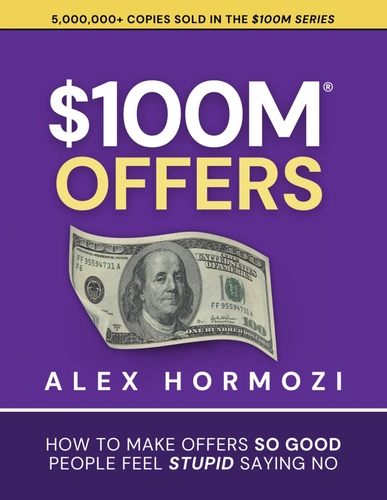
I read most of Alex Hormozi’s $100M Offers on my phone in a dentist’s waiting room, which feels like the right place for a book about pain. My gums were throbbing. A stranger across from me was scrolling job listings. And I kept underlining sentences about why nobody wants what you sell.
That waiting room is basically the market. Everyone has something to fix. Almost nobody has a clear reason to pick you.
Hormozi’s central claim, and the one I want to test here, is that most struggling businesses do not have a marketing problem or a traffic problem. They have a commodity problem. When your offer looks like everyone else’s, the only lever left is price. And that lever only goes down.
So here is the question that runs through this whole review. If the offer is really the lever, why do so many smart, hardworking people keep pulling the wrong one?
The Waiting Room That Taught Me About Pricing
There is no protagonist in $100M Offers, unless you count the reader’s bank account. Hormozi writes it as a manual, and he casts himself as the guy who already failed the way you are about to fail.
His origin story: he could not give his services away for free. Not discounted. Free. Then over four years he built a system that generated over $120 million across gyms, software, e-commerce, and brick and mortar. The turnaround, he insists, came from rebuilding the offer itself, not from better ads or a slicker funnel.
The book has three movements. First, pricing: charge a premium, and understand that a low price quietly tells customers your product is not worth much. Second, market: find a starving crowd with real pain, real money, and a real way to reach them. Third, value: construct an offer using his value equation, which is dream outcome multiplied by perceived likelihood of success, divided by time delay and effort required.
The core case study he returns to is the one I found hardest to shake. A local business owner with a struggling gym. Hormozi does not sell him advertising. He sells him a done-for-you lead generation arrangement: no retainer, no setup cost, you only pay when people actually show up. The client cannot lose. Which is exactly the point.
What that case demonstrates is that risk reversal is not generosity. It is engineering. The seller absorbs the uncertainty that was blocking the purchase, and in doing so, makes the decision almost physical rather than mental.
Where the book frustrated me is its certainty. Hormozi writes like a man who has never met a problem that a guarantee stack cannot solve, and the tone wears thin around the guarantee chapters. There is also an uncomfortable implication running beneath the whole thing: the techniques here work on people. Some of the “everyday urgency” tactics sit close enough to manipulation that I put the book down for two days.
Still, the diagnosis is honest. Most of us price from fear. We look at competitors, shave a little off the top, and call it being competitive. Hormozi points out that those competitors are usually broke too, so copying them is a strange strategy.
The Mirror in the Value Equation
The image that stayed with me is not a business one. It is the dentist’s chair.
You pay for absence. You pay for the cavity that does not happen, the pain you never feel. Nobody thanks a dentist for the tooth that stayed quiet. And yet that is the entire product.
Hormozi’s value equation works the same way. The dream outcome is the tooth that never aches. Perceived likelihood is whether you believe the dentist knows what she is doing. Time delay and effort are the drill, the bill, the afternoon you lose. Lower those two and the price stops mattering nearly as much.
Once I saw it that way, I could not unsee it. Every purchase I have ever hesitated over was a ratio problem, not a money problem.
The book’s craft matters here. Hormozi repeats the equation like a chorus. He builds templates you could photocopy. He tells you to write down every problem a customer has, in absurd detail, before you write a single line of sales copy. That instruction is the best thing in the book, honestly, because it forces you to stop guessing what people want.
The universal pattern underneath all of it is this. People do not resist paying. They resist feeling foolish. The moment you absorb the risk of their disappointment, the resistance dissolves.
What It Can Fix and What It Cannot
Here is my verdict, two thirds of the way through the argument. The strongest cage in small business was never the market. It was the belief that your price is fixed by what everyone else charges.
$100M Offers is worth your time if you already sell something and you suspect you are underpricing it. If you run a service business, a studio, a consultancy, or a storefront, the market selection chapter alone will probably earn back the cover price. Read it with a pen. Answer the questions. I did, reluctantly, and found three things I had been giving away for free.
It is not for you if you have no product yet. The book assumes you have something to package, and if you do not, the frameworks will feel abstract. It is also not for you if you want nuance about ethics. Hormozi treats persuasion as a neutral tool, and he does not spend much time on where the line sits.
The book will not fix a bad product. It will not make you enjoy selling if you hate selling. And it will not settle the question I still carry around, which is whether an offer can be genuinely irresistible and still be good for the person buying it. Hormozi believes the market answers that. I am not fully convinced.
But it will do one thing. The next time you name a price and feel that small flinch of apology in your chest, you will hear him asking why. And you might, for once, answer honestly.
“The pain is the pitch.”

