I read the first half of Noah Kagan’s Million Dollar Weekend in a laundromat, waiting for a dryer that had already eaten two of my quarters. Not glamorous. But maybe appropriate for a book that keeps insisting you don’t need the right conditions to begin. You just need to begin.
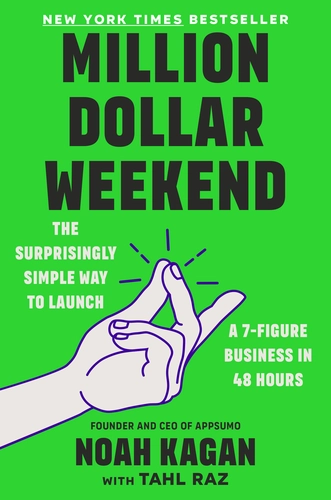
The promise is in the subtitle: launch a seven-figure business in 48 hours. That’s a bold claim, and I almost put the book down at the cover. I’ve been burned by business books before. The ones that sell you a fantasy wrapped in a hardcover and then funnel you toward a $997 course. Kagan doesn’t do that. Mostly. But does the promise hold up? That’s the question I kept asking as I turned pages, and it’s the question this review tries to answer.
A Man Who Got Fired and Decided That Was Fine
Kagan’s origin story is not rags to riches. He was employee number thirty at Facebook, got fired, and then built a series of businesses including AppSumo, which reportedly generates tens of millions in annual revenue. He’s not pretending to be a genius. He’s the guy who kept trying things while everyone else was still brainstorming.
The book’s central character isn’t really Kagan. It’s the reader. Specifically, the reader who has been “thinking about” starting something for three years. You know the type. You might be the type.
The core conflict is simple: you want to start a business, and you have a thousand reasons why you can’t yet. No capital. No time. No idea. Kagan dismantles each excuse with the patience of someone who has heard them all and the impatience of someone who thinks they’re mostly nonsense.
His signature move is the coffee challenge. Walk into a coffee shop. Ask for ten percent off. Get rejected. Survive. Repeat. It sounds almost too simple to matter. But Kagan’s argument is that the fear of asking is the actual barrier, not the lack of a business plan. The coffee is just the training ground.
What struck me most was the Customer First framework. Kagan argues that most first-time founders start with what they want to build. He calls this the Founder First mentality, and he’s right that it’s the default setting for almost everyone. The alternative is to start with who will pay and work backwards.
The Case for Asking Before You Build
The book’s real theme is permission. Not permission from a bank or an investor. Permission from yourself. Kagan’s writing has this quality of a friend who is slightly annoyed at you for still being scared. He doesn’t coddle. He also doesn’t lecture.
The coffee challenge works as a metaphor because it’s so small. It’s not a business. It’s a moment. And that’s exactly the point. The gap between wanting to start something and actually starting it is usually filled with big, abstract fears. Kagan replaces them with small, concrete actions.
His rejection follow-up questions are worth the price of the book alone. “Why not?” “Who is one person you know who would really like this?” “What would make this a no-brainer for you?” These aren’t just sales tactics. They’re a way of staying in the conversation instead of retreating into silence.
The Freedom Number concept also deserves attention. Kagan asks you to calculate exactly how much money you need per month to feel free. Not a million dollars. Your number. It might be $3,000. It might be $8,000. The specificity matters because it turns an abstract dream into a concrete target.
Where the book stumbles is in the 48-hour promise itself. Some of the examples feel compressed. A weekend is enough to test an idea, maybe get your first sale. It is not enough to launch a seven-figure business. Kagan knows this, I think. The title is marketing. But the gap between the title and the content bothered me more than it probably should have.
The imagery throughout is deliberately unglamorous. Coffee shops. Google Forms. Email lists. Tacos. This is a book about the unsexy mechanics of starting something. There are no sports cars on the cover. The aesthetic is closer to a friend’s kitchen table than a TED stage.
The action steps are genuinely actionable. Kagan doesn’t just tell you to validate your idea. He tells you exactly how. Send a survey. Ask for money. Count the yeses and the nos. The book is short, and it respects your time. The inspirational stories sometimes blur together, though. A few of the case studies feel like they were included because Kagan knew the person, not because the example was particularly instructive. And the tone occasionally veers into motivational speaker territory, which clashes with the otherwise practical voice.
If you have been circling an idea for months without doing anything, this book will push you. If you need a push more than a framework, it will work. If you learn by doing rather than by reading, it will land. But if you are an experienced founder looking for advanced strategy, skip it. If you want a deep dive into marketing or finance, skip it. And if you are allergic to the word “mindset,” skip it.
The book’s deepest value isn’t in the tactics. It’s in the reframe. Kagan treats starting a business as an experiment rather than a life sentence. You try something. It works or it doesn’t. You learn. You try again. That’s it. That’s the whole thing.
I finished the book in two sittings. I didn’t launch a business that weekend. I did send three emails to people I’d been avoiding, asking for things I’d been too proud to ask for. One of them said yes. One said no. One never responded. The ratio felt about right.
What the Book Cannot Start for You
Here’s what I keep coming back to. Million Dollar Weekend is not a book about getting rich. It’s a book about getting unstuck. The seven-figure promise is the hook, but the real offer is permission to be bad at something in public. To ask for a discount and get rejected. To send the survey before it’s perfect. To start before you’re ready.
Kagan writes in one of the later chapters, “I remind myself I’m going to die eventually and none of this really matters.” That line landed harder than I expected. It’s not nihilism. It’s perspective. The stakes of asking for ten percent off a coffee are zero. The stakes of launching a business are also lower than you think, at least in the beginning.
The book has flaws. The title overpromises. Some examples are thinner than others. The energy can feel relentless in a way that grates if you’re already exhausted.
But I’ve read a lot of business books that made me feel smart and did nothing else. This one made me feel slightly embarrassed that I hadn’t started yet. That’s a different feeling. It’s less comfortable. It might be more useful.
The book won’t launch your business. But it might make you feel slightly less ridiculous for wanting to try. And on a Tuesday night, in a laundromat, with two quarters already gone, that felt like enough.
“Every day, I feel the sting of rejection. And because of that, I succeed.”

