When Worry Becomes Something You Do Automatically
Some worries have an obvious trigger. Others seem to appear simply because your mind has become accustomed to looking for the next problem.
You worry about tomorrow while finishing today’s work. You think through a conversation again while making dinner. You solve one imagined problem and immediately notice another. Eventually, worrying can become less like a response to a specific situation and more like a habit your mind slips into whenever there is a moment of uncertainty.
That is what makes habitual worry so difficult to change. You are not only dealing with the thing that concerns you. You are also dealing with a familiar mental routine that keeps returning even when there is nothing new to solve.

Worry Can Feel Like Preparation
Part of the reason people keep worrying is that it seems useful. If you think through every possibility, maybe you will be ready. If you replay what happened, maybe you will avoid making the same mistake. If you imagine everything that could go wrong, perhaps you will feel more in control.
But repeated worry rarely provides the certainty it promises. Instead, it trains your attention to keep scanning for another problem, another possibility, or another reason not to relax.
Breaking the habit starts with recognizing that difference. Useful planning eventually leads to a decision or action. Worry tends to keep producing more questions.

Catch the Habit Before It Takes Over
You do not have to wait until you have been worrying for an hour to do something about it. Pay attention to the small signals that usually come first.
Maybe you start checking your phone repeatedly, replaying a conversation, asking someone for reassurance, or opening another search because you feel you have missed an important detail. These behaviors can become part of the worry habit without you even noticing.
Once you recognize your usual pattern, interrupting it becomes much more realistic. You can stop adding information, step away from the mental replay, or shift your attention to something concrete instead of feeding the same thought for another twenty minutes.
Break the Anxiety Circle by Miles Carter
Break the Anxiety Circle is built around the idea that anxiety often becomes self-reinforcing. A thought creates an emotional reaction, the reaction makes the thought feel more urgent, and the resulting behavior gives the mind another reason to keep paying attention.
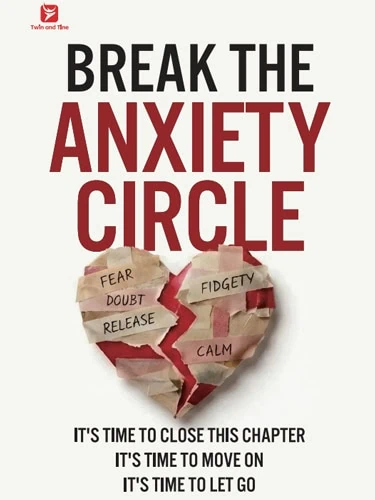
The book explores this cycle through overthinking, anxiety loops, self-doubt, people pleasing, emotional regulation, and difficulty letting go. That combination matters because worry rarely stays neatly contained. A concern about one conversation can become worry about what someone thinks of you, which can become self-doubt, which can lead to another round of analysis.
Carter’s approach encourages readers to work on the pattern rather than waiting for every individual worry to disappear. The practical focus includes learning to:
- Recognize recurring triggers before they become long mental spirals.
- Interrupt repetitive analysis when thinking is no longer producing useful information.
- Reduce reassurance-seeking habits that provide temporary relief but keep uncertainty alive.
- Create healthier responses to emotional discomfort instead of immediately trying to eliminate it.
The book is especially relevant for people who have become frustrated by advice that amounts to “just stop worrying.” Habitual worry is rarely something you can switch off through willpower alone. It is a learned pattern, and changing it requires becoming more aware of what keeps reinforcing it.

Break the Anxiety Circle
Miles CarterA mental reset for people trapped in the overthinking loop. Understand why your mind won’t stop racing — and how to break free from anxiety, people-pleasing, and emotional exhaustion.
Give Your Mind a Different Habit to Practice
Stopping worry does not mean leaving your mind completely empty. It means giving yourself another way to respond when uncertainty appears.
You can acknowledge the concern, decide whether there is actually something to do, and then return your attention to the part of life that is happening now. That can feel surprisingly difficult at first because worrying has become so familiar.
With repetition, however, the urge to keep analyzing does not have to receive the same automatic response every time. The mind can learn that uncertainty does not always require another round of checking, predicting, or replaying.
Break the Pattern Instead of Fighting Every Thought
A worry habit becomes less powerful when you stop treating every thought as a problem that must be solved immediately. Some concerns deserve action. Others simply need to be noticed and allowed to pass without another hour of analysis.
Break the Anxiety Circle helps readers make that distinction by looking at the cycle underneath chronic worry. Once you understand how the habit is maintained, it becomes easier to step out of it before another small concern takes over the rest of your day.
If you found this helpful, these books go deeper into the same themes.



Break the Anxiety Circle
$19.90

From Debt to Wealth
$19.90

