I still remember the moment I realized my words were working against me. I was trying to ask a simple question. What came out sounded like an accusation. The other person’s face tightened. I walked away confused. I had meant well. So why did it land so badly?
That question sent me looking for the best books on how to speak better. Not because I wanted to win arguments. Because I wanted to stop losing people I cared about over sentences I never meant to say.
Why Do Good Intentions Come Out as Bad Words?
Most of us believe communication is about honesty. Say what you feel, and people will understand. But that belief falls apart fast in real life.
I used to think my problem was shyness. Then I noticed something stranger. With strangers I was fine. With the people closest to me, my words turned sharp. Why? Because with the people we love, we stop editing. We assume love will absorb the impact.
Does love absorb impact? Sometimes. Not always. A sentence said in frustration can sit in someone’s chest for years.
That gap between what we mean and what people hear is where most conflict lives. Learning to close it is a skill. And skills can be learned. That is the promise of the best books on how to speak better.
What Makes a Communication Book Actually Useful?
Many communication books are inspiring and useless. You finish them feeling warm and remember nothing a week later. The useful ones give you scripts. Real sentences. Lines you can borrow when your mind goes blank.
Here are three books that do exactly that.
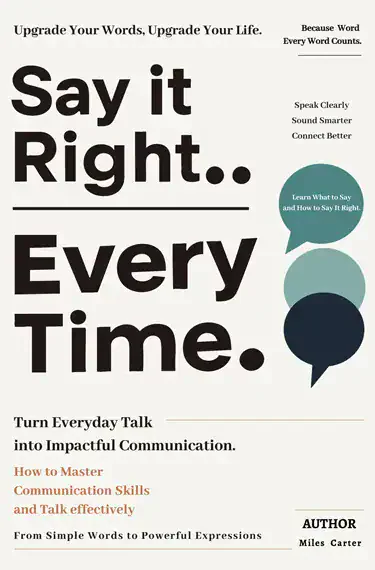
Say It Right Every Time
Practical tools for the moments that matter. Say what you mean, calmly.
This book by Miles Carter is the foundation. The subtitle says it plainly. Practical tools for the moments that matter.
What makes it useful:
- Side-by-side comparisons. Each chapter puts a clumsy version of a sentence next to a mature version. You see the difference instantly.
- Real scripts. Saying no. Making requests. Handling conflict. Words you can borrow.
- Gentle but firm. It replaces rigid phrasing with boundaries without walls.
- One example stuck with me. Instead of “That’s not my job,” you say, “I can’t take that on this week. Here’s what I can do.” Same no. No damage.
If your struggle is freezing up or saying yes when you mean no, start here.
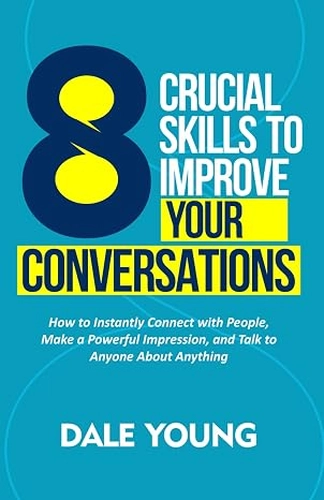
8 Crucial Skills to Improve Your Conversations
Great communicators are trained, not born.
Dale Young spent over twenty years in media and PR. His book reads like a training manual. And he argues something freeing. Great communicators are not born. They are trained.
What makes it useful:
- Mindset shifts. How to stop fearing conversations and start approaching them with curiosity.
- Techniques for building trust quickly.
- 8 common habits that make people lose interest, and how to fix them.
- Scripts for small talk, networking, and hard conversations.
I used one of his questions at a school event and ended up talking to another parent for forty minutes. The tools work.
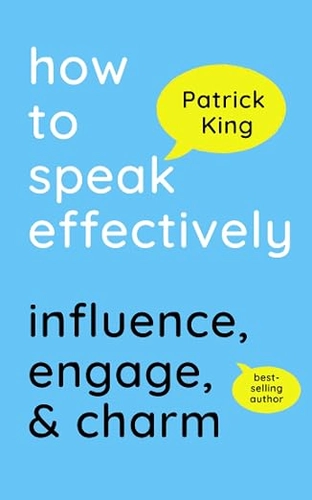
How to Speak Effectively
Influence, engage, and charm.
Patrick King digs into the smaller signals. Tone. Question quality. Filler words. He calls some of them trash words and shows you how to cut them.
What makes it useful:
- How to improve every interaction by one percent. It sounds modest. Over a year, it adds up.
- How to ask better questions that keep people talking.
- How to listen in a way that makes people feel heard.
- How to speak with influence without being aggressive.
If people drift away mid-sentence when you talk, start here.
Which Book Fits Your Situation?
Not every reader needs the same book. Ask yourself which scene keeps repeating in your life.
Are you the person who agrees to everything and resents it later? Start with Say It Right Every Time. The chapters on boundaries and saying no will feel written for you.
Do you go quiet at parties and replay conversations at midnight? Start with 8 Crucial Skills. It rebuilds confidence from the ground up.
Do people drift away mid-sentence when you talk? Start with How to Speak Effectively. It sharpens delivery, tone, and listening.
Can you read all three? Sure. But one at a time, practiced slowly, beats three skimmed in a month.
The Fifteen-Minute Practice Ritual
Reading alone changes nothing. I learned this the hard way. I finished four books one winter and still snapped at my husband over dishes.
So I built a small ritual. Fifteen minutes, three times a week. I call it the Borrowed Line.
Here is how it works. Before bed, I open one of the books and pick a single script. Just one. I write it on a sticky note. The next day, I look for one chance to use it. One real conversation. Then at night I ask myself two questions. Did it feel natural in my mouth? Did the other person respond differently than usual?
That’s it. No journaling marathon. No self-analysis spiral.
The first line I borrowed was for saying no. My neighbor asked me to join a committee I had no time for. Normally I would have said yes and complained for weeks. Instead I said, “I can’t commit to meetings right now, but I’d love to help with the bake sale.” She smiled. Nothing broke.
That tiny success taught me more than a hundred pages of theory. Why? Because speaking is physical. Your mouth needs reps, the same way your legs do.
What These Books Really Change
I still catch myself saying the wrong thing sometimes. But now I notice it faster. I course-correct. I apologize when I need to.
The bigger change is quieter. I have fewer regrets sitting in my chest at night. I have fewer conversations I wish I could redo.
And the people around me feel it too. They open up more. They listen more. Not because I am smarter. Because I am clearer.
So which book will you open this week? And which one sentence will you borrow tomorrow?
References
Carter, Miles. Say It Right Every Time: Practical Tools for the Moments That Matter.
Young, Dale. 8 Crucial Skills to Improve Your Conversations. Modern Mastery Series.
King, Patrick. How to Speak Effectively: Influence, Engage, & Charm. How to Be More Likable and Charismatic Series.

