I sat through a meeting last month where a colleague said “I might be wrong, but maybe we should consider…” and watched the room move on without her. Two hours later, a different person said roughly the same idea in eleven words and everyone nodded. Same intelligence. Same point. Different sentence.
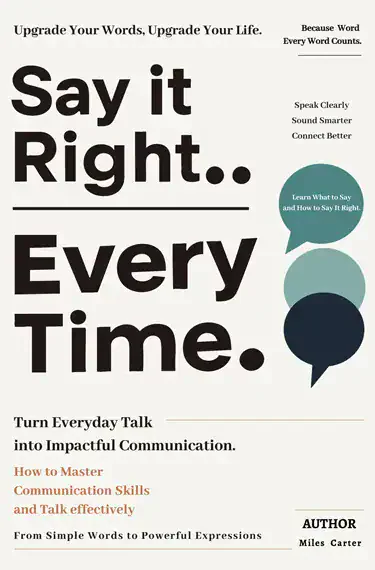
Miles Carter’s Say It Right Every Time is built on a question that most communication books dodge: does the way we phrase things actually change what people hear, or is that just self-help marketing? His answer, developed across dozens of everyday situations, is that phrasing is not decoration. It is the message. The book’s central argument is that clear, calm self-expression is a trainable skill, and most of us never got trained.
What the Book Actually Teaches
Carter’s method is almost stubbornly simple. Each chapter takes a real situation, a request, a refusal, a disagreement, a job interview, and places two versions side by side. The basic version sounds like most of us on a tired Tuesday. The mature version says the same thing without apology or aggression.
What makes this work is the specificity. Carter does not tell you to “be assertive.” He shows you the exact sentence, then explains why it lands. The recurring concept, and I think it is the book’s most valuable one, is that boundaries and warmth are not opposites. They are roommates. You can decline a request and keep the relationship, but only if you decline it in a certain way.
The case studies carry the weight here. There are scripts for asking for a raise, for pushing back on a deadline, for telling a friend that a joke stung. I’ll be honest, a few of the scripts felt slightly polished for real life. Nobody I know speaks that cleanly under pressure.
The Sentence You Keep Rehearsing in the Shower
The book’s real subject, underneath the scripts, is timing. Carter keeps returning to the gap between feeling something and saying it. That gap is where most damage happens, and also where most repair happens.
His imagery stays domestic and small on purpose. Conversations are compared to doors, some you open, some you knock on first. That is the whole metaphor, and it earns its place because it repeats. A door is not dramatic. Neither is a Tuesday argument with your partner about who forgot to call the plumber.
What struck me was how the book treats silence. Carter suggests that a pause before responding is not weakness. It is information gathering. I tried this for a week. It felt awkward and slow and occasionally people filled the silence with something more honest than what I would have said anyway.
The universal pattern here is older than any workplace. Every culture has rules about who gets to speak plainly and who must soften everything. Carter’s contribution is showing that the rules are learnable, not innate. This character, the reader practicing these lines, is not becoming someone new. They are becoming someone audible.

Who Should Read This, and What It Won’t Fix
This book suits people who leave conversations replaying them in the car. It suits the person who says yes and means no. It will not suit anyone looking for charisma tricks or persuasion tactics, and that is a feature, not a gap.
Its weakness is repetition. By the fourth chapter, the comparison format starts to feel like a worksheet. And Carter rarely addresses what happens when the other person simply will not listen, no matter how gracefully you phrase things. Boundaries do not always get respected. The book is quieter about that.
Still, what you carry away is durable. You start hearing your own hedging in real time. You notice the word “just” appearing three times in one email. You catch yourself apologizing for existing in a meeting you were invited to.
Maybe that is what communication really is. Not the perfect sentence, delivered perfectly. The willingness to say the true thing plainly, and then stay in the room after you’ve said it.

