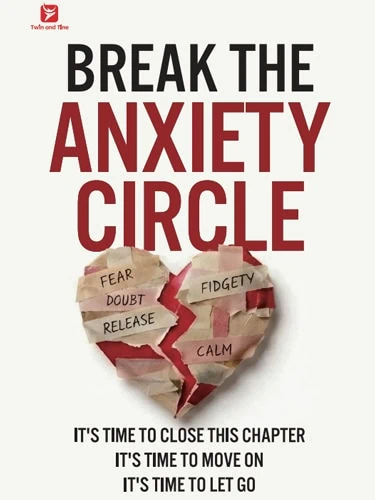
I didn’t buy this book. A friend left it on my kitchen counter after a dinner where I spent most of the evening talking about how tired I was. Not the kind of tired that sleep fixes. The kind that comes from carrying the same anxious thoughts around for years, setting them down only long enough to pick them up again.
I ignored it for four days. Then, on a Wednesday night when I couldn’t sleep, I opened it. I read the first chapter standing up in my kitchen with the lights off. By the second chapter, I was sitting on the floor.
The Night I Finally Saw the Pattern
Carter opens with a scene that felt uncomfortably familiar. A woman lies awake at 2 a.m., replaying a conversation from three years ago. Nothing was wrong with what she said. Nothing was wrong with how she said it. But her brain kept running the tape anyway, looking for the flaw.
I read that and had to put the book down. Because that’s me. That’s been me for as long as I can remember. And for the first time, someone was describing it without calling it a disorder or a weakness or something to fix with meditation apps.
Carter calls it the loop. Not anxiety. Not depression. Just a loop. A groove your brain wears into itself, usually in childhood, usually as a form of protection. You learned to predict problems before they arrived. You learned to read the room, to anticipate disappointment, to prepare for the worst. It kept you safe then. It’s exhausting you now.
I had never thought of my anxiety as a survival strategy before. I had always thought of it as a flaw. A defect. Something to apologize for. Carter doesn’t see it that way. He sees it as a loyal friend that never learned when to stand down.
The Question That Changed How I Talk to Myself
The book is built around seven themes. Self-blame. Indecision. People-pleasing. Boundaries. Emotional regulation. Past regrets. Building a calmer relationship with your own mind. Each chapter takes one knot and works it loose with concrete methods.
The chapter on self-blame is the one I keep returning to. Carter asks a question that stopped me cold: if your inner critic spoke to your best friend the way it speaks to you, how long would that friendship last?
I had never thought about it that way. I had always assumed the harsh voice in my head was just honesty. Just accountability. Just me being realistic. But Carter shows how that voice is usually inherited. It’s a parent, a teacher, a coach, someone from your past who spoke to you in a way you never deserved. And now you speak to yourself in that same voice, not because it’s true, but because it’s familiar.
He offers a tool for this. When the inner critic speaks, write down what it says. Then write down what you would say to a friend in the same situation. The gap between those two responses is where the healing happens.
I tried it. The gap was enormous. I would never speak to anyone the way I speak to myself.
The Craft of Saying Just Enough
Carter’s writing is plain. Almost conversational. He doesn’t perform wisdom. He shares it like someone who has been where you are and decided to leave a light on.
His imagery is simple. He describes anxiety as a rocking chair. It gives you something to do, but it gets you nowhere. He describes overthinking as standing in a dark hallway, opening door after door, finding the same empty room. These images stick because they’re not trying to be poetic. They’re trying to be true.
The book covers boundaries, which I didn’t expect. I thought this would be a book about breathing exercises and positive affirmations. Instead, Carter writes about how people-pleasing is not kindness. It’s self-abandonment. How saying yes to everything means saying no to yourself. How protecting your peace is not selfish. It’s necessary.
That chapter made me uncomfortable. I recognized myself on every page. The way I say yes before I’ve even checked in with my own body. The way I apologize for things that aren’t my fault. The way I shrink myself so others feel bigger.
What This Book Doesn’t Do
It doesn’t promise to eliminate anxiety. It doesn’t pretend you’ll never spiral again. And it doesn’t replace the hard work of actually sitting with your discomfort.
Some chapters feel repetitive. Carter circles the same core ideas. But maybe that’s intentional. People like me need to hear things more than once before we believe them.
The book also assumes a certain level of stability. If you’re in acute crisis, this isn’t a life raft. It’s a swimming lesson. It requires some capacity to sit with discomfort without being overwhelmed. And it doesn’t address the harder question of what to do when your anxiety is tied to real, ongoing circumstances. Money problems. Health issues. A job that’s slowly killing you. Carter stays on the internal side of things, which is both his strength and his limitation.
Who This Book Is For
This book is for the person who has read the theory. Who knows about mindfulness and cognitive behavioral therapy and all the other tools. But who still finds themselves at 2 a.m., replaying a conversation from three years ago.
It’s for the person who apologizes for existing. Who says yes when they mean no. Who lies awake wondering if they said the wrong thing, did the wrong thing, are the wrong thing.
It’s also for anyone who has tried to think their way out of anxiety and found that thinking is the problem. Carter doesn’t offer transcendence. He offers something smaller and more usable. A way to notice the loop. A way to step out of it. A way to stop treating every anxious thought as a crisis that demands immediate resolution.

The Lesson I’m Still Carrying
I finished this book on a Sunday afternoon, sitting on my couch with the windows open. I didn’t feel cured. I didn’t feel transformed. I felt something quieter. I felt seen.
Carter writes near the end that healing is not about becoming a different person. It’s about becoming more of who you already are, minus the noise. I don’t know if I’m there yet. But for the first time in a long time, I believe it’s possible.
There’s a line early in the book that I keep coming back to. “You are not your thoughts. You are the one who notices them.” I had heard that before. Everyone has. But something about reading it in this book, after reading all the chapters that came before it, made it land differently.
Maybe that’s what healing really is. Not a mind that finally goes quiet. A person who learns to sit with the noise and stop mistaking it for the truth.
I still have anxious moments. I still replay conversations sometimes. But I no longer believe those moments are who I am. They’re weather, not climate. And that shift, small as it sounds, has changed everything.
I gave the book back to my friend. She asked me what I thought. I said it was the most honest thing I had read in years. Then I bought my own copy. I think I’ll need it again.
If you found this helpful, these books go deeper into the same themes.




Break the Anxiety Circle
$19.90

From Debt to Wealth
$19.90

