It Starts With One Small Comment in Your Head
After making a mistake during a meeting, Daniel went back to his desk and thought, “I always do this.” Nothing else had happened. His manager had simply moved on to the next topic, and nobody had criticized him. But that one sentence quickly became another: “I should have known better.” Then came, “Maybe I’m not as good at this as I thought.”
By the time lunch arrived, the original mistake was no longer the main issue. Daniel was carrying around a much bigger judgment about himself.
Negative self-talk often develops this way. It rarely begins as a dramatic statement about your entire life. It starts with a small criticism, and if you keep answering it with another criticism, the conversation inside your head can become much harsher than the situation ever was.

Notice the Difference Between a Fact and a Verdict
The first useful step is catching what your mind is actually saying.
“I forgot to send the file” is a fact. “I am useless” is a judgment built on top of that fact. The first statement gives you something you can fix; the second turns one event into a conclusion about who you are.
That distinction can be easy to miss because the second thought often appears immediately after the first. When you slow the process down, you can start asking whether you are responding to what happened or attacking yourself because it happened.
Stop Trying to Win an Argument With Your Own Mind
People sometimes respond to negative self-talk by forcing themselves to think the exact opposite. “I’m not bad at this. I’m amazing.” When that does not feel believable, the inner critic simply comes back with more evidence.
A more practical response is to make the thought more accurate. Instead of telling yourself that everything is fine, you can acknowledge what went wrong without turning it into a character judgment. Maybe you made a poor decision, handled a conversation badly, or missed something important. That can be true without becoming a permanent description of you.
A useful check is to ask:
- What actually happened?
- What am I adding to the story?
- Would I speak to someone else this way?
- Is there something I can do now, or am I simply punishing myself?
Those questions create a little distance between the event and the criticism.
Break the Anxiety Circle by Miles Carter
Break the Anxiety Circle looks at negative self-talk as part of a wider pattern involving self-doubt, overthinking, anxiety, emotional reactions, and the need for reassurance. That broader view matters because harsh inner dialogue rarely appears by itself. It often gets stronger when you are already worried about a decision, another person’s opinion, or something you regret.
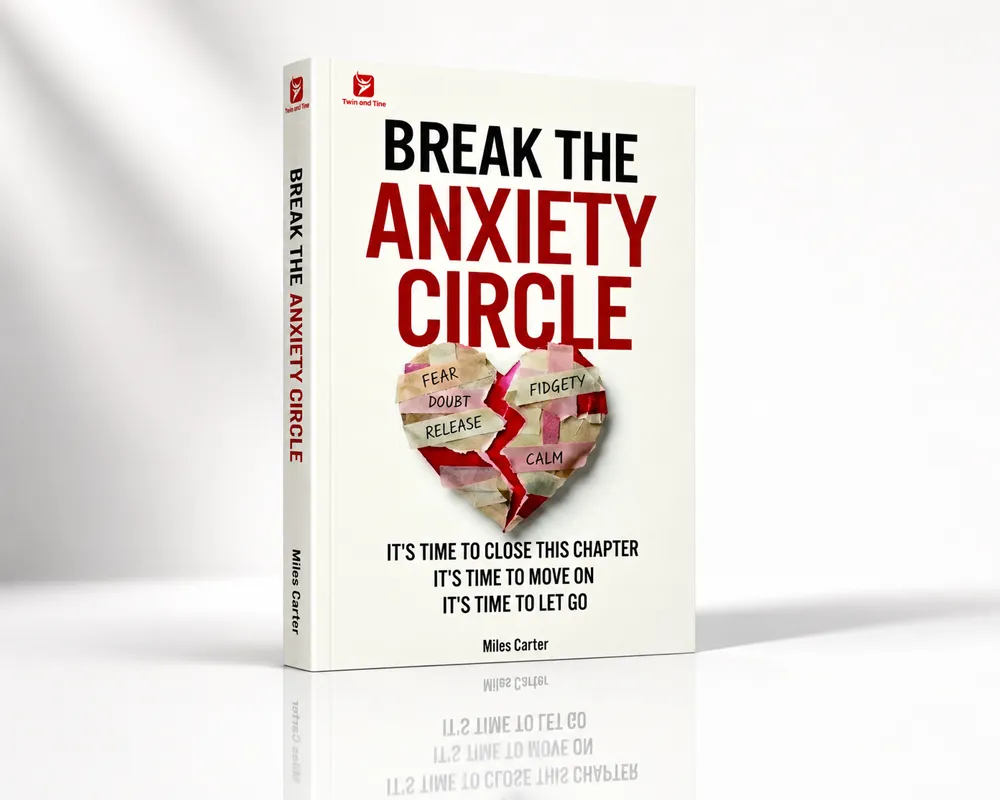
The book helps readers recognize how quickly one thought can turn into a loop. A mistake becomes self-criticism; self-criticism creates anxiety; anxiety makes you search for more evidence that something is wrong; and the search keeps the original thought alive.
Its practical themes include:
- Recognizing automatic self-judgment before it becomes a longer internal argument.
- Breaking repetitive thought patterns instead of trying to solve the same concern over and over.
- Working on self-worth so mistakes do not automatically become judgments about your value.
- Reducing dependence on approval when other people’s reactions are feeding the inner criticism.
- Letting go of the past when an old mistake continues to influence how you see yourself today.
What makes the book relevant here is that it does not treat negative self-talk as a few bad sentences you can simply replace. It looks at the emotional pattern underneath those sentences and why the mind keeps returning to them.
Give Yourself a More Useful Response
Interrupting negative self-talk does not mean pretending you did nothing wrong. In fact, a calm and honest response can be much more useful than either harsh criticism or forced positivity.
You might decide that the mistake needs fixing, the conversation deserves clarification, or the habit that caused the problem needs some attention. Once you have identified that, there is usually no benefit in continuing to punish yourself.
The thought can end with an action instead of another accusation.
Your Inner Voice Does Not Have to Become Your Judge
Everyone has moments of self-criticism. The important part is whether that voice becomes the person making all the conclusions about you.
When you learn to notice the difference between useful reflection and automatic self-attack, mistakes become easier to process. You can learn from them, repair what needs repairing, and continue with your day without carrying the same judgment into every decision.
That is the kind of pattern Break the Anxiety Circle helps readers examine: not how to become endlessly positive, but how to stop letting one difficult thought become an entire story about yourself.
If you found this helpful, these books go deeper into the same themes.




Break the Anxiety Circle
$19.90

From Debt to Wealth
$19.90

