I read most of this book in a parked car outside a grocery store, which feels like the right place for it. Engine off. Phone face-down on the passenger seat. Somewhere in chapter three I started feeling mildly accused.
Mike Michalowicz built Profit First around a single reversal. Standard accounting says Sales minus Expenses equals Profit. He says flip it: Sales minus Profit equals Expenses. Take your profit out first, then run the business on whatever remains. The book pairs that idea with five bank accounts, small percentage transfers, and a deliberately inconvenient bank with no debit card.
The thesis I kept circling back to: is profitability a math problem or a behavior problem? Because Michalowicz clearly believes it’s the second one, and he spends the entire book proving it.
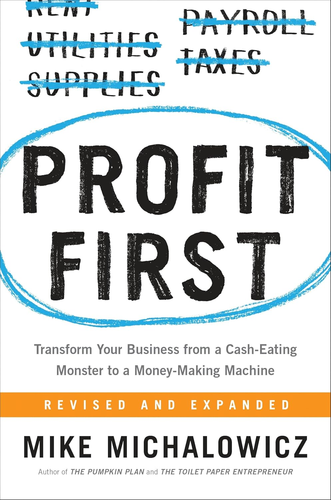
The Mechanic Who Distrusts Your Willpower
Michalowicz isn’t a theorist. He’s a serial entrepreneur who nearly went broke multiple times before stumbling onto this system, and he writes like a guy who’s been yelled at by a bookkeeper.
The protagonist here is really the reader-entrepreneur: someone competent, hardworking, and quietly terrible with cash. You know the type. Sales are up, the business is growing, and somehow there’s never money in the account when taxes come due.
His core move is a case study about a gym owner drowning in revenue but unable to pay himself. Michalowicz has him open separate accounts and transfer 1% to profit immediately. One percent. That’s almost insulting.
But it works because it bypasses willpower entirely. You can’t spend what isn’t in the checking account. The friction is the feature.
Is that condescending? A little. He assumes you’ll raid your own savings the moment nobody’s watching, and honestly, he’s right about most of us.
The Walk to the Bank
The central theme is that financial discipline fails when it depends on intention. It succeeds when it’s structural. Same logic as hiding your running shoes so the only pair left is the ones you actually need.
The imagery throughout is bank accounts, envelopes, and physical distance from your own money. Michalowicz loves the image of a bank with no ATM, no app, no card. You have to walk in and ask a human being for your own profit. That walk is the whole argument.
I recognized this pattern from my own life. I once moved my credit card to a drawer in a different room because I couldn’t stop ordering food at midnight. Same principle. Remove the friction-free path and watch your behavior change.
The counterintuitive percentages, profit at 1%, owner’s pay at 1%, taxes at 1%, operating expenses absorbing the rest, are meant to grow slowly over quarters. Never backward. That one-way rule is what separates this from every budgeting app I’ve abandoned.

Who This Book Actually Serves
This is a genuinely useful book for freelancers, solo operators, and small business owners who are profitable on paper and broke in reality. The system is simple enough to start this week.
If your income arrives in irregular waves, you may find yourself doing some translating to make the percentages fit. And if your books are already tight and your margins clean, the tone might feel like it’s explaining things you solved years ago. One reviewer called it half woo-woo, half specific advice, and I think that’s a fair way to describe the mix.
The uncomfortable part is that Michalowicz insists you pay yourself before you pay your vendors. That feels irresponsible until you’ve watched a business die while its owner worked for free for two years.
Profit First won’t fix your relationship with money overnight. But it will make you notice, every time you check your balance, how much of your financial life runs on hope.
“If you don’t take your profit first, you will never take it at all.”

