I kept a list, for about a year, of everyone I owed something to. It wasn’t a real list. It lived in my head, and it grew. A friend’s birthday I half-forgot. A message I answered four days late. My mother’s phone call that I took while folding laundry, saying mm-hmm in the right places.
Then I found Miles Carter’s Let It Unfold, a fifteen-week guided journal, and I noticed the question printed near the front. Why do I keep putting everyone else first, and still feel like I am never enough?
I sat with that for a while. Is this a book about self-care, or is it something harder to name?
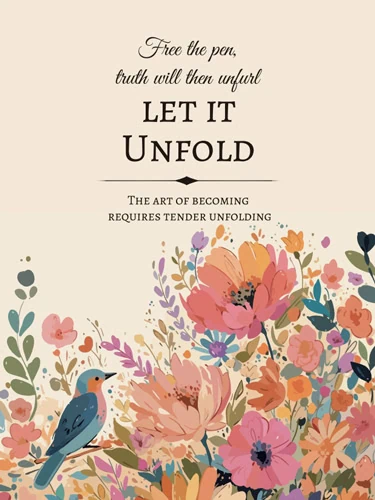
What the Journal Actually Asks You to Do
Carter’s structure is almost aggressively gentle. Five days a week, one theme per day. Monday is self-acceptance. Tuesday is mindfulness. Wednesday turns toward growth and action. Thursday is the heavy one, where you look at difficult emotions and the patterns underneath them. Friday closes with gratitude and reflection.
Fifteen weeks. No chapters to finish, no plot to follow. Just short prompts, exercises, and blank space.
I’ll be honest: I almost put it down in week two. The prompts felt too simple. Where in your body do you feel this? I wrote my jaw and felt faintly ridiculous. But the ridiculousness wore off, and what remained was the blank space. Carter trusts silence. He doesn’t fill every page. That restraint is the craft here, the way a good editor knows which sentence to cut.
The person at the center of this journal isn’t a character. It’s you, or whoever is holding the pen. And that person carries the same conflict the opening question names: the habit of tending everyone else’s garden while your own goes dry, and the strange guilt that arrives when you finally sit down alone.
The Pattern Thursday Keeps Finding
Thursday is where the book earns its keep. Difficult emotions, inner patterns, the things you learned early about what love costs. Carter returns to this day again and again, and you start to see why. The other four days are scaffolding. Thursday is the room.
I noticed a small thing. He never uses the word healing. Not once that I could find. He writes about noticing, naming, slowing down. It sounds like a technicality. It isn’t. Healing implies a finish line, and a finish line implies you’re behind schedule. What Carter offers instead is a rhythm, the way tide comes in without announcing anything.
There’s an image that stayed with me: a window left open in a room you’ve stopped entering. That’s what unexamined feeling is like. The journal doesn’t slam the window. It just asks you to stand in the doorway for a few minutes a day.
Who is this for? Anyone who has read a dozen self-help books and felt the sugar rush fade by Thursday. It’s not for someone in acute crisis, and Carter doesn’t pretend otherwise. The prompts aren’t therapy. They’re a chair, placed where you can reach it.

What Fifteen Weeks Can and Cannot Do
Here’s my honest accounting. The journal has a weakness, and it’s repetition. By week eleven, the Monday-through-Friday rhythm can feel like a treadmill, especially if you miss days and the guilt compounds, which is a particularly cruel irony for a book about self-acceptance.
But that flaw is also the argument. Let It Unfold is built on the idea that change isn’t an event. It’s a Tuesday you show up for, badly, and then another Tuesday. The title is the thesis. You don’t force the bloom. You keep watering.
I finished my fifteen weeks in about four months. I still catch myself rehearsing apologies before I know whether I’ve done anything wrong. The list in my head hasn’t disappeared. But it’s quieter now, and some weeks I forget to add to it.
Maybe that’s what this journal is really offering. Not a version of you who stops giving. Just someone who finally sits down long enough to hear their own voice, and finds it isn’t as small as they feared.
“Let it unfold. You are not behind. You are becoming.”

