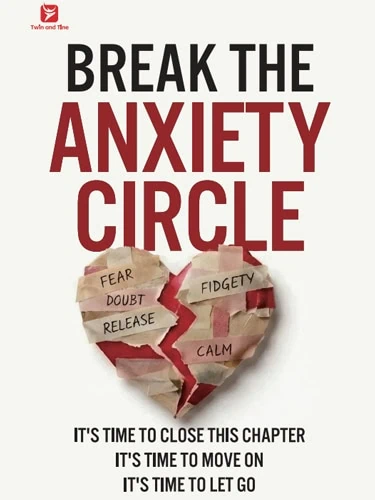
I picked up Break the Anxiety Circle on a Tuesday night, mostly because I could not sleep. My mind was doing that thing again, replaying a conversation from three days earlier, word by word, looking for the moment I said something wrong.
If you have ever asked yourself whether a book about overthinking is actually worth your time, I understand the hesitation. You have probably read a few of them already, and most felt like someone telling you to just relax.
So here is my honest answer.
Quick Answer: Is Break the Anxiety Circle worth reading?
Yes, with one condition. It is worth reading if you want a companion, not a cure. Miles Carter does not promise to fix you in seven days. He writes like someone who has been stuck in the same loop and found a few doors that actually open.
Why Do I Keep Replaying Everything in My Head?
This is the question the book keeps returning to. Why does a small moment turn into hours of analysis? Why does one awkward sentence become proof that something is wrong with you?
Carter’s answer is gentle. He suggests the replaying is not a flaw in your character. It is a habit your mind built to keep you safe. Somewhere along the way, your brain decided that if it just thinks hard enough, it can prevent the next painful thing from happening.
I recognized myself in that. After a hard season at work, I would lie awake rehearsing conversations with my manager. What if I am falling behind? What if I missed a sign? My mind was working overtime. The cost was that I never rested.
The book does not lecture about this. It tells stories. One chapter follows a man who cannot stop editing emails after he sends them. Another describes a woman who apologizes before anyone has blamed her. These small scenes land harder than any explanation.
What Does the Book Actually Suggest You Do?
Here is where I expected the usual advice. Breathe. Meditate. Journal. And yes, some of that appears, but it is woven into stories rather than handed to you as a list.
The idea that stayed with me was this. You do not have to win the argument with your own thoughts. You just have to stop showing up to it. Carter describes a moment when he realized he was spending his mornings debating himself about a decision he had already made. Nothing new came from the debate. It was just noise wearing the costume of productivity.
So he tried something smaller. When the loop started, he would ask one question. Is there an action here, or only a feeling? If there was an action, he did it. If there was only a feeling, he let it sit without solving it.
That sounds simple. It is not easy. But it is doable on a bad day, and that matters more than a perfect method you abandon by Thursday.
Does It Help With People-Pleasing Too?
Yes, and this surprised me. I picked up the book expecting it to be about overthinking alone. But the chapters on saying yes when you mean no hit just as hard.
Carter writes about a period when he agreed to everything, then resented everyone. He describes the slow realization that keeping the peace was costing him his own peace. There is a line I copied into my phone. Every yes you do not mean is a small debt you pay later with interest.
If you are the person who says no problem while your stomach tightens, that chapter alone might be worth the read.
What About Letting Go of the Past?
This is the part I found most honest. The book does not pretend you can close the door on old regrets and walk away clean.
Carter suggests something different. You stop fighting the memory and start understanding what it taught you. Not to excuse it. To stop carrying it into every new room.
I have a memory I used to replay about a fight with someone I love years ago. After reading that section, I did not suddenly feel fine about it. I felt less afraid of it. That is a smaller thing, and a real one.
The One Tool I Actually Kept
If you take nothing else from the book, there is a practice Carter returns to again and again. He calls it the Pause and Name habit.
When the spiral starts, you pause. You name what is happening without judging it. You say, quietly, something like, this is the loop again. I am replaying, not solving.
Then you give yourself one small physical action. Wash a cup. Step outside. Text a friend one honest sentence. The point is not to escape the feeling. The point is to remind your body that you are here, in this moment, not in the one your mind keeps revisiting.
I tried this for two weeks. Some days it worked. Some days I was back in the loop within minutes. But the loop got shorter. That felt like something.

Who Should Skip This Book?
Let me be fair. If you are looking for a clinical explanation of why your brain does this, this is not that book. If you want worksheets and structured exercises, you will be disappointed. Carter writes in reflection and story, and some readers want more structure.
Also, if you are in a season where you need real support from a professional, a book is not a substitute.
But if you want something that feels like a long conversation with someone who gets it, this is a good one to keep nearby.
FAQ
Is Break the Anxiety Circle a self-help book?
Yes, but it reads more like a series of stories and reflections than a structured program. It is less about steps and more about shifts in how you relate to your thoughts.
Who is this book best for?
People who overthink, replay conversations, struggle with people-pleasing, or carry old regrets. If any of those sound like you, it will land.
Does it offer practical tools?
Yes. The Pause and Name habit is the main one. It is simple enough to use on a bad day.
Is it based on clinical research?
Not heavily. It draws more on personal experience and observation. If you want a clinical approach, pair it with something like The Anxiety and Phobia Workbook.
Is it worth the read if I have already read a lot of anxiety books?
Yes, for the tone. It does not lecture. It walks beside you and points at the patterns. Sometimes that is exactly what you need.
One Last Thing
I still have nights when my mind will not quiet down. I still replay conversations I cannot change. But now, sometimes, in the middle of it, I remember that line about the loop.
And I get to choose, just for a moment, whether to keep showing up to the argument.
That choice, small as it is, is why I think the book is worth reading.
References
- Carter, Miles. Break the Anxiety Circle.
- Bourne, E. J. The Anxiety and Phobia Workbook. New Harbinger Publications, 2015.
- American Psychological Association. “Anxiety.” APA Dictionary of Psychology.

Break the Anxiety Circle
Miles CarterA mental reset for people trapped in the overthinking loop. Understand why your mind won’t stop racing — and how to break free from anxiety, people-pleasing, and emotional exhaustion.

