“That’s not how I see it.”
There is nothing particularly dramatic about those words, yet the conversation can change completely depending on what comes next.
One person may explain their reasoning, listen to the other side, and continue the discussion. Another may immediately start defending their position, interrupting, bringing up unrelated examples, and treating disagreement as proof that the other person is being unreasonable.
The difference is not always the opinion itself. Often, it comes down to how people experience disagreement.
You can disagree with someone and still make it clear that you heard them. You can challenge an idea without criticizing the person who said it. And you can hold onto your own position without treating every conversation like something that needs a winner.

Separate the Person From the Idea
A disagreement becomes much harder when the subject quietly changes from “I disagree with this idea” to “I disagree with you as a person.”
That shift often happens through small phrases. “You never think this through.” “That’s typical of you.” “You always make things difficult.” Once the conversation reaches that point, defending the original idea becomes almost impossible because both people are now defending themselves.
Try keeping the disagreement attached to the actual point instead. “I don’t think that approach will work because we’ve had the same problem with it before” gives the other person something concrete to consider without turning the exchange into a judgment about their character.
Let the Other Person Finish the Thought
Interrupting often feels justified when you already know where the other person is going. You may be certain that they misunderstood something, missed an important detail, or are about to make an argument you have heard before.
But cutting them off usually makes the conversation longer, not shorter.
When people feel they were not allowed to finish, they tend to repeat themselves or become more forceful. Letting someone complete their thought does not mean you agree with it. It simply gives you the full version of the argument before you decide how you want to respond.
You may even find that the point you thought you needed to challenge is not exactly what the person meant.

Look for the Part You Actually Agree With
Not every disagreement is total.
You may agree with someone’s goal but disagree with how they want to reach it. You may agree that a problem needs attention while having different ideas about what caused it. You may both want the same outcome while prioritizing different risks.
Finding that shared ground can change the tone of the entire conversation.
Instead of opening with “I completely disagree,” you might say, “I agree that the deadline is a problem. I’m just not convinced that cutting the review stage is the best way to fix it.”
You have not weakened your position. You have simply shown that the disagreement has boundaries.
Ask What Would Change Their Mind
This is a useful question when the conversation starts going in circles.
“What would make you reconsider that?”
It does two things. First, it tells you whether the disagreement is based on evidence, experience, preference, or something else. Second, it gives the other person a chance to explain what matters most to them.
You can ask yourself the same question. If there is genuinely nothing that could change your position, you may be dealing with a personal preference rather than an argument that needs to be won.
That realization can save a lot of unnecessary energy.
Know When the Conversation Has Stopped Being Productive
Some disagreements can be worked through. Others simply keep repeating the same points.
If you have both explained your positions, answered the main questions, and reached the point where each person is repeating the same argument in slightly different language, continuing may not add much.
You can say, “I think we see this differently, and I’m not sure repeating the same points is helping.”
That does not mean the disagreement has been solved. It means you have recognized that more talking is not automatically going to produce more understanding.
Where Say It Right Every Time Fits In
Say It Right Every Time by Miles Carter puts a lot of attention on disagreement itself: how to share an honest opinion without alienating people, how to disagree without creating distance, and how to communicate your position while still keeping the conversation constructive.
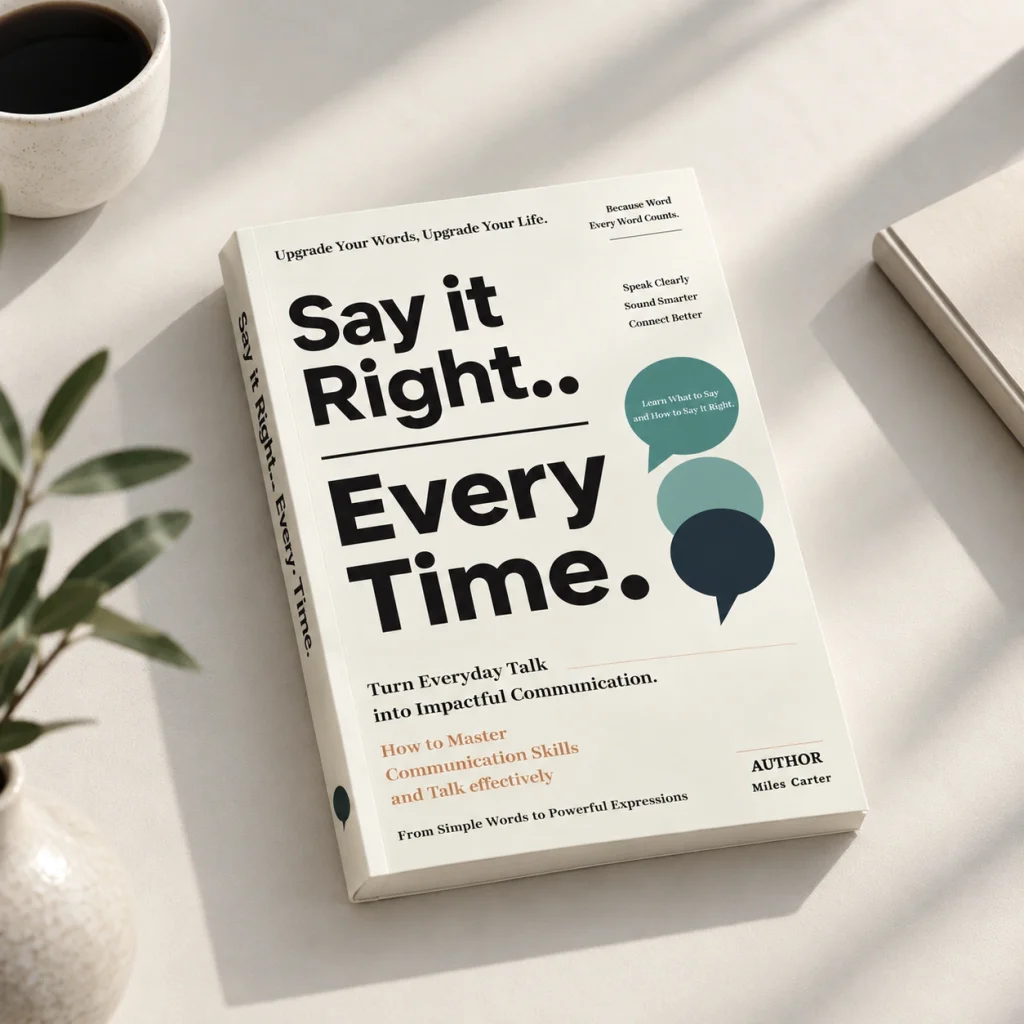
The book also covers related situations such as respectful requests, boundaries, confidence under pressure, saying no without guilt, and responding when another person becomes rude. These skills matter because disagreements rarely happen in isolation. A difference of opinion can quickly become uncomfortable when one person feels ignored, criticized, or pushed into agreeing.
The practical focus is on the language people use in those moments. Instead of treating disagreement as something you either avoid or push through forcefully, the book offers ways to express a clear position while leaving room for the other person to remain part of the conversation.

Say it Right..Every Time.
Miles CarterPractical communication tools for the moments that matter — say what you mean, calmly and confidently.
You Do Not Need to Agree to Have a Good Conversation
A productive disagreement does not always end with one person changing their mind.
Sometimes the useful outcome is much simpler: both people understand what the other thinks, the important differences are clear, and neither person had to turn the conversation into a personal fight.
That is a different way of thinking about disagreement. The goal is not to remove every difference. It is to learn how to stay connected to the conversation while the difference is still there.
Did this article help you see things differently? Our books turn helpful ideas into practical tools you can return to anytime.



Imagine The Other Half
$24.99

