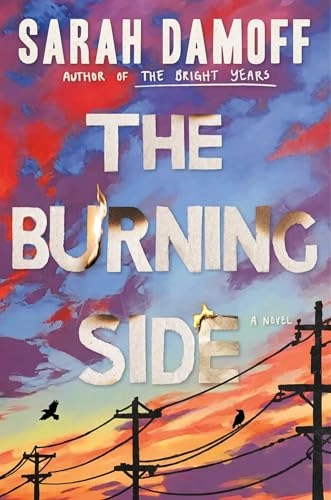
There is a moment in every long relationship when you realize the other person has already left, even though they are still in the room. Sarah Damoff builds an entire novel around that moment, then sets it on fire. April Torres walks out of her burning house carrying her infant son and her husband’s manuscript. Leo walks out behind her carrying their daughter. Everyone survives. The house does not. And April knows she left the stove on because Leo had just told her he was no longer in love with her.
This is a book about whether love can outlast the moment it stops being returned. Not love as a feeling. Love as a decision you keep making in the dark, with no evidence it’s working.

Two People Who Stopped Talking Years Before the Fire
April is a compulsive caretaker, the kind of woman who gives everyone else the good chair and then wonders why her back hurts. She has dyslexia, she’s a tutor, she’s a mother of two, and she has spent years quietly resenting a husband she never learned to fight with. Leo is a high school history teacher who was abandoned by his parents at seven and raised by an aunt. He has never once in his life believed he deserved to stay anywhere.
That’s the collision. She gives until she’s empty. He leaves before he can be left. Neither of them is the villain, which is exactly what makes the book so difficult to put down.
What got me was the pasta. Not the fire itself, honestly. The pasta. April was cooking dinner for a man who had just ended their marriage, because that is what she does, and then she stood there and her body simply stopped cooperating. I have never left a stove on during a crisis. I have, however, driven to a grocery store and forgotten why I was there because someone had hurt me three hours earlier. The body keeps score in small, stupid ways.
Leo infuriates me. I want to be honest about that. There were stretches where I wanted to shake him, and I suspect Damoff wants that, because she keeps giving him just enough tenderness to make the frustration unbearable. He hesitates to move into April’s parents’ house not because he’s cruel but because the Russo family is the only real family he has ever had, and walking away from April means walking away from all of them.
So the question isn’t whether they still love each other. It’s whether love without communication is anything more than a habit two people are too exhausted to break.
A House, a Mind, and the Things We Can’t Rebuild
The burned house is the book’s central image, and Damoff does not overwork it. She doesn’t have to. April and Leo spend the novel waiting to find out what’s salvageable, sifting through a structure that looks standing from the outside and is hollow within. It’s not subtle. It’s just true. Marriages are like that. You can walk past one every day and never know the floor is gone.
Then there’s Deb, April’s mother, who gets the book’s quietest and most devastating chapters. Her husband Billy has early-onset Alzheimer’s, and she has been carrying the diagnosis alone, protecting her children from a truth that was always going to arrive. I found one of her lines genuinely uncomfortable: a moment where she resents that her daughter’s crisis has landed on top of her own. Some readers have called that selfish. I read it as the most honest sentence in the novel. Caregivers are allowed to be furious. We just don’t like hearing it.
Memory is the real subject here. Billy is losing his. April is trying to preserve hers, the version where her marriage still worked and her house still stood. Leo is trying to outrun his. Three people, three relationships with the past, one burning house tying them together.
Damoff has a background in social work, and it shows in how carefully she handles Billy’s decline. No melodrama. No lessons. Just a man slowly misplacing the people he loves while his wife learns to introduce herself again each morning.
The Sentence Neither of Them Can Say
April and Leo’s refusal to communicate wore on me around the two-thirds mark. There’s a stretch where both of them are circling the same conversation without having it, and I kept thinking: one of you, please, just say the sentence. That may be realistic. Real people do exactly this. But realism and readability aren’t the same thing, and I noticed the drag.
The middle chapters also lean heavily on flashbacks to 2011, when April and Leo met at a summer school where she tutored students with dyslexia and he taught history. These sections are sweet and necessary, but they lack the pressure of the present-day story, and I found myself rushing through them to get back to the burned house.
What redeems it is the ending, which I won’t describe, except to say that Damoff resists the tidy resolution the setup seems to promise. Nobody gets everything. Some things stay broken. The book earns its hope rather than handing it out.
Read it if you loved The Bright Years and want to see Damoff operate with a wider cast. Read it if you’re the person in your family who absorbs everyone else’s pain and calls it love. Read it if you’ve ever stayed in something past its expiration date because leaving felt like admitting you wasted the good years.
Skip it if you need plot momentum. This is a novel where the drama is a conversation held at the wrong moment. Skip it if Alzheimer’s hits close to home and you’re not ready, because Damoff does not look away.
What I took from it is smaller than a lesson and more useful. Houses can be rebuilt. People mostly can’t be replaced. The work of loving someone long-term is not romantic, and it is not a feeling you either have or don’t have. It’s a series of unglamorous decisions made on days when nobody is at their best.
Damoff puts it better than I can, in a line I wrote down and kept: “Love cannot be reversed, cannot be erased, maybe cannot even be a mistake. It can end, and it does, but it is never undone.”
This book won’t fix your marriage. It won’t explain your parents to you. It will, I think, make you a little more patient with the people who keep showing up even when they’ve forgotten how to say the right thing.
I still haven’t stopped checking the stove.

