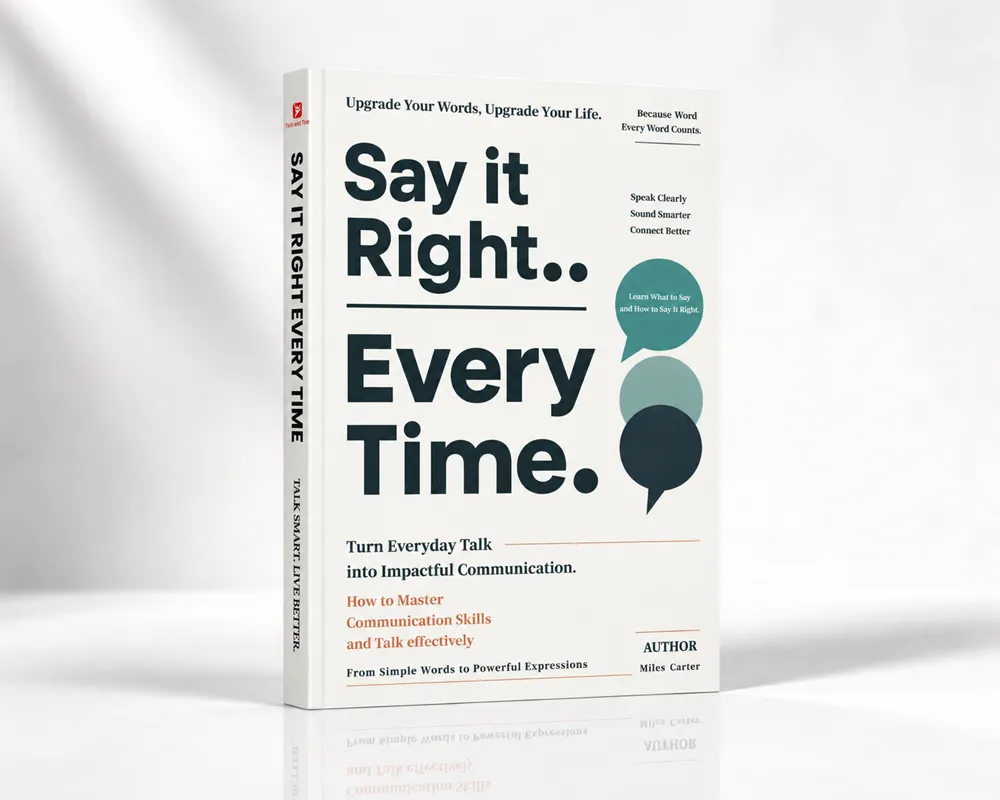
I sat in a coffee shop last week and watched two people break up in slow motion. Not loudly. That was the strange part. One of them kept saying “you always do this,” and the other kept getting smaller in the chair. Nobody raised a voice. Nobody ordered a second drink. I thought about that scene for the rest of the afternoon, and then I thought about Miles Carter’s book, which I’d finished two days earlier.
Carter’s central claim is almost embarrassingly simple. The same message, reworded, lands in a completely different place. He calls the difference between “you never listen” and “I feel unheard” a matter of maturity, and he spends two hundred pages proving it isn’t just semantics.
What the Book Actually Argues
The core concept is what Carter calls the Basic versus Mature split. Every chapter shows the same moment twice.
| Basic Version | Mature Version |
|---|---|
| “You didn’t think of me.” | “That made me feel left out.” |
| “You never listen.” | “I feel unheard right now.” |
| “Stop overreacting.” | “I can see this matters to you.” |
| “Because I said so.” | “Here is why this matters.” |
The fact doesn’t change. The emotional weather does. He isn’t asking you to soften the truth. He’s asking you to stop wrapping it in accusation before you hand it over.
The other big idea is that silence is a tool, not a failure. Strategic pausing, he argues, does two things at once. It lets your own reaction cool down, and it signals to the other person that you’re not going to be dragged into a fight on their schedule.
I’ll be honest, I rolled my eyes at this at first. It sounded like a trick from a sales seminar. Then I tried it during a tense call with my landlord and, annoyingly, it worked.
He also leans hard on reframing. “We retain 90%” instead of “we lose 10%.” Same number. Different spine.

The Protagonist Is You, Which Is the Problem
There’s no character arc here, no protagonist to root for, and that’s the book’s weakness as much as its design. The reader has to supply the conflict. Carter gives you scripts, hundreds of them, but he never quite shows what happens when someone refuses to play along with your new mature phrasing.
The gap the book doesn’t fill:
- Boundaries don’t always get respected
- Sometimes the calm response just makes the other person louder
- Not everyone will meet you halfway just because you reworded things
- The book stays practical and doesn’t dig into why you developed these habits
I finished the book still unsure how to handle that. It’s a real gap.
Who It’s For and What It Costs
This book is for you if:
- You’ve ever replayed a conversation at 2 a.m. and rewritten it twenty times
- You know what you mean but lose it somewhere between the thought and the mouth
- You want practical scripts for work and daily life
- You prefer tools over deep psychology
This book is not for you if:
- You want to understand the childhood roots of your communication patterns
- You need help with someone who refuses to engage honestly
- You want a quick fix that works in every situation
The workplace section is the strongest part, honestly. Scripts for asking for a raise, for pushing back on a coworker who takes credit, for saying no to your boss without sounding like you’re apologizing for existing. That last one hit close to home.
What you won’t get is depth on why you developed these habits in the first place. Carter stays practical. He doesn’t dig into family patterns or old wounds. Some readers will want that. Others will be relieved.
The Deeper Pattern
What struck me, reading late at night, is that Carter is really writing about a kind of loneliness. The loneliness of meaning something and being heard as its opposite.
His technique section on echoing, where you repeat back what someone feels before you respond, is less a communication trick than an act of attention. You’re telling the other person: I heard the shape of what you said, not just the words.
That’s the quiet argument under all the scripts. Most conflict isn’t about disagreement. It’s about two people who both feel unseen, both reaching for the same missing thing, both using language that guarantees they won’t get it.
What You Take Away
You don’t close this book fluent. You close it more aware of the half-second before you speak, which turns out to be where everything happens.
Carter’s best line, buried in the boundaries chapter, is this: “Calm is not the absence of feeling, it’s the decision not to let feeling do the talking.”
That’s what I keep coming back to. Not the scripts, though I’ve stolen a few. The idea that maturity in speech isn’t about being nice. It’s about being clear enough that the other person has nothing to defend against.
Maybe that’s what all those tense conversations were missing. Not better arguments. A little more room.

