Saying What You Actually Mean Without Sounding Harsh
I used to think I was a clear person. Then my wife told me, after eleven years, that she never knew when I was actually upset. She said I would go quiet, say “it’s fine,” and then sulk for two days. That conversation stung. But it also started me on a long road of figuring out how to practice clear communication in real life, not just in theory.
If you have ever walked away from a conversation thinking, “that came out wrong,” you are in the right place. This is not about becoming a smooth talker. It is about closing the gap between what you feel and what other people hear.
Quick answer: How do I practice clear communication without sounding harsh or unsure?
You pause before reacting, swap blame for feeling, replace apologies with thanks, and check whether the message you sent is the message that landed.
Here are three books that helped me practice clear communication. One gives you side-by-side sentence swaps. One covers the essential keys to effective communication in any setting. One explains why we struggle to say what we mean in the first place.
Why Do We Struggle to Say What We Mean?
Most of us learned to talk. Almost none of us learned to communicate. There is a difference. Talking is releasing words. Communicating is making sure those words arrive the way you intended.
When I was growing up, my family handled conflict through silence. If someone hurt your feelings, you just stopped talking to them for a while. Nobody explained anything. So when I became an adult, my default setting in tense moments was to shut down. I thought I was being calm. Other people thought I was being cold.
James W. Williams, in Communication Skills Training, points out that one of the biggest mistakes people make is assuming the message they sent is the message that landed. That gap is where most misunderstandings live.
So the first honest question is not “why doesn’t anyone listen to me?” It is “am I actually saying the thing I think I am saying?”
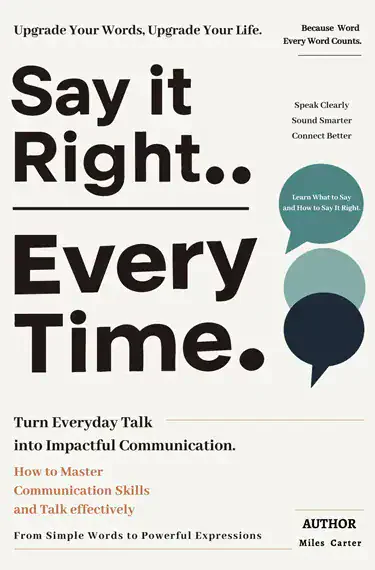
Say It Right Every Time
By Miles Carter
This is the book I keep coming back to.
What makes this book different:
It does not give vague advice like “be more confident.” It shows you two versions of the same sentence, side by side, and lets you feel the difference.
| Basic | Mature |
|---|---|
| “You never help around here.” | “I’m feeling stretched thin. Can we split the evening routine?” |
| “You didn’t think of me.” | “That made me feel left out.” |
| “Sorry I’m late.” | “Thanks for waiting.” |
Same frustration. Completely different response from the other person.
The basic version puts someone on trial. The mature version invites them into a solution. And here is the thing I had to learn the hard way. The mature version is not weakness. It takes more strength to say “I feel overwhelmed” than to snap “you’re useless.”
What you get:
- Sentence-level swaps for real conversations
- How to share a feeling without assigning blame
- The difference between “sorry” and “thank you” and why it matters
- How to pause before reacting instead of firing back
- A framework Carter calls “calm power.” The difference between shouting into a well and lowering a bucket.
Best for: Anyone who knows what they mean but cannot get it out right.
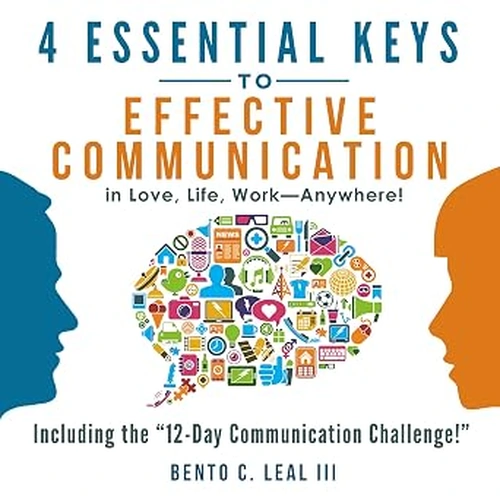
4 Essential Keys to Effective Communication
By Bento C. Leal III
This book covers the foundation that comes before the sentences.
What makes this book different:
It treats listening as a skill you practice, not a personality trait. Most communication problems are not caused by a lack of love or good intentions. They are caused by misunderstandings, assumptions, and poor listening.
What you get:
- How to listen before you respond
- Common listening blocks that make us tune out
- How to check whether your message landed the way you meant it
- Small exercises to practice better communication daily
One key idea: You cannot communicate clearly if you have not first listened clearly. Understanding comes before being understood.
Best for: Anyone who realizes the problem is not what they say but that they are not really hearing the other person.
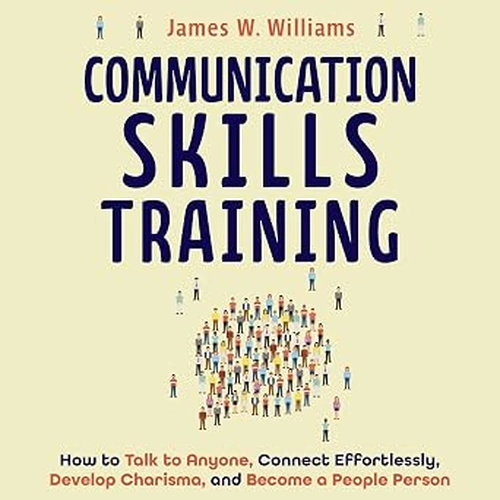
Communication Skills Training
By James W. Williams
This one explains why we struggle to say what we mean in the first place.
What makes this book different:
Williams points out that one of the biggest mistakes people make is assuming the message they sent is the message that landed. That gap is where most misunderstandings live.
What you get:
- How to talk to anyone and connect effortlessly
- Why your message often lands differently than you intended
- How to develop charisma without faking it
- Practical tools for becoming a better communicator in any setting
One key idea: The first honest question is not “why doesn’t anyone listen to me?” It is “am I actually saying the thing I think I am saying?”
Best for: Anyone who wants to understand the gap between what they say and what people hear.
The Three Tools I Use Most
| Tool | How it works | Why it matters |
|---|---|---|
| The Three-Second Pause | Before you respond to something that stings, wait three seconds. Count them. | Your first reaction (defensive) fades. Your second thought (wiser) surfaces. |
| The “I” Reframe | Lead with “I feel” instead of “you did.” | “You” triggers defense. “I” shares a feeling without assigning blame. |
| Thank Instead of Sorry | Say “thanks for waiting” instead of “sorry I’m late.” | Every “sorry” makes you feel smaller. Every “thank you” makes you feel equal. |
Try one of these tonight. When your partner or a friend says something that triggers you, just pause. Breathe once. Then answer. Notice how your posture changes, not just your words.
Which Book Should You Read First?
| If you want… | Start with… |
|---|---|
| Sentence-level swaps for real conversations | Say It Right Every Time |
| To listen better before you speak | 4 Essential Keys to Effective Communication |
| To understand why your message gets lost | Communication Skills Training |
You do not need all three. Pick the one that matches where you are right now.
Final Thought
That night my wife told me she never knew when I was upset, I sat in the kitchen for a long time after. I remember staring at the counter and thinking about all the years I spent assuming silence was safe. It was not. Silence just meant she had to guess. And guessing is exhausting for the person doing it.
Clear communication is not a skill you master once and keep forever. It is a practice, like stretching. Some days you are flexible. Some days you are stiff. You show up anyway.
Start with one book. Try one technique. See what happens.
References
Carter, M. Say It Right Every Time: Practical Communication for Real Conversations.
Leal, B. C. 4 Essential Keys to Effective Communication in Love, Life, Work — Anywhere! BCL3 Publishing.
Williams, J. W. Communication Skills Training: How to Talk to Anyone, Connect Effortlessly, Develop Charisma, and Become a People Person. SD Publishing.

